
Physical AI-based manufacturing automation is here and ready for the factory floor. According to the World Economic Forum, physical AI and training-based robotics can reduce engineering effort by up to 70% and accelerate time-to-value by up to 50%. Early adopters such as Amazon have already realized benefits with 25% faster delivery using an AI-based sortation and generative AI-guided manipulator system.
Advances in the evolution of foundational models has also made these systems economically viable. Previously, deploying vision systems required weeks of data gathering and retraining every time the environment changed. Today Physical AI pipeline solutions can handle unstructured tasks right out of the box, ensuring ROI under two years.
So what’s holding back widespread adoption of Physical AI?
The true bottleneck is navigating the fragmented landscape of hardware, AI models, safety requirements, and integrating all the disparate pieces together.
This article provides a practical framework for identifying the right tasks for Physical AI and selecting the appropriate AI architecture for each. It also explains how a platform-based approach simplifies Physical AI adoption on the factory floor.
Why Physical AI Solutions Need the Foundation of Automation Platforms
A vast majority of industrial robot cells deployed today were deployed as standalone projects with custom engineering and integration. Irrespective of the advancement in Physical AI maturity, the technology by itself cannot eliminate this process and the resulting cost burden.
A useful analogy is the car engine. A powerful engine alone does not create a high-performance vehicle. It still requires the right chassis, transmission, electronics, and control systems to translate raw power into reliable performance. Physical AI models are similar. The AI model may provide perception and decision making, but a production-ready system still requires vision hardware, robotics, motion planning, safety controls, and edge compute working together as a single machine.
Today, much of the Physical AI robotics industry resembles a collection of automotive suppliers. One vendor provides the AI model, another the robot arm, another the vision system, and another the compute infrastructure. Integrating these disparate components into a reliable production system often falls to the manufacturer or a third-party integrator.
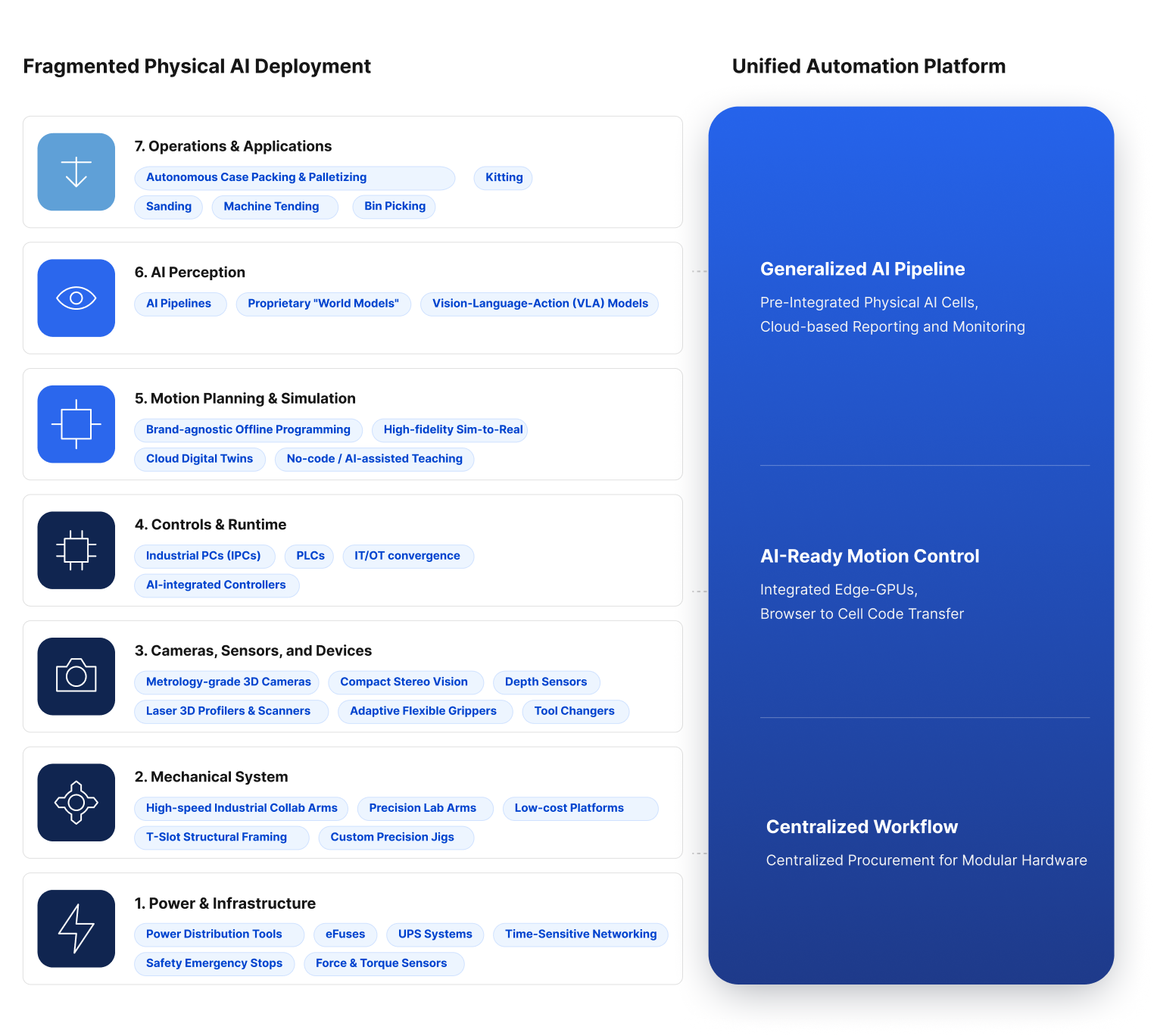
Full-stack automation platforms with built-in AI integration solve this problem by delivering the full vehicle rather than a box of components. By integrating robotics hardware, vision, AI pipelines, and motion control into a single stack, manufacturers can deploy Physical AI systems faster and adapt them to new tasks without rebuilding the system from scratch.
Evaluating the automation platform then becomes the prerequisite before actually considering AI pilots. A quick rule of thumb is to ensure that the platform encompasses both the breadth (full automation stack coverage) and depth (capabilities under each).
| Guidelines to Select Automation Platforms for Physical AI |
|---|
| Vision (Hardware + Software) :Does the platform provide industrial cameras, 3D sensors, and the AI perception models as a unified package, or will you need to source vision hardware separately and integrate it yourself? |
| Robotics & Motion Control: Does the vendor supply the physical arms or support brand-agnostic robot arm integration, motion planning software, and safety certification end-to-end, or are you just buying the “brain” and tasked with finding compatible robots and hardware components? |
| Edge Compute & Deployment: Does the solution include edge compute infrastructure with pre-optimized AI inference, or will your team need to handle model deployment, latency optimization, and hardware compatibility? |
| Mechanical Fixtures, Safety, and Add-Ons: Does the system provide a complete solution that is built for your existing layout and process? This may include custom jigs, re-grip stations, safety enclosures or sensors, and other peripherals to provide seamless integration and more autonomy in your production environment. |
The Playbook to Deploy Physical AI
Once the integration challenge is solved through a unified platform or an end to end partner, manufacturers can focus on the strategic decisions that determine successful deployment.
1. Target High-Variance Bottlenecks with Clear Labor Density
The best starting point for Physical AI are unstructured tasks with greater labor concentration that makes traditional automation impractical.
Consider random bin picking as an example. Conventional automation requires fixtures to orient parts precisely before a robot can grasp them. Physical AI pipelines remove much of this complexity by detecting randomly placed parts, determining viable grasp points, and planning collision free robot motion.
Common High Variance Use Cases to Consider
- Deep bin picking for assembly
- Machine tending with inconsistent part orientation
- Mixed-SKU palletizing
- Kitting and sorting operations
2. Match the Physical AI Solution to the Task
Most commercially available Physical AI systems today rely on either AI pipelines or end-to-end learning-based models. Selecting the right approach depends on understanding the specific nature of the task at hand.
VLA models excel at tasks requiring real-time adaptive decision-making and high dexterity, such as hand-to-hand material transfer, bi-manual manipulation, or handling deformable objects, where both perception and action must adjust dynamically to unpredictable conditions. In contrast, AI pipelines combine computer vision with classical control or rule-based logic and are better suited for tasks with visual uncertainty but structured execution, such as bin picking or guided assembly, where deterministic motion follows once objects are detected and localized. While VLAs handle end-to-end reasoning in unstructured scenarios, AI pipelines offer more predictable cycle times and easier safety certification for semi-structured operations.
The key is to carefully assess the task’s characteristics, expected cycle times, and why conventional automation isn’t viable. This systematic evaluation ensures the right architecture is matched to the right application.
3. From One-Off Automation Projects to an Automation Roadmap
Traditional automation often results in a series of isolated deployments with limited flexibility for future adaptation. Physical AI changes this dynamic by enabling software-driven reconfiguration instead of mechanical redesign when onboarding new SKUs.
This shifts automation planning from isolated capital projects to a multi-year automation roadmap. Instead of budgeting for one-off machines that depreciate as products reach end-of-life, leadership invests in adaptable automation that can evolve with production needs.
4. Assigning Ownership Across Operations and Engineering
No matter how intelligent they are, automation systems cannot self-deploy yet. According to McKinsey’s State of AI survey, 94% of manufacturing companies report shortages in AI-related skills. This makes defining internal roles and aligning responsibilities paramount. Before launching a Physical AI pilot, consider key ownership questions: Who manages the data strategy? Who decides when to upgrade foundation models? Also, most Physical AI solutions today require some degree of setup, which may require internal or external expertise. For instance, certain grasps in a bin-picking cell may still need manual programming to optimize performance.
Establishing an internal working group for AI deployments can help coordinate these responsibilities and ensure successful implementation.
5. Scoping the Pilot: Beyond Proof-of-Concept
Deloitte’s 2026 State of AI survey reveals that only 25% of companies successfully scale their AI pilots into production. Many Physical AI pilots stall because the conditions of a pilot rarely match the realities of a factory floor. What works in a controlled environment with small teams often breaks down once infrastructure, safety compliance, and maintenance requirements enter the picture.
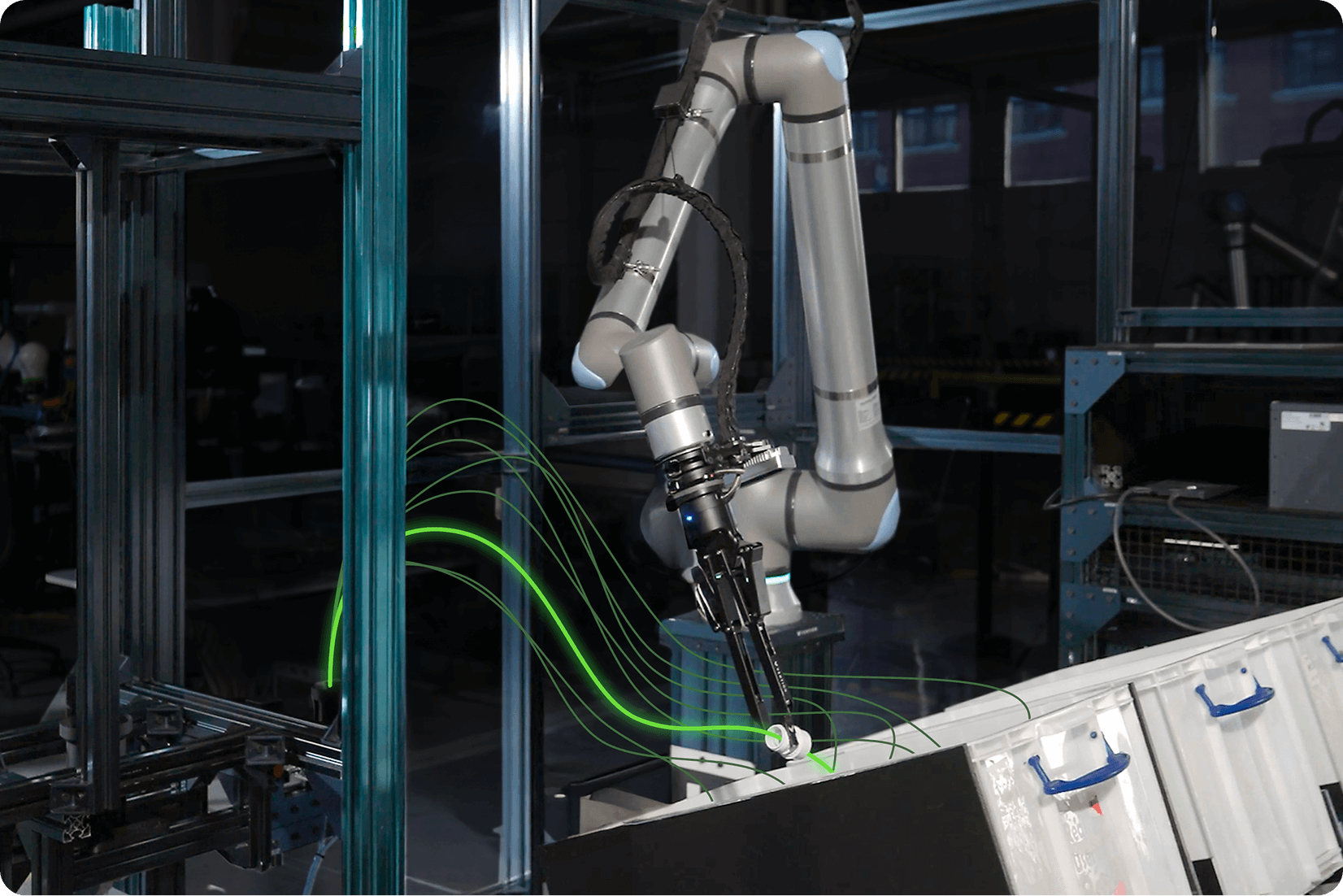
Pre-integrated AI systems are emerging to close this gap. For example, Vention’s Rapid Operator AI packages the full execution stack into a single deployable unit, combining a cobot, end-of-arm tooling, stereo vision, and NVIDIA edge compute on the factory floor. Since the hardware, AI pipeline, and motion planning are designed to work together, manufacturers avoid the integration burden that often stalls pilots.
The platform also addresses common production barriers. Industrial-grade hardware and built-in robot safety modules help satisfy safety and compliance requirements without redefining existing standards. Monitoring tools such as RemoteView, RemoteSupport, and MachineAnalytics provide operational visibility and remote diagnostics after deployment.
Finally, the system reduces the operational friction that typically emerges in production. A CAD-to-reality pipeline allows new SKUs to be introduced by uploading a 3D model rather than retraining models from scratch,
An Industry in Transition
Physical AI systems are ready for production floors, and their economic rationale sets the stage for large-scale adoptions. However, the availability of production-ready technology is rarely the sole ingredient that drives industry-wide adoption. Manufacturers will still need the discipline to identify the right use cases, deploy pilots that reflect real factory conditions, and build multi-year automation roadmaps.
For executives, this presents an imperative to focus on agile processes to adopt Physical AI. The leaders in this transition will be the organizations that treat Physical as a scalable capability built on platforms instead of isolated pilots.
***
Discover how Physical AI can help on your shop floor. Send your parts and process details to Vention to set up a Physical AI demo.


