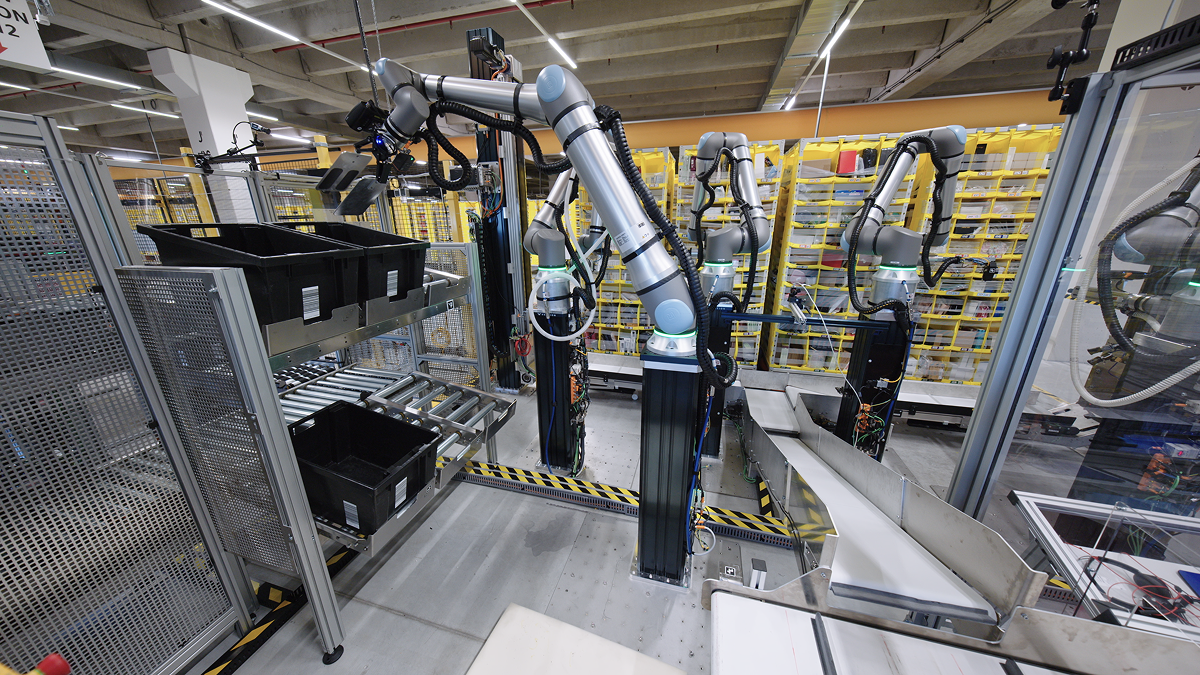
Photo by Amazon
Inside Amazon’s sprawling fulfillment centers, over a million robots already zip across floors, ferrying yellow storage pods to human workers who pluck items and box them for shipment. These machines support around 75% of customer orders, a staggering automation rate that has redefined modern logistics. Yet some of the most fundamental warehouse tasks have remained stubbornly manual until now. Picking and stowing items in densely packed storage pods, for example, requires greater dexterity, touch sensitivity, and real-time adaptation.
This is why Amazon’s Vulcan project marks an inflection point, not just for the eCommerce giant but warehouse automation in general.
What differentiates Vulcan is its Physical AI-driven ability to measure pressure in real time, handling delicate items without damage. It can reach the top and bottom shelves of storage pods, places that previously required workers to climb ladders, and collaborate with humans when an object proves too complex to grasp alone. The true challenge, however, isn’t limited to creating a smarter, more dexterous robot cell; it’s deploying it at scale, replicating the design across hundreds of facilities, and upgrading it over time without tearing apart entire operations.
This is where the industry shift is more visible. Amazon and other enterprises are moving away from one-off, integration-heavy robotics toward scalable, modular automation platforms, such as Vention’s full-stack experience.
Physical AI Solves the Technical Problem, Vention Solves the Scale
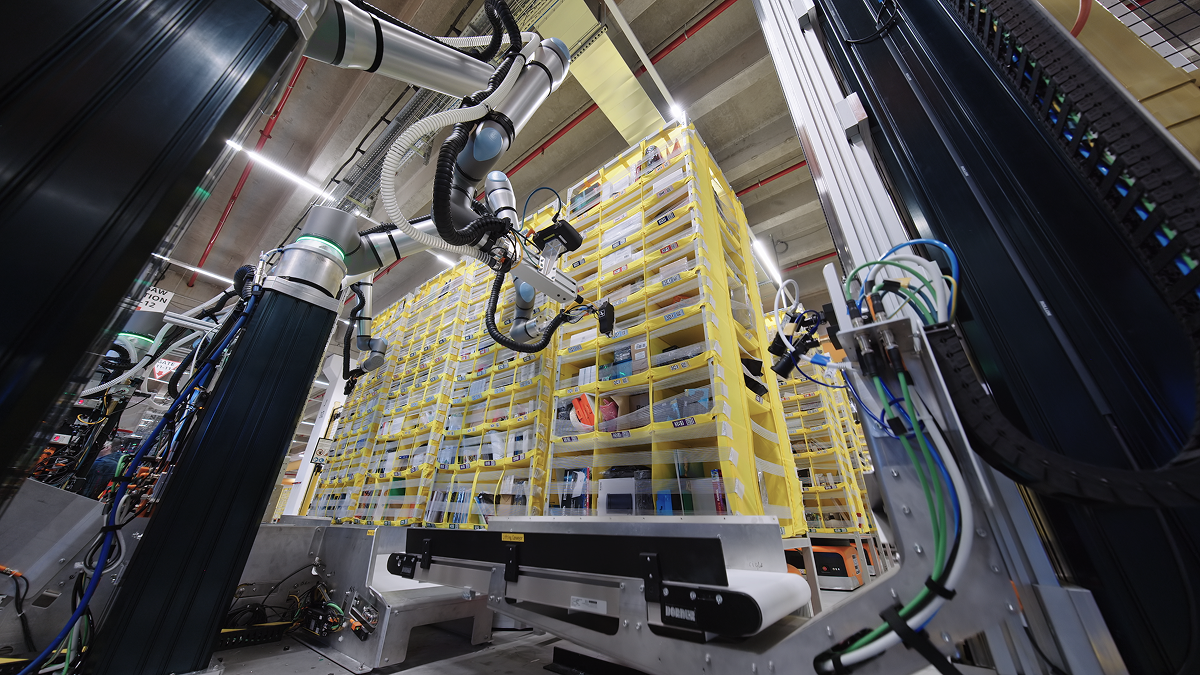
Photo by Amazon
The scale and opportunity in Physical AI-driven warehouse automation is unprecedented. In Amazon alone, over 14 billion items are stowed by hand across the globe. With the successful pilot, Amazon expects over 80% of these items to be stowed by Vulcan, at the rate of 300 items per hour. The robots are expected to operate 20 hours a day. Rolling out Physical AI projects of this magnitude requires much higher standardization, simplification of key processes and reliability, which a fragmented approach to automation cannot offer. The complex handoffs required at each stage, duplication of efforts, and long timelines that take months to complete through traditional methods aren’t ideal for large automation transformation projects. This is where a platform-driven approach is needed, enabling early validation, consistency, faster rollout, quicker path to ROI; which makes it possible to test hypotheses, validate and scale up seamlessly.
In the case of Amazon, while their team trained Physical AI models through real-world scenarios, Vention’s modular platform provided the underlying infrastructure. Vention’s hardware components such as carts and pedestals and MAP software platform provide the reliable physical and digital foundation required to standardize and roll out innovation across their global sites.
Three Ways Vention’s Platform Enables Scale
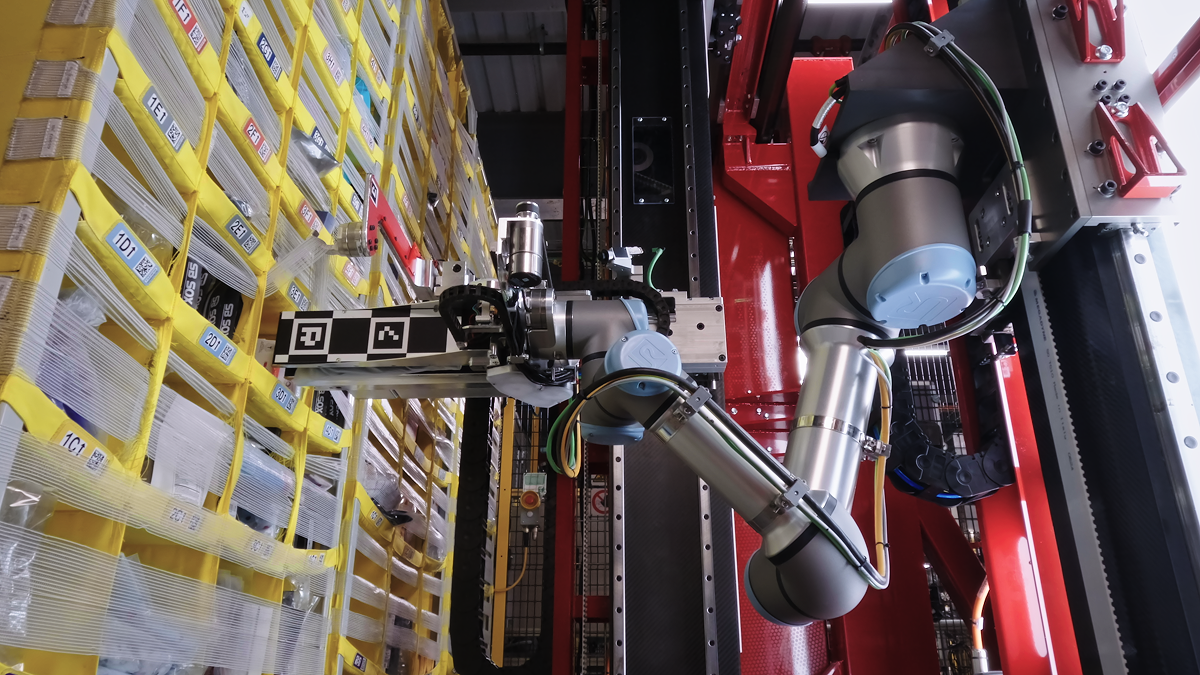
Photo by Amazon
1. Replicable Deployments
Standardized hardware parts and industrial carts provide a consistent physical foundation for automation systems. Re-usable designs, logic and workflows create the virtual building blocks for future deployments. Together this enables replicability across facilities without duplication of efforts.
2. Simplified Integration
A unified, cloud-based platform integrates robots, sensors, vision systems, as well as programming, simulation, and compute within a single environment. This reduces orchestration complexity and eliminates the need for custom integration at every deployment.
3. Scalable Operations
Common architectures and centralized oversight across sites simplify coordination, multi-site governance, monitoring, and maintenance. Systems can be replicated, improved, and expanded without introducing variability or operational risk.
Together, these capabilities enable systems like Vulcan to move beyond prototypes and become reliable, scalable solutions deployed across enterprise networks.
How Platforms Democratize Order Fulfillment Automation
A defining advantage of modern automation platforms is their ability to remove traditional barriers. Deploying robotics across multiple sites is no longer limited to retail conglomerates like Amazon or Walmart. Mid-sized and niche manufacturers can now achieve similar outcomes through a platform-based approach.
At Polykar, this played out through multi-site replication. A cobot-based palletizing system deployed in one facility was reproduced in a second using the same architecture, hardware, and programming environment, with minimal re-engineering. Instead of treating each rollout as a new project, the team reused a standardized design and software stack, reducing integration effort and accelerating deployment. The result was a 30% increase in productivity, achieved with significantly less engineering overhead.
Platforms also level the playing field by channelizing innovation in design and programming. Consider Safari Sun, a family-owned apparel manufacturer managing over 300 SKUs within limited space and budget. As operations scaled, their team faced rising picking errors and mounting operational complexity. Traditional automation options were costly and slow to implement.
Using Vention’s platform, the company designed a ceiling-mounted 3-axis gantry robot to maximize vertical space and handle product variability. The ease of use of Vention’s AI-assisted MachineLogic platform helped them self-program the gantry with little previous experience. It also made it possible to move from concept to deployment in eight weeks, eliminating picking errors across SKUs and improving packaging consistency.
What emerges across these examples is a consistent pattern. Whether scaling across multiple facilities or deploying within a single operation, the advantage is not just the automation itself, but the underlying infrastructure that makes it simple, and replicable.
Why Platforms Will Prove to Be a Competitive Advantage
Seen in the context of larger consumer and technology trends in order fulfillment, the value of platforms is unmistakable. Next-day delivery expectations, unpredictable order volumes, and increasingly diverse product catalogs expose the limitations of rigid, single-purpose automation.
While Physical AI advances tactile sensing, AI-driven motion planning, and collaborative safety features, the next competitive advantage in warehouse automation will rely on moving fast, and replicating innovation across locations. The warehouses and fulfillment networks that will thrive are those built on platforms that can adapt not in months, but in weeks.
The message for operations managers is becoming difficult to ignore: automation can no longer be approached as a series of isolated projects. An automation roadmap powered by an end-to-end platform reduces integration risk, accelerates deployment timelines, and provides a clear path for continuous improvement.
***
Download our latest Whitepaper to see how automation platforms are transforming enterprise businesses.