The best-of-breed philosophy dominated enterprise software strategy for two decades. In 2023, the SaaS Sprawl for large enterprises had reached almost 130 applications. For the next two years most would attempt to reverse the trend. By 2025, 68% of CIOs surveyed by ADAPT Research were actively targeting a 20% reduction in IT vendor count, driven by increased complexities, vendor management challenges, and integration challenges. The parallels with manufacturing automation are hard to miss.
The strategy of sourcing the best robot from one vendor, the best vision system from another, and the best PLC from a third has diminishing returns. Over the years this approach has resulted in an ‘Automation Sprawl’ that makes integration challenging for nearly 50% of manufacturers. But beyond day-to-day operations, this old model of procurement also adds hidden costs that don’t show up as a line item in most ROI and TCO calculations. Centralized procurement, modular hardware, and an integrated software-defined automation platform have the potential to reverse this and offer a new blueprint for automation.
This article examines the four cost categories that fragmented automation generates below the budget line, and how leading enterprises are solving this with an integrated software-defined automation platform.
Budget Overruns and Delayed Time-to-Value
Multi-vendor automation components are not pre-validated to work together. When a robot, a vision system, and a conveyor come from different suppliers, the engineering team is responsible for establishing compatibility across mechanical interfaces, communication protocols, and software environments. That challenge compounds when the software layer is equally fragmented: teams routinely work across separate platforms for CAD design, robot programming, simulation, PLC configuration, and deployment, each with its own file formats, data models, and logic representations. None of that integration work appears in any vendor’s scope.
What results is a workflow defined by constant context-switching. Engineers move between disconnected systems, manually reconciling bills of materials, motion logic, and configuration data at every handoff. Changes made in one environment must be re-entered or re-validated in others, creating compounding error risk as the project progresses. This overhead falls entirely on the customer’s engineering team and must be custom-built, tested, and reworked for each project. The financial impact of that invisible layer is consistent across the industry.
32% automation initiatives faced budget overruns on their most recent automation project.
2025 State of Manufacturing Report
Timeline erosion follows the same pattern. A traditional multi-vendor automation project moves through ten discrete phases, from vendor search to production ramp. The typical timeline for automation can range from 28 to 60 weeks, with system design, programming, and sourcing itself taking up over 10 weeks. Unexpected integration challenges, and delays caused by fragmented workflows add to the long timelines. By the time the system is up and running, the project has already consumed capital for months, diminishing the time to value.
The Feed, a direct-to-consumer nutrition company in Broomfield, Colorado, had received traditional automation quotes with a 40 weeks timeline. The application itself was not simple: a high-throughput custom conveyor system with demanding cycle-time requirements. The constraint was the architecture itself. Each component in a multi-vendor stack requires separate sourcing, compatibility validation, and integration work that nobody budgets for at the start.
When The Feed switched to a software-defined platform where design, programming, and hardware sourcing share a common environment, they went from quote to deployment in six weeks. The system now processes more than 5,000 orders per day and reallocates 15 workers per shift to higher-value tasks.
The Late-Stage Debugging Trap
The most financially damaging phase of a multi-vendor project is commissioning. In a fragmented system without simulation capability, logic is validated against real hardware for the first time when that hardware is already installed and the project is theoretically complete. Even if the engineering team has access to a simulation tool, switching between the design, programming and ordering hardware parts remains a disconnected workflow with many potential gaps. The result is usually rework at a late stage which requires coordination across multiple vendors and platforms, with no central accountability. This is one of the primary reasons automation projects do not perform as expected.
The IndustryWeek survey captures this exact pattern.
Why Projects Fail to Meet Expectations
- 49%: Integration with existing systems
- 38%: Unexpected technical issues
- 31%: Delays in delivery and installation
Glasgow-based McAlpine and Co. Ltd knew from experience that the commissioning phase of a multi-vendor project is where cost overruns concentrate. Their approach for automating case packing was to validate logic digitally before any hardware shipped, using an integrated software-defined platform that connects programming and simulation at the design stage rather than at final acceptance. The system was designed, programmed, and operational within three weeks, exceeded its stated objective of 7.2 picks per minute, and required no late-stage rework.
Getting there in three weeks, rather than several months, is what simulation-first engineering makes possible.
The Specialist Dependency
A fragmented automation stack creates a specialist dependency at every change point. The PLC programmer fluent in one vendor’s environment may not be able to work in another’s. The controls engineer who resolved the vision integration may be the only person in the facility who understands how the system was configured. When that person leaves, the organization loses the institutional knowledge required to maintain or modify the system without calling in external support.
This labor churn has an immediate impact on production. A 2024 Deloitte survey found that 80% of manufacturing professionals reported labor turnover had disrupted production. In a multi-vendor environment, that turnover risk is amplified: every departure represents a potential loss of proprietary integration knowledge that no vendor can reconstruct cheaply. The other trend to factor in is growing product variety. SKU counts have expanded by 50% across the last decade. When every change to a fragmented system requires an external specialist, the engineering hours do add up.
Safari Sun, an apparel kitting operation in Orlando, Florida, recognized the downside of automating with external dependency. In kitting environments, SKU mix shifts frequently, and reliance on external specialists for every format change turns each adjustment into a scheduling and procurement exercise. Their solution was to select a platform with open, Python-based programming and a unified software environment that any engineer on the floor could learn.
“With the machine, it’s much easier to train new employees. It only takes ten minutes or so to do it and anyone in the shop can use it now.”
Chris Dvornick, Director of Operations, Safari Sun
Inconsistent Performance at Scale
When multi-vendor fragmentation is the default approach across an organization, those costs compound at the portfolio level. Each facility that deploys automation under a fragmented model builds a one-off system. Organizations with five or more plants may be running five different automation architectures, none of which can be monitored, updated, or benchmarked centrally. Each site independently kickstarts separate workflows for design, programming and commissioning instead of re-using the assets and best practices created by other plants. As a result the quality of output within the same organization can be significantly varied.
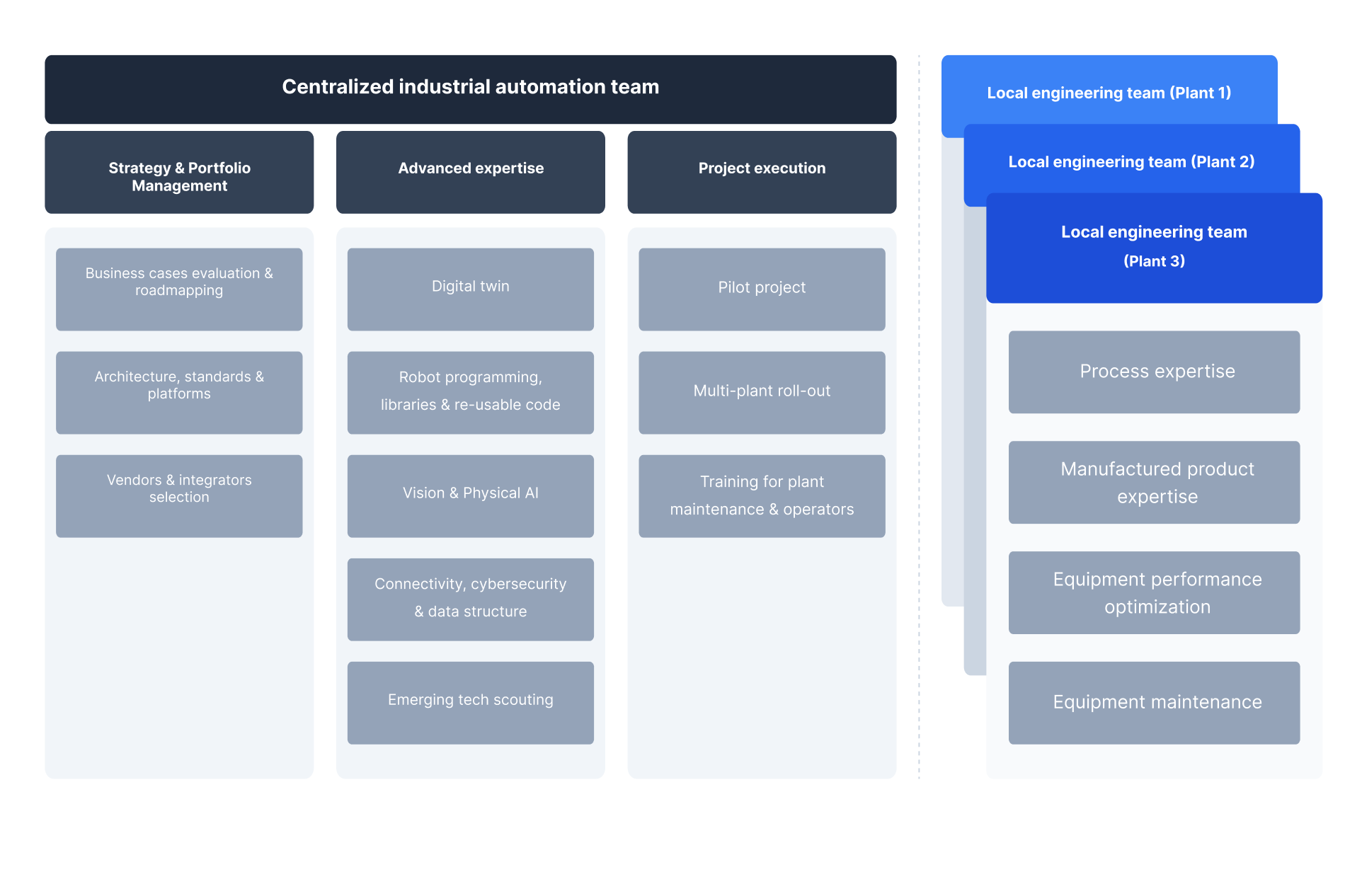
The business case for standardization is conceptually simple. Manufacturers using a product-based, unified automation approach, and establishing a center of excellence achieve faster return on investment over seven years compared to those using traditional approaches.
Sears Seating, a 170-year-old suspension seating manufacturer in Davenport, Iowa, identified fragmentation as a key blocker to scaling up. Previous internal automation efforts had generated safety concerns and a persistent lack of standardization. Expanding to a new facility, they committed to a modular, software-defined platform that their engineers could build on incrementally, constructing a reusable design library that eliminated starting from scratch on each deployment.
The software-defined approach helped Sears Seating go live in 15 days at 50% lower cost than traditional integrator quotes, reduced operating costs by 20%, and paid back in 15 months.
The Case for an Integrated Software-Defined Automation
The costs outlined above are structural features of multi-vendor automation. They appear across project types, company sizes, and industries because they are generated by the architecture itself: the custom integration layer, the absence of simulation-based validation or integrated simulation capability, the vendor-specific programming environments, and the lack of a shared data model connecting design to deployment to operations.
A vertically integrated platform with both breadth and depth to handle the entire workflow addresses each of these conditions directly. When design, programming, simulation, procurement, deployment, and operations share a single environment, integration is built in. Errors surface during simulation rather than during commissioning, when they are far cheaper to fix. A system deployed on a standardized platform can be operated and modified by internal teams without waiting for external specialists. For complex deployments that do require external specialists, the platform makes it easy to collaborate on design, enabling transparent feedback loops.
An integrated automation platform acts as a single source of truth for all projects, building a common link for internal engineering teams, integrators, and operations.
The deployment timeline difference is significant. Projects on unified platforms deploy in 6 to 12 weeks, with turnkey systems available in 5 to 7 days.
The financial outcomes follow directly. Vention’s average payback period, for instance, is 0.9 to 1.3 years. The unified, platform-based approach also lowers capital expenditure by 25% and offers 4x higher ROI. Over a seven-year horizon and across multiple facilities, these are substantial savings.
Fragmented automation generates real costs. The line items are harder to read on a project budget than a robot arm or a control panel, but they accumulate throughout the project lifecycle and persist long into operations. Manufacturers who have moved to unified platforms have not avoided those costs by chance. They eliminated the architectural conditions that produce them.
***
Planning your next automation project? Speak with a Vention application engineer to scope your system.


