Robotics orders in North America continue to grow, according to the latest report from the Association for Advancing Automation (A3). Despite this momentum, automation at scale remains restricted. High upfront costs, integration complexity, and economic uncertainty continue to limit how far many deployments progress beyond isolated cells.
Plug-and-play automation platforms promise a way forward by reducing integration hours, making automation profitable over a wider range of user cases. Yet, not all platforms are created equal. As organizations scale from isolated deployments to comprehensive, multisite programs, they must evaluate these platforms for both breadth and depth to ensure sustainable scalability.
Platform Breadth: Fully Replacing the Fragmented Stack
Platform breadth measures how much of the automation value chain a single system covers. Does it span the full lifecycle from design to operations, or is only focused on a single aspect such as programming? A true end-to-end platform should cover the following key steps in the automation process.
Scope → Design → Program → Simulate → Order → Deploy → Operate
Evaluating an automation platform’s coverage of this entire journey matters because fragmentation has a cost. In most factories, mechanical design happens in one system, robot programming in another, PLC logic in a third, simulation in a fourth, and procurement outside engineering entirely. Each handoff introduces delay, translation error, and rework, and has a clear impact on the total deployment cost and timelines.
Over time, multiple deployments across multiple sites compound these inefficiencies. A packaging line validated in CAD cannot be simulated accurately because the robot program lives elsewhere. A cell proven in simulation still requires changes when hardware arrives because the bill of materials was sourced independently. A deployment that worked in one plant cannot be replicated without starting over. Fragmentation does not just slow deployment. It institutionalizes reinvention, making every new project an engineering reset instead of a scalable program.
Automation platforms with genuine breadth collapse these silos into a single digital stream. Design decisions flow directly into programming, simulation reflects actual hardware configuration, and ordering ties to validated designs. This continuity enables replication, saving engineering hours spent reinventing the wheel.
End-to-End Automation On Vention’s Platform
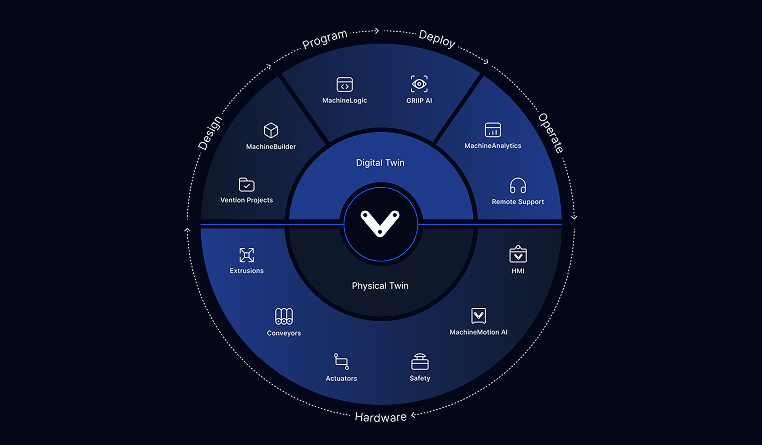
Breadth also applies to the range of applications a platform can support across the factory floor. A practical test is whether a platform can extend beyond a single cell to support an entire production line. In end-of-line packaging, for example, a complete system may include case packing, palletizing, conveyors, and manual workstations for inspection or labeling. Each element has distinct design and programming requirements, which increases engineering effort and change management overhead.
In traditional project-based automation, each deployment becomes its own microcosm with unique controllers, proprietary PLC code, and vendor-specific configurations. Over time, this creates orphaned code and fleeting standards. As a result, critical knowledge is trapped in silos, and when key individuals leave or retire, disappears altogether. Implementing a platform-based strategy changes this dynamic. For manufacturers scaling across multiple facilities, it lowers supplier overhead, accelerates replication, and prevents the loss of critical institutional knowledge.
Platform Depth: Readiness for Real World Conditions
Platform depth measures how capable an automation platform is within each of its pillars. Take programming as an example. Depth in this context means offering multiple layers of capability based on the user’s experience. Platforms with strong depth, such as Vention’s MachineLogic, provide multiple entry points: a code-free interface for new practitioners, Python for intermediate users, and full IDE or CLI access for expert programmers.
Simulation is another great example of how platform depth add more layers to a platform’s capabilities. If a platform can move beyond simple visualizations to physics-based simulations, it saves hours of debugging work on the shop-floor. Adding more functionalities such as kinematic validation and being able to accurately estimate cycle times improve confidence in design.
For manufacturing teams responding to changing variables on the shop floor, platform depth can be an important lever to control output and improve the predictability of results.
Why Automation Platforms Must Merge Breadth and Depth

Breadth unifies the fragmented automation workflow, while depth makes each pillar powerful enough that engineers no longer need external tools. Replacing the traditional automation stack therefore requires platforms that combine both. When breadth and depth converge, manufacturers gain exponential value through faster project execution, lower engineering costs, greater standardization, and simplified procurement.
This combination allows manufacturers to scale automation in ways that were previously difficult under traditional project-based approaches. For example, Polykar deployed two cobot palletizers at their Edmonton facility, validated the system, and then replicated the identical solution at their Montreal plant, with the same hardware configuration, the same software logic, and operators already trained to run it. The result was a 30% increase in production across both plants, with no new vendor engagements and no rebuilding from scratch.
The same dynamic also allows automation teams to move away from bespoke engineering and toward reusable automation building blocks. For Sears Seating, switching from traditional automation to Vention’s platform helped create a library of designs, allowing them to iterate and ‘copy-paste’ automation. It also reduced the costs of automation by 50%.
The New Model for Automation Adoption
As AI capabilities mature and hardware costs continue to fall, competitive advantage will increasingly come from building an automation flywheel. In this model, fast and repeatable deployments replace one-off, project-based automation. Manufacturers that adopt platforms with real breadth and depth are best positioned to win, because each successful deployment becomes a reusable template for the next. Over time, this compresses months of engineering effort and permanently shifts automation culture from “can we automate this problem?” to “can this scale across similar problems at every site?”
***
Want to continue learning more about automation platforms? Download our new whitepaper!


