Manufacturers today run on software, and they’re ready to spend more on it. Industry reports project the manufacturing operations software market to reach over $50 billion by 2031. Manufacturers today use software to manage supply chains, forecast demand, track financials, and design products. Teams collaborate across continents in real time, product updates ship in minutes, and data flows from every corner of the business into a single source of truth.
Then they walk onto the factory floor that is still stuck in the 90s. Most automation cells, the part of manufacturing that decides productivity and output, is still built the old way.
Every new cell is a custom project. Every deployment is a negotiation between vendors, integrators, and timelines. The tools don’t talk to each other, the knowledge lives in a few people’s heads, and when something goes wrong, someone has to fly in to fix it, keeping production on pause.
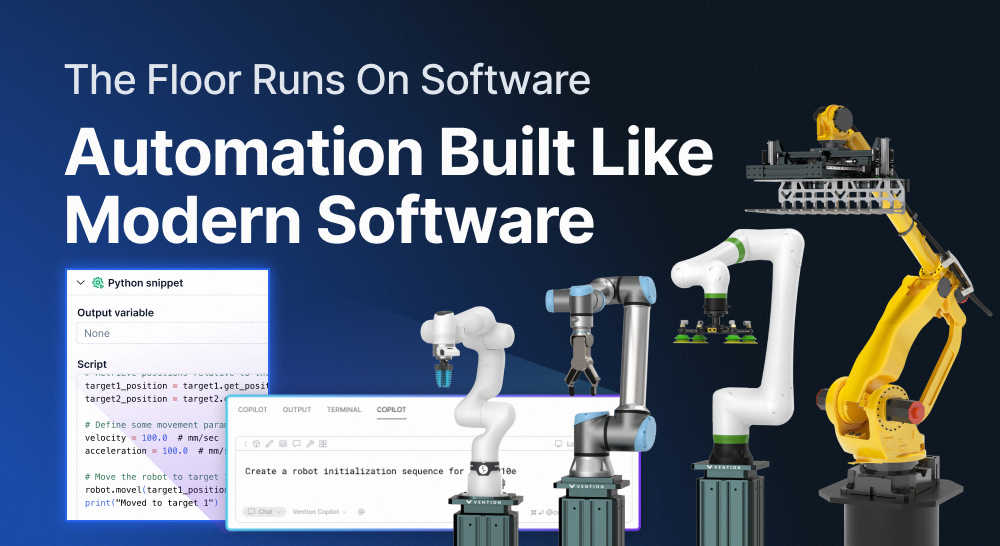
This picture is changing as manufacturers change their mindset to treat automation less like a construction project and more like software development. The software-defined automation era is here.
What Software-Defined Automation Actually Means
The software industry solved the problem of wasted efforts, tribal knowledge and fragmented procurement a long time ago. Software-defined automation brings their approach to manufacturing automation where design, testing, deployment, and operation of physical automation systems are managed through software, the same way modern applications are built and maintained.
Reuse over rebuild
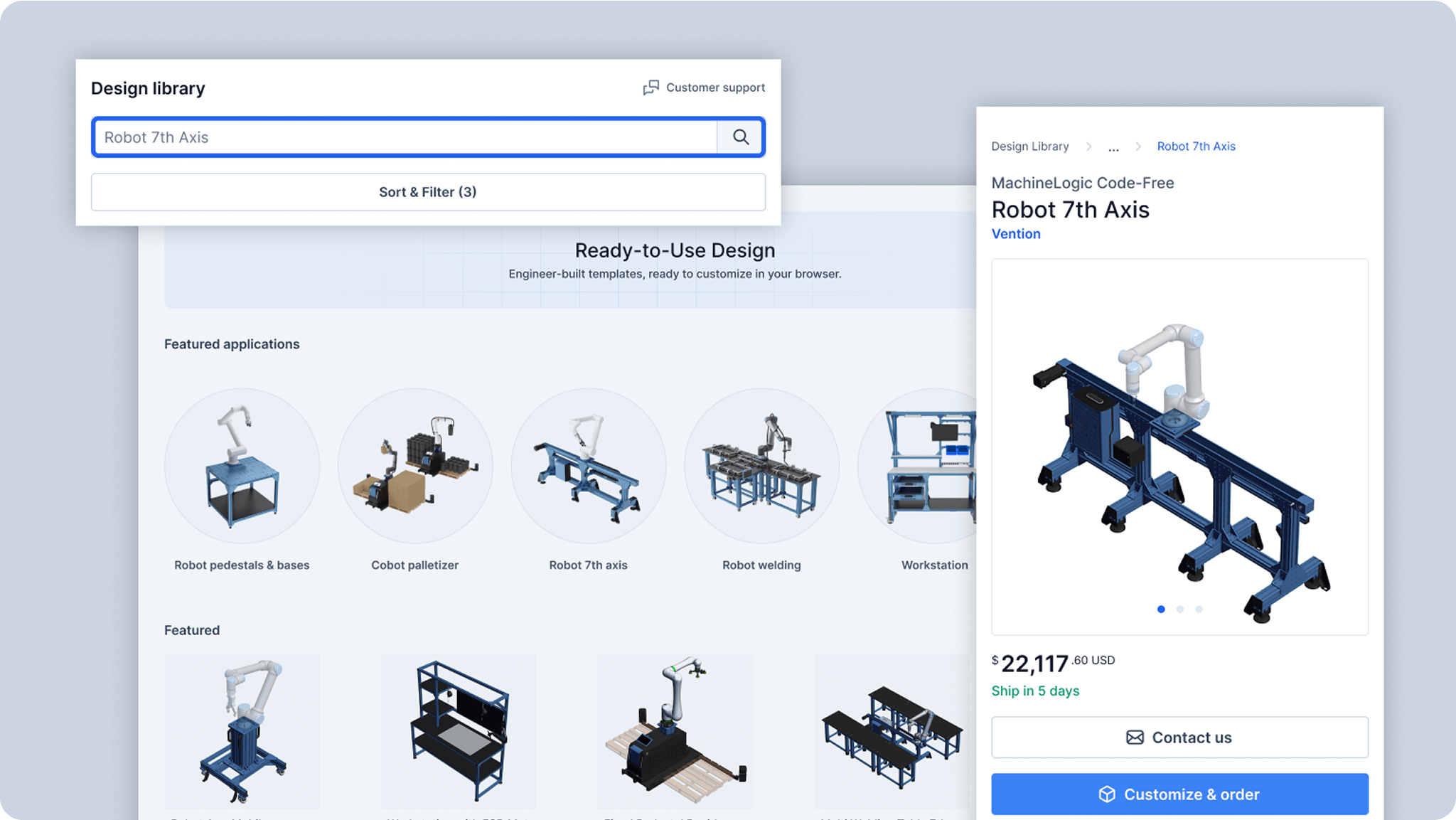
Software teams don’t write the same code from scratch for every project. They build on reusable modules, shared libraries, and version-controlled repositories. Software-defined automation works the same way: design a cell configuration once, save it, and deploy it again - on a different line, in a different plant, with the same confidence.
Simulate before you ship
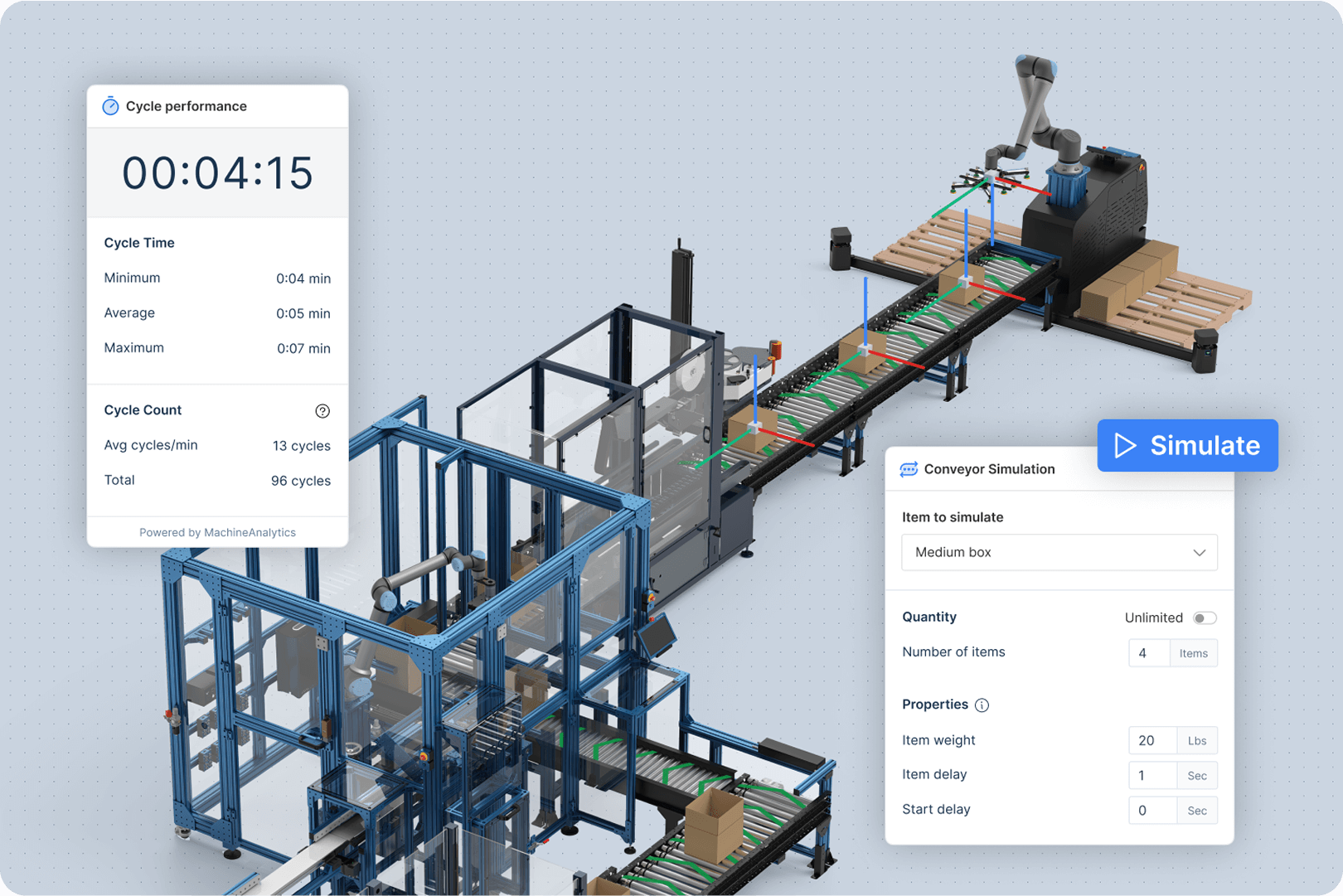
No serious software team ships to production without testing. In automation, the equivalent is the digital twin, a virtual replica of a cell that lets you validate programs, detect collisions, and run edge cases before a single component is commissioned. Problems get caught in the model, not on the floor.
Cloud-connected and always updatable
Software is deployed remotely, monitored continuously, and updated over-the-air. That’s now true for automation too with controllers that receive OTA updates, live dashboards that surface performance data, and remote diagnostics that don’t require an on-site visit. The machine stays connected to the platform that built it.
AI is already in software platforms - and it’s coming to automation
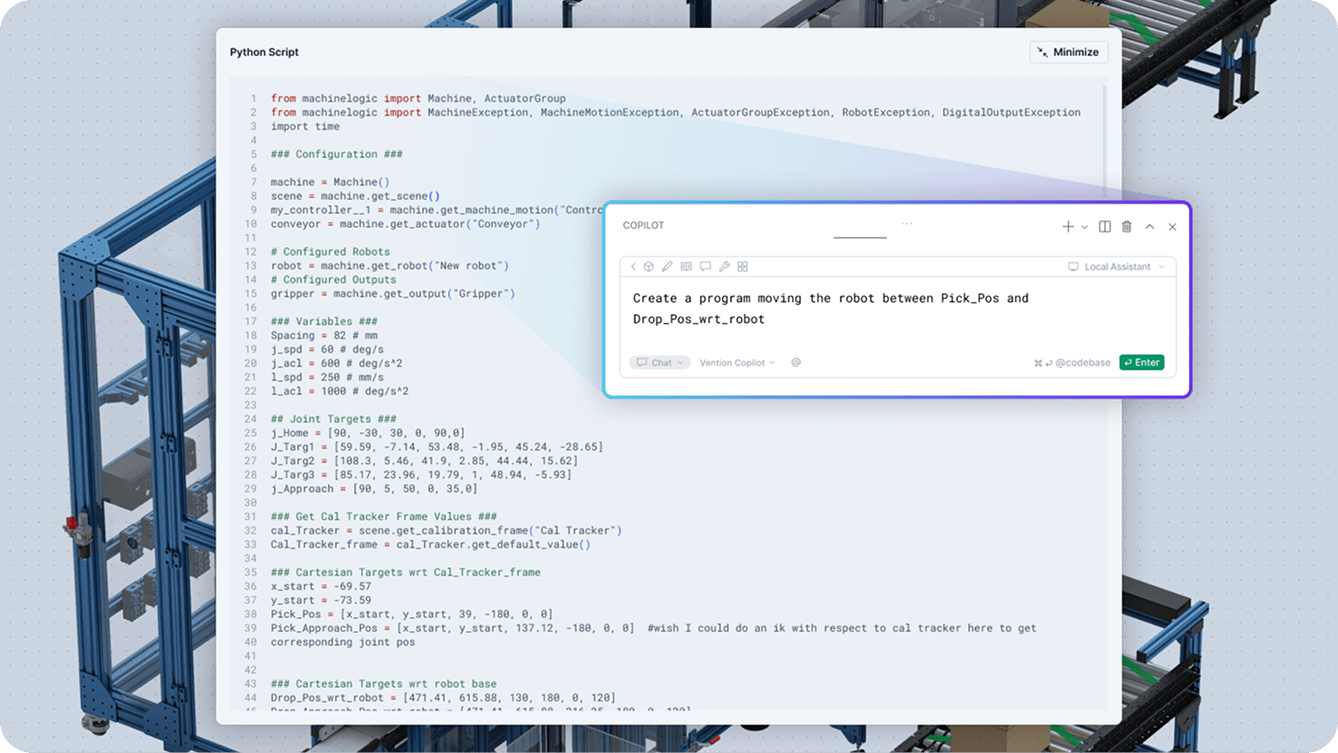
From code completion to anomaly detection to intelligent recommendations, AI has become a native part of how software gets built and operated. Automation is following the same trajectory: AI-assisted programming, smart path planning, operator guidance that reduces the expertise required to run complex equipment.
The trajectory of industrial automation is moving beyond traditional integration with software features tacked on. Unified platforms designed from the ground-up with the software-defined mindset will shift the conversation around automation from single-point, project-based deployment to a system that gets smarter, more connected, more capable, and easier to deploy over the years.
What the Software-Defined Model Looks Like in Practice
Software-defined automation isn’t a mere projection that needs years to consolidate. It’s already here and early movers are using it to create benchmarks for the future. The examples below illustrate how manufacturing leaders are applying it in practice.
Design with confidence
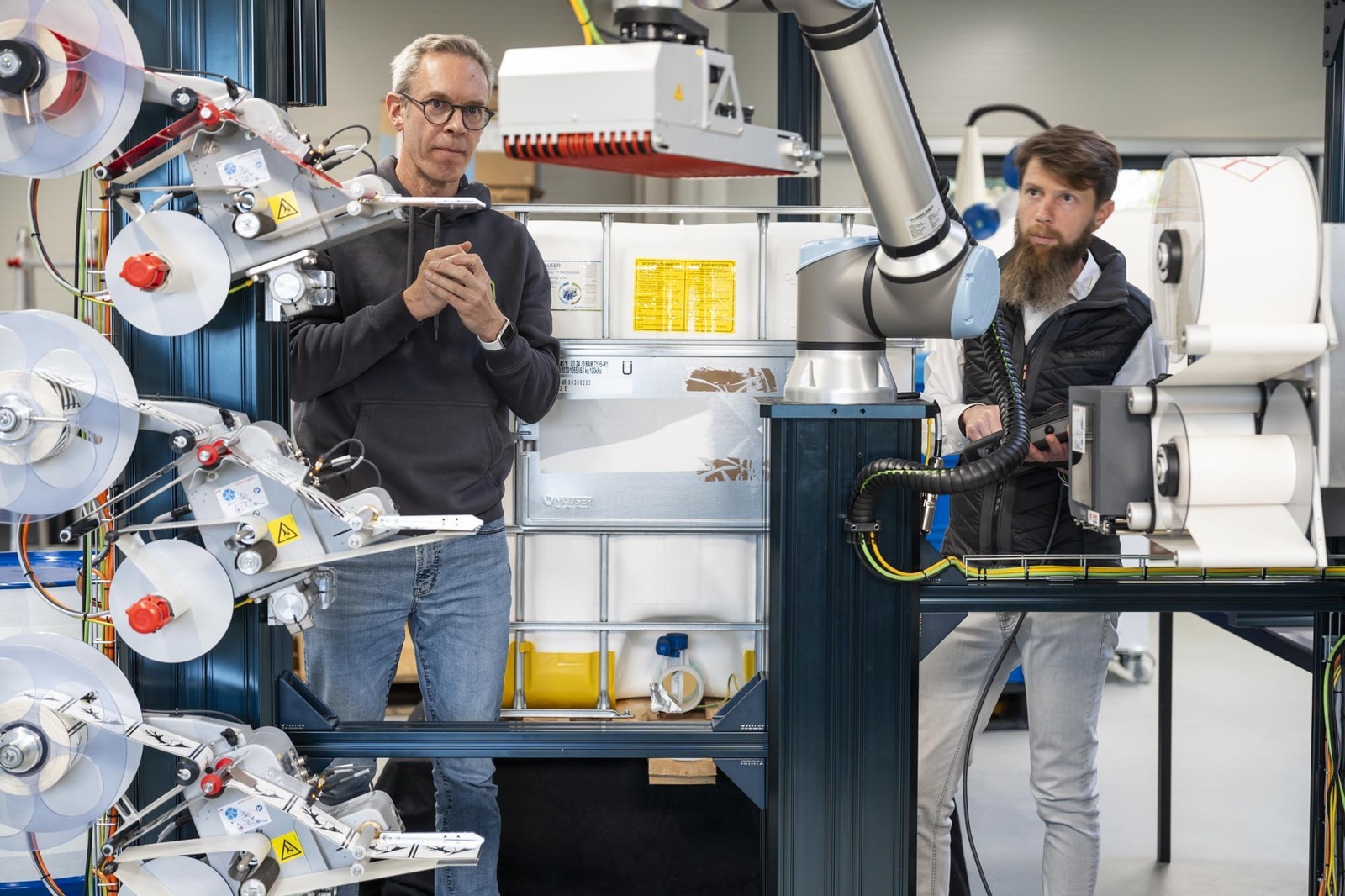
Moin Robotics needed to replace manual, error-prone container labeling for a chemical contract filler. By building on Vention’s modular ecosystem, they bypassed traditional fabrication entirely and hit a 15-week speed-to-market on a vision-guided labeling system. The result was a 25% productivity increase, one operator per shift reallocated, and a projected 20-month ROI, with a modular design that adapts as container and label formats change. That speed and accessibility is what a unified design-to-deployment environment makes possible.
Program in the language of software
The most advanced automation platforms today are programmed in Python, the same language used across software development, data science, and robotics research. That is the analogy made real. Safari Sun, a family-owned apparel manufacturer, proved the point: with no prior Python experience, the team self-programmed a 3-axis gantry robot in Python using MachineLogic to pick across 300+ SKUs in a tight footprint.
For teams without that background, no-code interfaces cover the same ground visually. Solestial used the no-code interface in MachineLogic to program and test its automation recipes before any hardware arrived. Same platform, different entry points, so the tool adapts to the team rather than the reverse. And the accessibility shows: at Safari Sun, a new operator learns the interface in under ten minutes.
Simulate before you ship
No serious software team ships to production without testing. In automation, the equivalent is the digital twin, a virtual replica of a cell that lets you validate programs, detect collisions, and run edge cases before a single component is commissioned. Solestial put this to work on a material-handling system for delicate solar wafers, validating throughput, robot kinematics, and process flow virtually, and debugging recipes before ordering a part. The payoff was concrete: parts arrived exactly as simulated, rework cycles were eliminated, and the line ran with a 50% throughput increase while reducing breakage. Problems get caught in the model, not on the floor.
Get design and programming right the first time
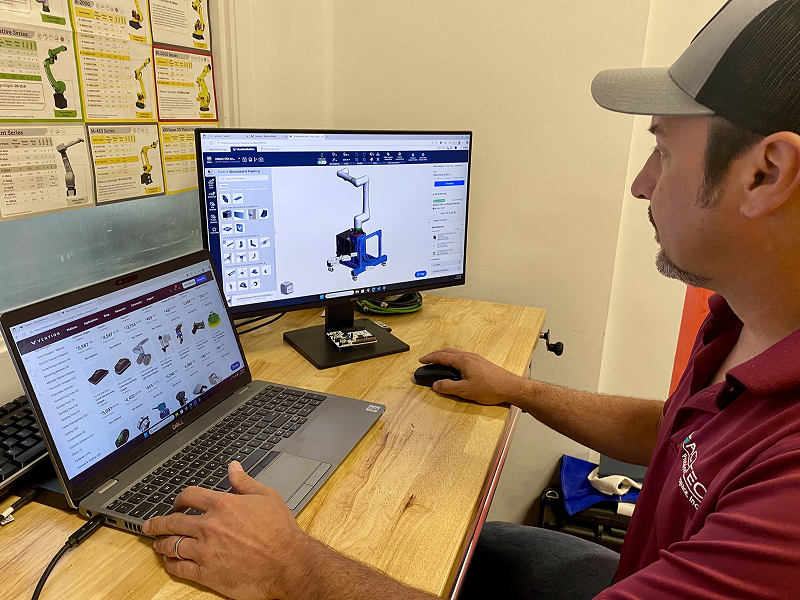
Physics-based simulation in the cloud means programs are validated virtually before they touch real hardware. Commissioning time drops. Costly late-stage surprises, the kind that blow timelines and budgets, get caught earlier, when they are cheap to fix. At Acutec Precision Aerospace, the platform’s Design Checker flagged a misaligned connector that would have slipped through and cost hours of floor rework. Designs that once took weeks now take days.
AI guidance on the floor
Smart assistance and AI copilot capabilities reduce the expertise barrier for design and programming. Controls-light engineers can contribute meaningfully. Operators get guidance through setup. This is already real at design time: Acutec’s engineers lean on an AI Design Assistant that flags errors as they build. On the operations side, Vention’s AI Operator extends the same idea into execution, generating grasp plans on the fly for tasks like bin picking and machine tending without hard-coded paths. McAlpine is already heading there, expanding from automated case packing into AI-powered bin picking. Platforms make the team more capable, not more dependent on specialists.
Deploy once, replicate everywhere
Polykar first tested cobot palletizing at its Edmonton plant, validated it, then replicated the same solution at its Montreal facility, where operators could create new palletizing patterns in minutes. President and CEO Amir Karim estimated roughly 30% more output, alongside better employee retention and more predictable production. The value of a platform approach is not the first deployment alone. It is that the second, third, and tenth are faster, lower-risk, and built on validated foundations rather than starting from zero.
Operate with visibility
Remote monitoring, live performance analytics, and OTA controller updates mean teams can see what is happening across every cell, and act on it, without being physically present. Harris RCS used Vention’s MachineBuilder software and modular hardware ecosystem to keep refining a deployed cobot machine-tending cell, modeling and rolling out updates quickly as needs changed, contributing to a 28% productivity gain. Diagnosing a fault doesn’t require a flight. Updating a program doesn’t require downtime.
Continuous support, built into the model
Software-defined automation doesn’t end at commissioning. Professional training, design and deployment assistance, and ongoing support are part of the platform rather than afterthoughts. Polykar cited exactly this continuity, from initial scoping through on-site deployment and operator training across both plants, as a primary reason they chose Vention. Teams aren’t handed a machine and left to figure it out. The relationship continues because the platform continues.
An open ecosystem

Hardware modularity across structural components, actuators, and end-of-arm tooling, combined with an open robotics ecosystem of collaborative and industrial robots, means the platform adapts to the application rather than the reverse. AEC showed how this plays out, integrating a FANUC CRX robot arm onto a Vention 7th-axis to run multiple part families with minimal changeover and no robotics background, reaching 20 hours of lights-out production.
As Physical AI matures, with smarter sensors, adaptive vision systems, and intelligent grippers, a unified software layer is what allows those capabilities to integrate cleanly rather than creating yet another disconnected tool.
Where Automation Is Heading
The platform model is here to stay and the manufacturers standardizing on it now are building a compounding operational advantage: faster deployment of new cells, easier replication across sites, lower dependence on scarce specialist knowledge.
Developers are at the center of this shift. Modern automation is increasingly being programmed by developers, in Python, from their own IDE, via CLI. The same workflows developers already know are becoming native to automation. That’s not a coincidence; but convergence. And cloud is what closes the loop: a developer can write, simulate, and validate a program, then push it to a controller on a factory floor in another city via OTA - without ever being on-site. Configurations are versioned. Updates propagate instantly. Knowledge doesn’t walk out the door.
And the next wave is already forming. As software-defined automation matures, agentic AI systems that can reason, plan, and act autonomously across complex workflows will gain prominence. This is automation that doesn’t just execute a program, but adapts based on real-time conditions. From software-defined automation to AI-defined automation, the unified platform is the foundation that makes it possible.
***
Talk to experts in software-defined automation to see how it could help you automate your shop floor more efficiently.