Order a conveyor system today and there is a reasonable chance it will arrive in six to twelve months. When it does, it will run on proprietary PLC logic that your team cannot touch without calling the integrator. And if production changes (a new SKU, a different layout, a line expansion), you will likely need to start the engineering process all over rather than adapt what you have.
This model worked in an era without significant external pressures that manufacturers face today. However, mounting labor shortages and SKU proliferation make this model inadequate. The National Association of Manufacturers projects a shortfall of 1.9 million manufacturing workers in the US by 2033. As per McKinsey’s analysis, SKU counts have grown by over 50% in the last decade for some manufacturers, forcing more frequent line changes. A conveyor that takes a year to arrive and cannot be reconfigured without a rebuild magnifies these challenges.
Multiple industry studies over the last two years found that 30 to 40% of unplanned production delays trace back to internal logistics issues, including late line feeding, congestion, and sequencing mismatches, rather than machine failures. In short, the problem is not the conveyor but the current processes favoured by most partners.
Here are five things that should be standard to de-risk your conveyor projects.
1. Develop a Deployment Timeline Your Production Schedule Can Absorb
A modern conveyor partner should shorten the path from concept to operation, not add months of engineering overhead around standard material flow.
Standard lead times for custom conveyor systems run to six, nine, or twelve months. For assembly environments where the conveyor dictates the pace of every workstation, that timeline delays the entire automation program. For fulfillment operations where 48% of companies are already deploying robotics, it means the conveyor backbone lags behind every other piece of infrastructure. For end-of-line packaging, where projects already stretch because of multi-vendor integration, a slow conveyor procurement cycle compounds delays. A 2025 survey by IndustryWeek found that deployment delays were causing 32% of manufacturers to go over budget and over schedule.
The root cause is rarely the mechanical manufacture of the hardware itself. It is the engineering overhead that surrounds custom conveyors: bespoke PLC programming, custom electrical integration, commissioning work that starts from scratch on every project. As Sean Dotson, founder of automation advisory firm Automation AMA and former integration company owner, described in his May 2026 analysis of the integration model: per-cell programming labor historically represented 35 to 45% of integrator project revenue. That overhead does not disappear. It gets priced into every project the customer buys.
A partner with processes built to compress that overhead changes the timeline as a structural outcome, not a promise. Platform-based automation and modular hardware can enable partners to shift to this new standard.
When pre-assembled modules replace custom fabrication and software-defined controls replace bespoke ladder logic, deployment weeks replace deployment months.
2. Validate Before You Commit to the Build
Most conveyor projects are still bought on descriptions, approved on assumptions, and truly tested only during commissioning. That is too late to course correct. Changes at that stage cost multiples of what they would have cost at the design stage, in time and money both.
The IndustryWeek survey found that one-third of automation systems fail to perform as expected, with incomplete scoping and insufficient de-risking during the design phase identified as primary drivers. Industry maintenance data consistently shows that emergency repairs cost three to four times more than routine preventive maintenance, and unvalidated conveyor configurations compound that gap over the system lifecycle. The cost difference between a validated and an unvalidated design is rarely close to that.
Changes found during commissioning cost more in time, budget, and disruption than changes identified during design. Buyers should be able to evaluate whether a conveyor will fit the application before hardware is ordered, not after it is on the floor.
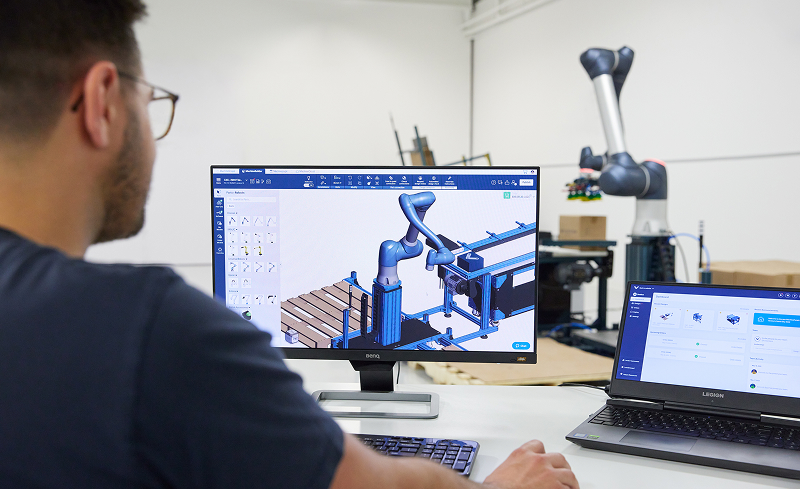
A digital twin changes this. When a team can model product flow, zone sequencing, accumulation behavior, and transfer point logic in a virtual environment before hardware is ordered, the problems that would otherwise surface during commissioning surface at zero cost.
Digital twins, and simulation should not be treated as a premium add-on. It should be part of the standard buying experience.
3. Control What Your Operators Can Run and Troubleshoot, Without Calling Specialists
The real test for identifying a viable conveyor solution is simple: when the line changes, can your team make the adjustment without waiting on outside support? Too often, the answer is no. A specialist writes the logic, the line goes live, and every later change becomes a service event.
The way most conveyor systems are programmed today creates a dependency that outlasts the deployment. A specialist writes the PLC logic. The line runs. Production changes (a new SKU, a different box size, a modified accumulation zone) and the same specialist, or one like them, needs to return to make the adjustment. The system works, but it is not in your hands. And when something breaks at 2 am on a Wednesday, the troubleshooting clock starts not when the problem occurs but when support can get on site.
Higher mix, more frequent model changes, and expanding SKU portfolios mean reconfiguration is no longer an exceptional event. Advanced Manufacturing’s February 2026 analysis puts it plainly: “choosing the wrong system tends to amplify bottlenecks, increase manual workarounds and complicate any future changes.” The dependency on specialists for routine adjustments is one of the primary drivers of extended payback periods.
The talent context makes it worse. Deloitte’s 2025 Smart Manufacturing and Operations Survey found that nearly half of manufacturing executives report moderate to significant challenges filling production and operations management roles. A 2026 analysis of the end-of-line packaging market names the shortage of PLC and robotics expertise as a top structural constraint on adoption industry-wide.
A partner whose system requires specialist knowledge for routine adjustments is selling you a conveyor that will need external support at exactly the moments your production schedule cannot absorb it.
Code-free and Python-based control environments offer a different design philosophy. They enable operators to configure zone behavior, adjust motor speeds, and manage product flow through a visual interface in a language that is widely understood and transparent.
Modern conveyor controls should make common changes easier, not harder. Buyers should look for systems their operators, engineers, or maintenance teams can understand, adjust, and troubleshoot without rebuilding the project around external support.
4. Design a System to Connect, Not Just to Function
Conveyors do not create value alone. They create value as part of a connected system. They interface with robotic cells and workstations on an assembly line, connect storage and picking in a warehouse, and link case erecting, packing, sealing, and palletizing on packaging lines.
That is why the question is not just whether the conveyor works. It is whether it connects cleanly with the rest of the operation and stays adaptable when the rest of the line changes. Separate vendors, separate controllers, and separate support models turn simple flow into a coordination problem. According to a 2022 PMMI study on end-of-line automation, multi-vendor integration overhead regularly consumes 15 to 20% of total project cost before the line produces a single unit. Dotson’s analysis puts it plainly: the translation code required to make multi-vendor systems communicate at the cell level was the largest single cost pool in the traditional integration stack, and the manufacturer absorbed every dollar of it.
This is why it’s more important for manufacturing teams to know if their conveyor partner has the scale to cover the entire system, and its next iterations, and whether the products they offer are built to work together from the start rather than connected after the fact. The macro signals in the automation industry are clear on where this is heading. SoftBank’s acquisition of ABB’s robotics business, Symbotic’s vertical integration of warehouse operations, the $1.4 billion raised by Skild AI to build cross-robot foundation models: these moves reflect a shift in how the industry thinks about integration.
The role of the integrator is changing from gatekeeper of compatibility to facilitator of innovation. System integrators enabled with platforms capable of automating the full line are best placed to deliver scalable end of line packaging solutions.
5. Source visibility and support that doesn’t require a scheduled site visit
Unplanned downtime costs industrial manufacturers as much as $50 billion annually, with the average manufacturer experiencing roughly 800 hours of equipment downtime per year.
The standard support model (log a ticket, wait for a technician, wait for travel, begin diagnosis) is structurally incompatible with those numbers. PMMI’s 2025 Aftermarket Parts and Services report found 75% of packaging end users identify delivery delays and parts availability as among their biggest operational concerns. The advancement in remote support infrastructure has changed the dynamics of this process. What used to take two days to diagnose onsite can now be done in ten minutes remotely. Connected systems have further improved machine diagnostics. Deloitte’s 2025 Smart Manufacturing and Operations Survey found that IoT-connected equipment reduces unplanned downtime by up to 30%.
Remote visibility, meaning continuous monitoring of machine performance, live access to operational state, and on-demand expert access in minutes, is not a premium feature when you consider the cost of downtime. For manufacturers operating across multiple facilities, it changes the support model entirely: an engineering team that can monitor, diagnose, and guide resolution across sites without travelling to each one is a fundamentally different capability than one that depends on dispatched technicians. Issues get resolved before they become stoppages. Performance data surfaces problems before they cause failures. And the knowledge of what the system is doing stays with the people who run it.
It’s not enough for remote support to exist in theory. It should be built into standard experience.
The Model Has Not Kept Up with the Floor
The five gaps above describe the difference between how most conveyor projects still work and how the best ones already do. The market is growing. The pressure on factory floors, from labor constraints, SKU proliferation, and the accelerating adoption of connected automation, is real and measurable. The manufacturers pulling ahead are not waiting for the traditional procurement model to evolve. They are choosing partners whose architecture was built for the way manufacturing actually operates now.
A modern conveyor project should move faster, validate earlier, adapt more easily, and create less dependency after go-live.
***
Talk to a Vention conveyor expert. No-obligation design review, online, in a day. Get a design review