Automation projects are known to subvert expectations when it comes to timelines, and not in a good way. 31% of manufacturing projects experienced delays in delivery or installation as per a recent survey by Vention and IndustryWeek. 33% reported that the system did not perform as expected once deployed. These are significant blockers often attributed to vendor selection and implementation complexity. What’s often overlooked is the faulty spec decisions made four to eight weeks prior to the ‘deployment day surprise’.
The more mismatched spec decisions about workstation geometry, material flow, and lead-time assumptions, the wider the gap is between expected and delivered output. This has real consequences on the shop floor that show up through missed customer commitments, unplanned inventory buffers and engineering overtime that erodes margins.
This guide is a practical framework designed to avoid costly spec errors. Whether you’re scoping a new build or taking on a retrofit of an existing setup, this five steps framework offers a structured approach to closing the gap between expectations and reality.
Why Most Automation Initiatives Experience Ramp-up Delays
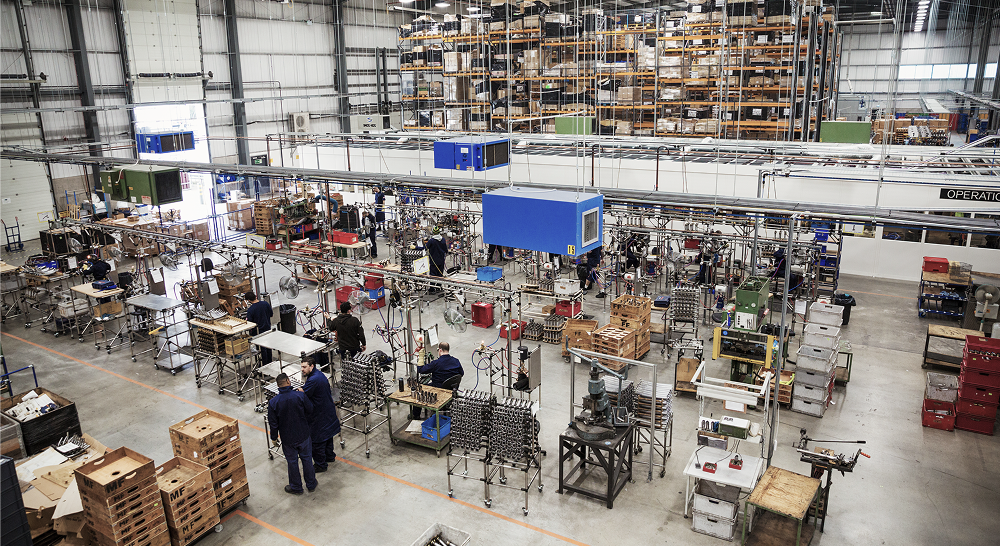
Before we jump into the framework, it’s important to understand where the usual spec decisions fail. Based on Vention’s experience of deploying over 25,000 machines in the field, there’s a consistent pattern to why facilities run into ramp delays.
Specs built around catalog SKUs
The path of least resistance in facility procurement is to start from a supplier catalog and select standard SKUs. Footprint dimensions, mounting patterns, and height ranges are fixed by the catalog, and the workflow gets adapted to fit. The result is a line where operators reach too far, turn at awkward angles, and place materials in locations that were convenient for the spec sheet rather than the assembly sequence. The result is an eventual push for rework and added engineering hours.
Lead times that conflict with the ramp curve
Custom structural steel carries lead times of six to twelve weeks once engineering, fabrication, and finishing are factored in. Legacy T-slot aluminum extrusion systems, while more flexible, typically involve a CAD back-and-forth with a distributor, manual BOM generation, and four to eight weeks from quote to delivery. When production is scheduled to start on a fixed date, this additional structural lead time leaves almost no margin.
No automation upgrade path
Traditional automation leaves little room for easy adaption, and often mandates starting a new initiative with no reusability for components and design. For example, a workstation designed only for manual assembly today may need to accept a collaborative robot or vision inspection system within 18 to 24 months. If the structural design does not account for that possibility, the workstation gets scrapped rather than upgraded.
Ergonomic mis-specs that surface as rework
One of the biggest challenges in writing accurate specs is that ergonomic errors do not announce themselves until operators are on the line. A workstation at the wrong height, with inadequate lighting for fine-pitch assembly, or with cable routing that forces awkward postures will generate a steady stream of correction requests and, in time, repetitive strain incidents. The only solution is a factory digital twin that can validate the ergonomics before the order is placed. This is easier said than done though, using the traditional approach to automation where design, procurement and digital validation are siloed.
Five-Step Spec Framework to Ensure Day-One Efficiency
The following five steps address each of the challenges above. The key is treating facility specification as a strategic decision.
Step 1: Map the workflow before the floor plan
Before any workstation footprint, aisle width, or utility drop location gets committed, map the sequence of work in detail: Takt time by station, kitting sequence, operator reach envelope at each task, and material flow from point of entry to point of use.

When expanding to a new facility in Davenport, Iowa, Sears Seating used the clean-slate opportunity to map workflow and ergonomics before committing to any structural layout. This upfront planning helped them cut opex by 20% post deployment.
Step 2: Match structure to work across all four categories
Production floor structures fall into four functional categories, each with distinct specification requirements:
- Workstations carry the assembly task and must be sized and adjusted precisely to the work sequence and operator population at each station.
- Carts enable material flow between storage, staging, and line-side delivery, and must be designed around the specific containers, weights, and routing they will handle.
- Jigs and fixtures hold the part or sub-assembly in the correct orientation and must be specified with the tooling access, repeatability, and reconfigurability that the product mix requires.
- Shelves and racks manage point-of-use storage and must be located and dimensioned according to the actual replenishment cycle and picker ergonomics, not generic capacity assumptions.
Mapping these four categories explicitly, rather than treating all floor structures as a single workstation spec, surfaces conflicts early and ensures each element is sized for its function.
Step 3: Build for the operator, not the catalog
Operator-centered design is a throughput strategy. The human factors that affect cycle time, error rate, and sustained output are measurable and specifiable. Height adjustability, reach-zone geometry, task lighting, cable management, and anti-fatigue matting each have defined ISO and EN ergonomic standards for assembly workstations. Those standards should be the reference, not the equipment catalog.
Step 4: Spec for change, not just for now
A structural system that requires a fabrication order every time the line changes will be avoided and worked around until it is replaced. Modular T-slot aluminum extrusion systems enable reconfiguration with standard Allen-key tooling, no welding, and no fabrication lead time. The key decision is profile standardization: selecting a single extrusion series for all structural applications on the floor creates an inventory of compatible hardware that supports reconfiguration without procurement delays.
Step 5: Leave the automation door open
Automation integration is far less disruptive when the structure was designed to accommodate it. Structural provisions that are inexpensive to spec in advance include the following.
| Provision | Specification | What it enables |
|---|---|---|
| Mounting surfaces | Flat, level, rated for robot or conveyor payload plus 2x safety factor | Direct cobot or conveyor attachment without structural rework |
| Access clearances | Structural geometry confirmed against robot working envelope | Prevents interference between frame and robot reach during commissioning |
| Cable and pneumatic routing | Dedicated paths integrated into the extrusion frame | Clean integration of power, data, and air lines without retrofitting |
| Guarding and sensor mounts | Cobot-specific mounting points built into the structure at design stage | Safety enclosure and vision system attachment without adding external frames |
This modular approach is particularly beneficial for industries with high-mix, low-volume models such as aerospace.
Harris RCS, a leading supplier to the aerospace industry successfully used this principle to build a mobile cobot machine-tending cell on Vention’s T-slot aluminum platform specifically because the modular structure could be updated as their process evolved. Since initial deployment, the cell has been modified multiple times without rebuilding.
New Build vs. Retrofit: Where the Spec Differs
The five-step framework applies to both retrofits and new builds, but the constraints that shape each step differ by context.
| Retrofits | New Builds | |
|---|---|---|
| Context | Active production, plant cannot stop · Fixed columns, utilities, overhead obstructions · Phased install over 6–18 months | Clean-slate facility, no legacy constraints · Fixed go-live date drives procurement · Full line installed before production starts |
| Workflow mapping | Column grid and overhead clearances are hard constraints · Map around what exists, not what’s ideal | No constraints, risk is over-engineering · Workflow map keeps committee decisions grounded |
| Structure selection | Modular systems that commission in sections · Existing stations stay live while adjacent ones are replaced | Design for the production ramp, not the five-year plan · Extendable systems avoid replacement when volume grows |
| Lead time | Deliveries sequenced to phased installation windows · Delays cascade into active production | Structural lead time must clear before go-live · Long procurement cycles compress operator training time |
| Automation path | Include cobot mounting provisions in original retrofit scope · Avoids a second line disruption | Spec mounting surfaces and clearances at design stage · Phase-one cost stays right-sized; structure grows with volume |
| Primary risk | Throughput loss during transition · Second disruption if automation provisions are missed | Over-specification inflates phase-one cost · Consensus-driven specs drift from workflow reality |
The Spec is the Ramp Plan
Every production floor expects a ramp curve. What floor teams do not expect is a ramp curve extended by four weeks because workstations arrived late, or a first month consumed by ergonomic corrections that a workflow walkthrough would have caught. These are not unavoidable outcomes.
Transitioning to a software-defined workflow removes a significant source of spec error. When designs are mapped to modular components and teams can move between design, simulation, programming, and ordering within a single platform, ergonomic issues and mismatches are caught before anything ships. Manufacturing teams that have moved to unified platforms are already seeing faster deployment timelines and fewer engineering hours per project. As changeover frequency increases and automation pressure grows, a well-defined ramp plan built on platform-based workflows becomes a durable operational advantage.
***
Planning a new build deployment or a retrofit integration initiative? Learn more about Vention’s factory expansion program.


