Siloed, plant-level automation rollouts do not scale as mid-sized manufacturers move toward multisite facilities. More than half of respondents cite lack of ownership, misaligned teams, and poor change management as key reasons automation projects fail to meet expectations, according to Vention’s State of Manufacturing Automation report.
This raises a critical question: should control remain at the plant level, or shift to a centralized industrial automation team?
In practice, the path to building an effective automation Center of Excellence internally is still poorly defined, with limited guidance on how to execute it successfully. Based on what we consistently see working in the field, this guide outlines when to centralize, how to structure the team, and which technology enablers accelerate the transition.
The Scale Threshold: When to Centralize
Minimum Viable Scale
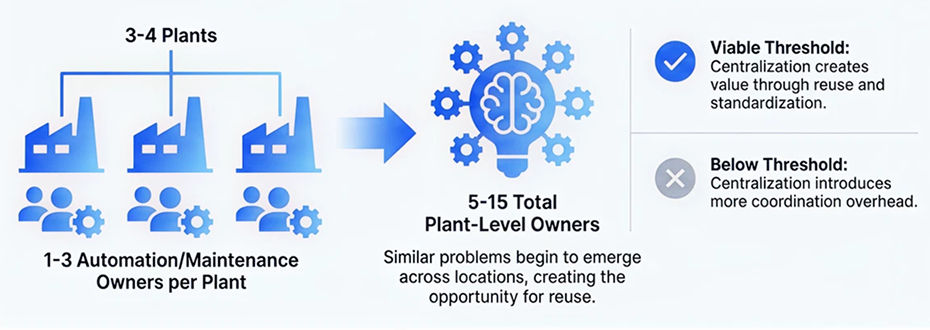
Centralization typically becomes viable when operations reach a level of repetition across sites.
In practice, this occurs when manufacturers operate a minimum of three to four plants, with each having 1 to 3 automation or maintenance owners (a total of 5 to 15 plant-level owners).
Signs for Centralization Readiness
Beyond scale, readiness is visible in operational challenges across plants.
Organizations tend to centralize when:
- Similar automation requests appear across plants.
- Project outcomes vary significantly from site to site.
- System maintenance becomes increasingly complex.
- Operator training times increase due to a lack of standardization.
Labor pressure is often an additional driver. As per the U.S. Bureau of Labor Statistics, manufacturers face over 400,000 unfilled roles, the talent pool for automation remains constrained. Consistently failing to fill automation roles at a plant level can be a strong signal to centralize and maximize your existing engineering resources.
Structuring the Centralized Team: The Three-Pillar Model
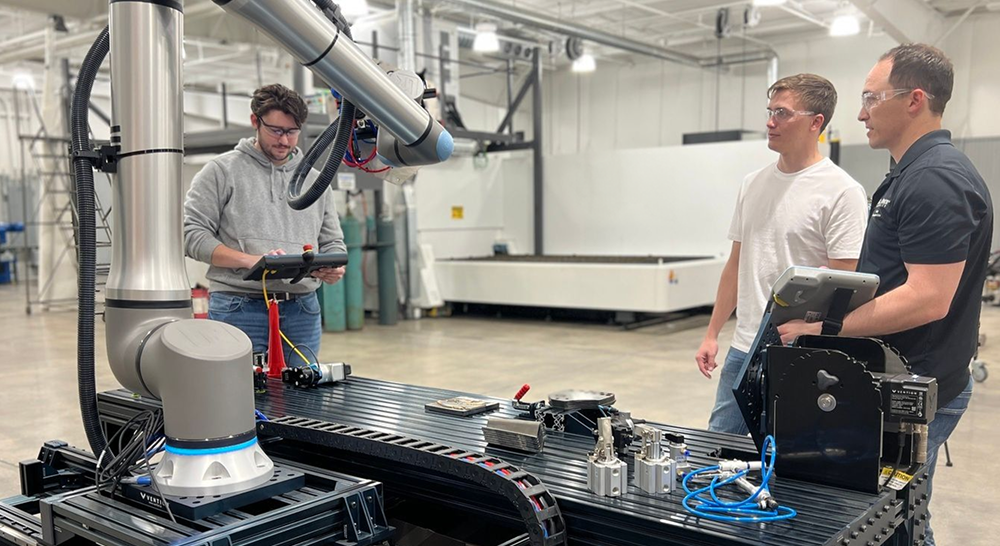
Three core competencies must be established when building a Center of Excellence for industrial automation. Together, they ensure the right balance between strategic investment decisions and consistent execution.
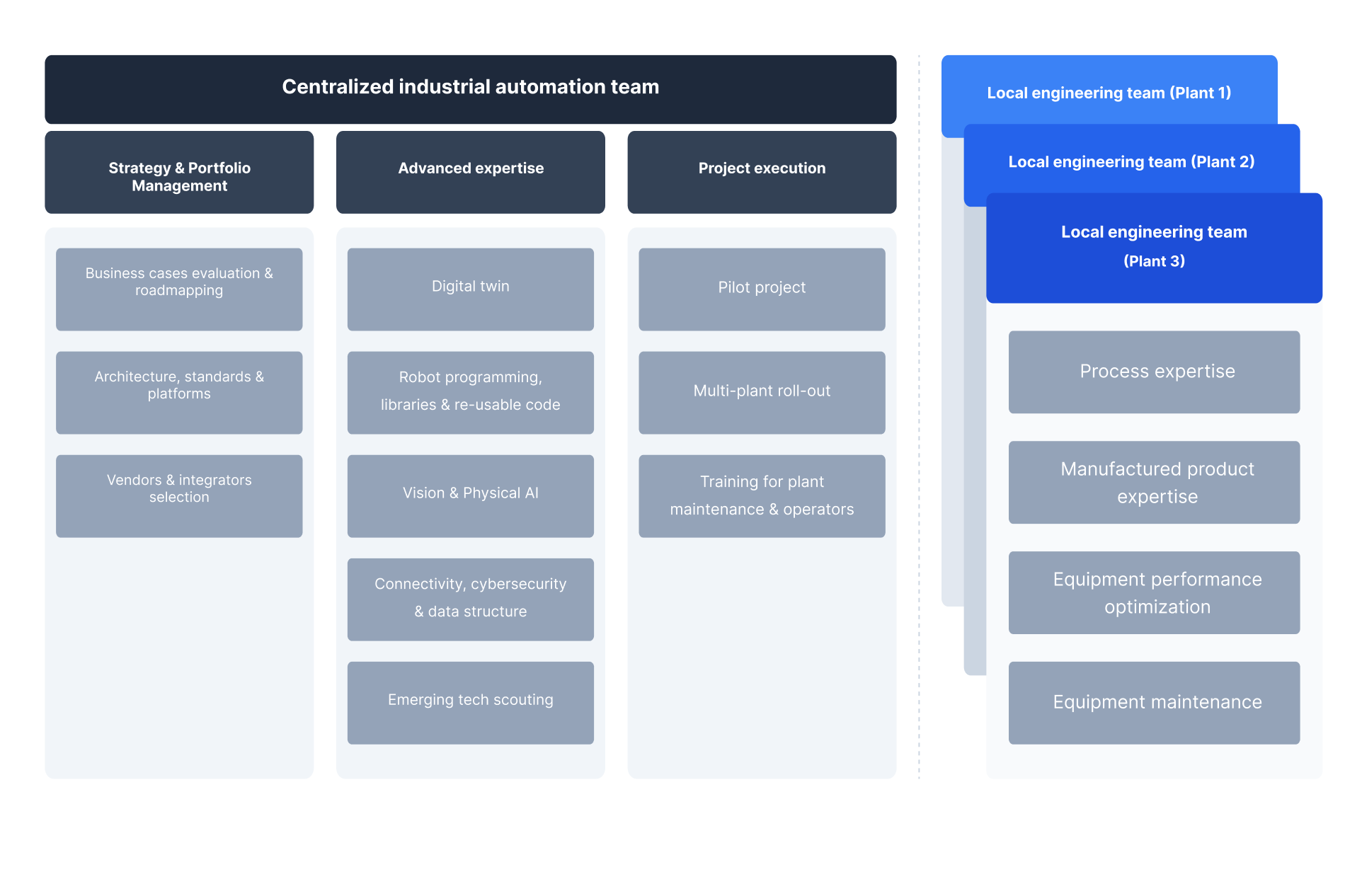
Strategy and Portfolio Management defines where to invest. This includes building enterprise-wide automation roadmaps, evaluating ROI, and selecting platforms.
Advanced Expertise concentrates technical capability across robotics, simulation, and Physical AI. The ability to validate automation centrally using digital twins plays a critical role. Next-generation manufacturers such as Solestial rely on physics-based simulation to de-risk system design before deployment, reducing commissioning time and avoiding costly rework.
Project Execution ensures delivery. It translates designs into operational systems, manages rollouts, and trains plant teams. This function is critical, as many automation failures occur not in design, but during deployment and adoption.
The interaction between these three functions enables scale, allowing manufacturers to move from isolated projects to a repeatable, ongoing automation roadmap.
Sizing the Team: The 5:1 Ratio Framework
Central automation teams should scale in proportion to automation teams at plant level. Most organizations start with a small team of three employees, one aligned to each of the three pillars covered above. As deployments increase, the team expands to support additional plants and projects.
Typically, a 10-person team represents a comfortable mid-range, while a 30-person team operates as a true automation powerhouse.
A practical benchmark for mid-size manufacturers is a 5:1 ratio between plant-level automation owners and centralized team members. This keeps the central team focused on high-leverage activities rather than becoming a bottleneck.
The Centralized-Decentralized Balance
Centralization works only when paired with strong plant-level ownership. Most organizations evolve toward a hybrid structure: They begin with a centralized team to define standards and build capability. As adoption grows, execution becomes more distributed, while the central team maintains ownership of architecture and advanced expertise.
However, specific day-to-day operations must remain at the facility level. Process expertise, manufactured product expertise, equipment performance optimization, and equipment maintenance must remain local. These are inherently tied to specific production environments.
Central teams add value by:
- Compounding learnings and preventing “reinventing the wheel”
- Defining scalable automation standards and platforms
- Supporting complex problem-solving and risk reduction
Local plant teams add value by:
- Operating and maintaining the systems
- Optimizing equipment performance for their specific product
- Sharing wins and the best practices that can be adopted as a new standard
Automation Platforms as Enablers for Centralized Teams
Technology is a crucial lever for centralization. Automation platforms accelerate the shift to common standards through a shared environment for designing, validating, programming and deploying automation. Without it, each project introduces new tools, code, and data structures, increasing complexity with every deployment. These decentralized decisions accelerate the spread of one-off standards. Establishing an enterprise-wide platform as the system of record helps eliminate this fragmentation.
Three ways automation platforms aid centralization
- Approved component libraries, design and code templates, and safety standards are embedded into the design process, ensuring consistency from the start; Replicability of design, logic makes scaling across plants easier
- Non-compliant designs are filtered out early because they cannot be validated or released within the system
- Documentation, bill of materials, and revision history follow a standardized structure, simplifying audits and future upgrades; Shared work environment improves collaboration
Taking the First Steps
Setting up a Center of Excellence turns automation into a scalable enterprise capability. Organizations that remain decentralized tend to repeat work, fragment systems, and struggle to scale. Those that centralize effectively create an environment where knowledge compounds, deployments accelerate, communication flows, and performance is consistent across all facilities.
The transition does not require a massive upfront investment. Starting with a small, focused team of three and building reusable systems is often enough to create momentum. Over time, that capability becomes a distinct competitive advantage.
***
Exploring pathways to standardize automation design, engineering and deployment? Learn how a platform-based approach helps in aligning your teams.


