When manufacturers start evaluating end-of-line packaging automation projects, the conversation almost always gravitates toward the price tag on the system itself. How much does the conveyor system cost? What about installation? The safety fencing? These are reasonable questions, but they frame the decision around the wrong number. The capital expenditure is visible and easy to compare. The cost of custom integration, and the cost of delay, is often harder to grasp, and frequently outweighs the capex. Not accounting for these factors when evaluating potential automation approaches distorts both the projected payback period and the expected return on investment.
The following scenarios and calculations help manufacturing leaders visualize what integration actually costs on a conveyor project, and explain why a one-stop-shop approach consistently delivers faster payback and lower total cost.
The Integration Tax: Why Custom Conveyor Projects Cost More Than They Should
Manufacturers don’t choose custom integration because they prefer it. Nearly half of manufacturers in a recent automation survey by IndustryWeek considered integration and lack of skilled automation workforce as their top barriers to scaling automation. Integration specialists are hard to find and retain, and new automation specialists increasingly prefer Python, making PLC programming akin to solving a rubric’s cube. So most teams default to external integration on a project-to-project basis.
Conveyor systems sit at the center of this problem. A typical end-of-line deployment connects equipment from multiple suppliers: a case erector from one vendor, a palletizer from another, conveyors and labelers from others still, with a separate integrator responsible for making all of it communicate. Each supplier brings its own control architecture and programming conventions. The integrator becomes the thread holding the system together, and when that relationship ends or key people move on, they take the tribal knowledge of how the system actually works with them. The result is an endless cycle of unclear ownership and the constant need to relearn the same lessons at additional cost.
The financial consequences of this pattern are predictable. Engineering hours accumulate across every phase: scoping, design, revisions, sourcing across multiple vendors, on-site programming, and late-stage debugging when hardware and software from different suppliers don’t behave as expected. A traditional conveyor project can span 18 to 40 weeks from order to running line, and nearly half of traditional automation projects fail to completely meet their original goals. By the time the system is generating savings, a substantial portion of the budget has already been consumed by the process of getting there.
What Conveyor Automation Actually Costs to Delay
These months-long integration timelines carry a direct financial cost that rarely appears on any quote or capital approval document. Every week the new conveyor system is not yet running is a week of labor efficiency gains that cannot be recovered. The automation budget gets approved, the project kicks off, and the clock starts ticking on costs while the savings clock stays frozen.
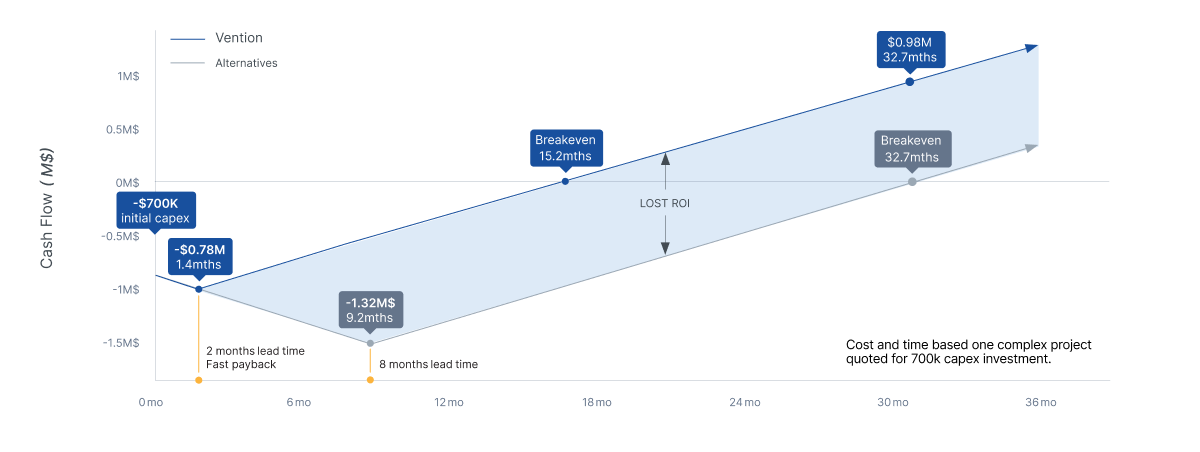
The chart below shows this gap for a complex conveyor project at $700K capex. With a traditional supplier, peak negative cash flow hits -$1.32M at the 9-month mark, and breakeven doesn’t arrive until month 33. With Vention, the curve turns positive at month 15. The shaded area between the two lines is the lost ROI of choosing a slower integration path.
Across project scales, that lost ROI is quantifiable.
- A small project ($75K to $150K capex) sees $15,000 to $30,000 or more in additional ROI from faster deployment, with Vention delivering in 1 week versus a traditional timeline of 18 weeks.
- A mid-size project ($150K to $500K capex) generates $70,000 to $140,000 or more in additional ROI, at 4 weeks versus 30.
- For complex projects above $500K, the additional ROI from deploying with Vention rather than a traditional supplier reaches $350,000 to $450,000 or more, at 6 weeks versus 40.
None of this appears on a traditional supplier’s quote. It is invisible to most capital approval processes, but it is entirely real.
How a Unified Automation Platform Changes the Calculation
Every handoff between vendors is a potential delay, a compatibility risk, and a future maintenance liability. A unified platform, on the other hand minimizes risk at every stage of the project lifecycle, not only at deployment.When design, simulation, sourcing, programming, and support all live in a single ecosystem, the handoffs that traditionally consume weeks simply disappear.
Vention’s MachineBuilder consolidates what traditional integration treats as seven separate steps into three. Design happens in a browser-based drag-and-drop environment. The digital twin validates the system before any hardware is ordered. Programming uses Python and no-code tools that a floor operator can learn in hours, and post-deployment support is available remotely within minutes from the machine pendant, compared to an industry average response time measured in days.
Benefits of the Unified Platform
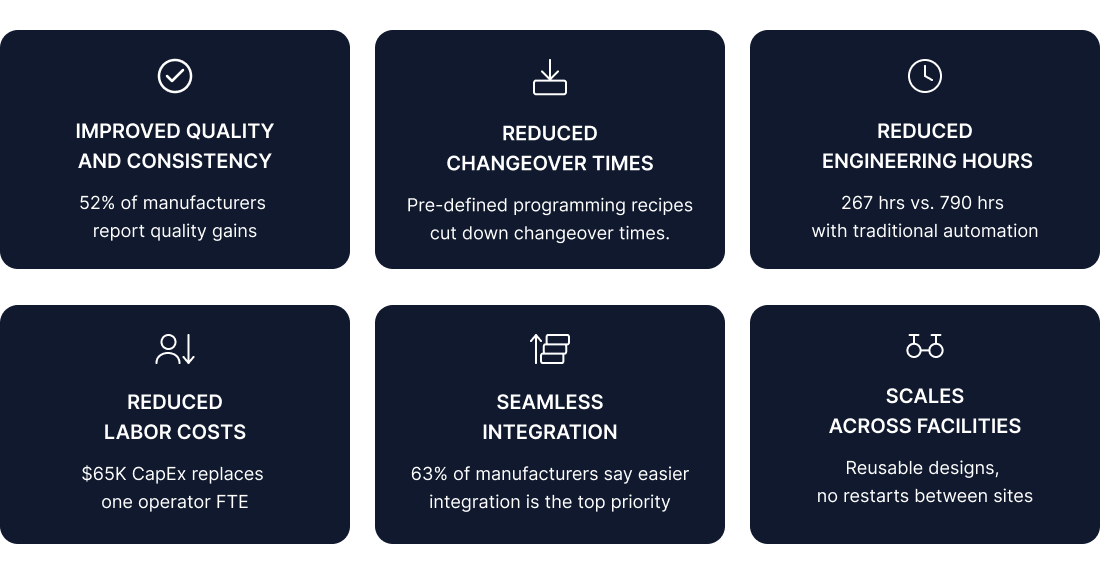
The replication advantage is where the economics diverge most sharply from custom integration. The Feed, the world’s largest sports nutrition marketplace for endurance athletes, received quotes of 40 weeks or longer from multiple providers for a conveyor system connecting two existing automation lines. Vention delivered it in 6 weeks.
How to Move Forward with Your Plan: Vention Resources
- Build the framework first. Before scoping individual projects, it helps to define what economically relevant automation actually looks like at your scale. Vention’s Enterprise Automation Transformation Guide provides a five-phase methodology.
- Talk to experts on conveyor automation. If you are unsure where to start, Vention’s application engineers have helped manufacturing operations across multiple industries scope, design, and deploy automation at scale.
- Quantify the business case for your specific operation. The numbers in this post use a conservative general estimate for costs. Read our C-Suite Guide to ROI to learn how to calculate your payback and use Vention’s ROI calculator to scope your projects.
***
Need Help Building an Automation Plan for Conveyor Systems?
You don’t have to work through the calculations alone. Talk to our specialists to quantify your project, identify the right technology, and take the first steps toward scaling automation on your line.


