Most operations leaders already know that their packaging line is yet to reach the ‘Smart Manufacturing’ stage. The harder question is where on the journey they actually stand, and what the next concrete move should be. There is clear intent to move from manual to smart operations for most leaders.
| 💡 What is Smart Manufacturing | |
|---|---|
| Smart manufacturing refers to end-of-line packaging automation environments where machines, software, and support systems share data in real time. This approach enables continuous visibility across the line, proactive maintenance, and the ability to adapt to changing conditions without stopping production. It is the operating state where teams act on real-time data rather than waiting to discover what failed. |
Deloitte’s 2025 Smart Manufacturing Survey of 600 executives found that 92% of manufacturing executives now view smart manufacturing as the primary driver of competitiveness over the next three years. The technology spending has mirrored this intent with nearly 75% of executives expecting to increase spending on smart manufacturing initiatives. But the reality today is that most operations have a significant gap between their current and desired maturity levels when it comes to smart manufacturing.
Moving from manual to smart is not a single decision or a capital event. It is a progression through four recognizable stages, each with its own symptoms, its own interventions, and its own ceiling. The manufacturers pulling ahead are not necessarily the ones spending the most. They are the ones who understand where they are in that progression and make the right architectural choices at each stage.
This article offers a framework for doing exactly that: evaluating where an operation currently sits and identifying the decisions that determine how far and how fast it can move.
Stage One: The Manual Operation and Its Ceiling

Manual operations feel manageable until external pressure arrives. The line runs on headcount, throughput rises and falls with shift size, a new SKU means retraining the team, and errors accumulate at the handoffs between workstations, largely invisible until a product reaches a customer in the wrong condition or the wrong count.
Thirty to forty percent of unplanned production delays trace back to internal logistics failures, including late line feeding, congestion, and sequencing mismatches between workstations, rather than machine breakdowns. The coordination between stations that depends entirely on people being in the right place at the right time is the true bottleneck on a manual floor.
The move at this stage is not wholesale automation but identifying the one or two points where throughput is most constrained by manual coordination. A targeted factory walk helps reveal these opportunities while keeping enough flexibility to absorb the SKU variation and format changes that are already arriving. Palletizing is the most common starting point because the task is physically repetitive, injury-prone, and straightforward to scope without disrupting the rest of the line.
The signal that a manual operation has reached its ceiling usually arrives as a product variant that stresses the entire line, revealing that headcount has become the only remaining lever and that lever no longer moves fast enough.
Stage Two: The Semi-Automated Trap

The natural first response to a manual ceiling is point automation: a palletizer added at the end of the line, a case packer installed at one station, a conveyor segment stitching two cells together. Each investment solves the problem it was purchased to solve, but the cumulative result across most mid-market manufacturing floors is a fragmented line where automated islands sit alongside manual operations, none of them designed to communicate, coordinate, or share a common data layer.
This is the semi-automated trap, and it is where a large portion of the industry currently sits. One-third of automation systems fail to perform as expected after deployment, with changing-scope identified as one of the drivers. Most point automation purchases are scoped around the individual machine, not the line it joins, and what performs well in isolation creates friction at every handoff.
Beyond the single deployment, the integration imperative adds countless hours in translation code required to make multi-vendor systems communicate. This cost takes a share of the payoff from each subsequent deployment. Every format modification, and every time the line needs to adapt to a new product configuration adds to this cost. Operations leaders who believed they bought automation frequently discover they also purchased an ongoing dependency on the specialists who built it.
The manufacturers who move to the next stage stop asking whether a task can be automated and start asking whether the automation connects cleanly to what sits upstream and downstream of it.
Stage Three: The Connected Line and What It Actually Delivers

A connected line is not the same thing as an automated one, and the distinction matters more than most automation purchasing conversations acknowledge. Automation replaces labor at individual tasks; connection creates visibility across the whole operation, and without that visibility, a throughput improvement in one area creates pressure somewhere else. For example, a case packer running faster than the sealer ahead of it produces congestion that operators absorb manually, offsetting the productivity gain the capital investment was meant to deliver.
The data on what connectivity actually delivers is consistent across a range of sources. The average manufacturer still absorbs roughly 800 hours of unplanned equipment downtime per year, at a cost of $10,000 to $100,000 per hour in continuous production environments. IoT-enabled predictive maintenance reduces unplanned downtime by 35 to 50% and increases overall equipment effectiveness by 20 to 25%. Forty-three percent of packaging operations have already deployed predictive maintenance technology on their lines, and 83% are actively considering it. What was an advanced capability associated with large-scale operations in 2020 has become a baseline expectation for operations leaders in 2026.
A connected line also changes the support model in ways that compound over time. When every machine surfaces its operating state in real time, a remote engineering team can diagnose a fault in minutes rather than waiting for a technician to clear a schedule and travel on-site. A historical log of performance data takes this further: teams can identify drift patterns before they become failures, and shift maintenance intervals from fixed schedules to actual usage. The question on the floor shifts from what broke to what is about to underperform, and expert support can reach the problem before it becomes a production stoppage.
The transition to a connected operation does not require replacing everything currently on the floor. It requires that the systems already there share data without custom translation work at each interface, and that the operators running the line can act on that data without waiting for a specialist to interpret it for them.
That last point is also the limit of what this stage can deliver: visibility without adaptability gets teams to the diagnostic, but not to the fix.
When controls are locked behind proprietary logic, real-time data becomes a dashboard rather than a lever, and the gains from connection stay partial.
Stage Four: Smart Manufacturing and How to Get There
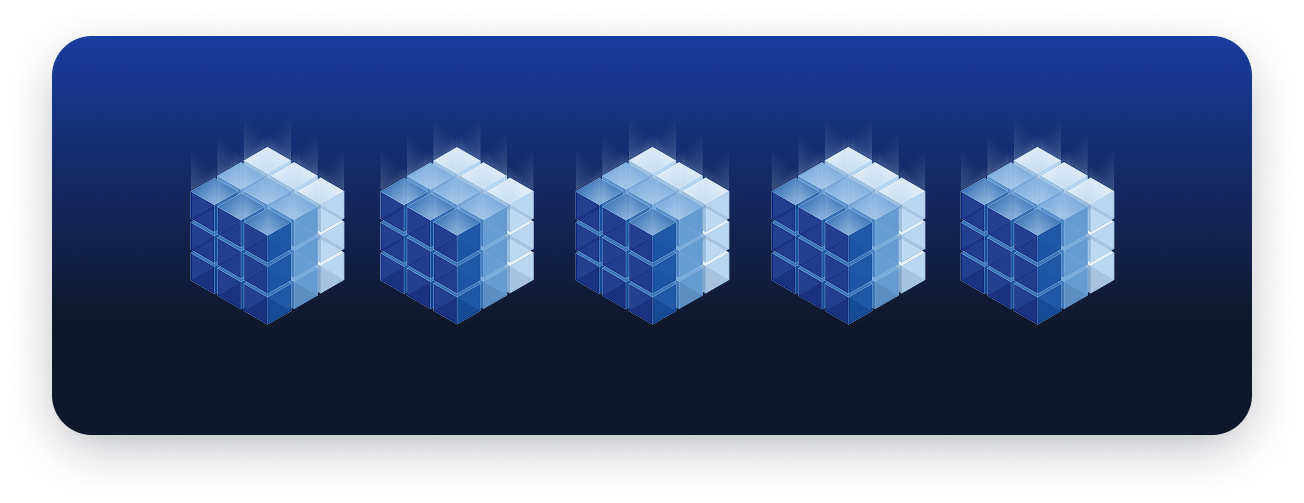
Smart manufacturing is the final stage and represents complete platformization of operations, powered by the technology stack that makes it systemic. A plant operating at this stage runs on real-time data, absorbs variation without stopping production, adapts controls and configurations with minimal specialist involvement, and surfaces performance problems early enough to resolve them before they cascade. The question that defines this stage is not what broke and why, but what is underperforming, by how much, and what the data says to do about it.
Investment is clearly moving in this direction, but execution is where most plants stall. Eighty percent of manufacturing executives plan to allocate 20% or more of improvement budgets to smart manufacturing initiatives, and comprehensive automation programs typically deliver payback within 12 to 18 months when the business case is built on accurate baselines. Yet only about one-third of organizations have scaled AI enterprise-wide despite using it in isolated functions, a pattern that mirrors adoption gaps in connected manufacturing more broadly.
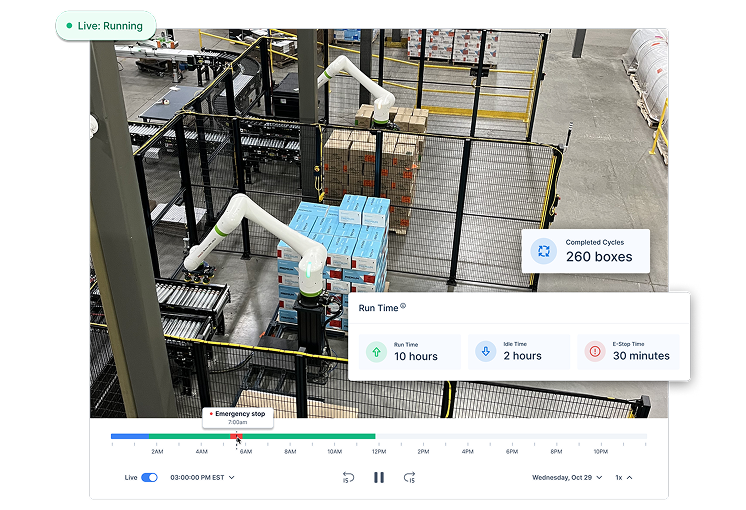
The manufacturers who reach and sustain the smart manufacturing stage share a common base: their equipment was built to share data without custom translation work at each interface, with hardware, software, and support designed to travel together. Controls are accessible to the people who run the line every day, not only to the specialists who configured it on day one. When a product mix changes or a format is added, the system adapts without an external team rebuilding the logic. And because that architecture replicates cleanly across lines and facilities, the investment compounds rather than restarts with each new project.
The Architecture Decision That Sets the Ceiling
Every stage of this progression is reachable from wherever a plant currently sits, and the distance between manual and smart is not measured in years of effort or capital intensity alone. It is measured, more precisely, in the quality of the architectural decisions made at each step along the way. A palletizer purchased in isolation to solve a labor problem at the end of the line becomes a barrier to the connected operation that comes next. A conveyor system built on proprietary controls becomes a dependency that slows every subsequent expansion. The ceiling at each stage is set by the decisions made about how that technology connects to everything else.
The manufacturers moving fastest towards smart manufacturing are building on platforms designed for integration from the start, where hardware, software, and support work together without a translation layer, where the line stays readable and adjustable by the team that runs it, and where each investment opens the path to the next stage rather than narrowing it.
***
Talk to a Vention automation expert for a no-obligation design review, online, in a day.