Palletizing is one of the toughest, most injury-prone tasks in manufacturing. The repetitive nature often leads to high worker turnover, production delays, and added operational challenges. That’s why robotic palletizing frequently tops the list of automation priorities. Robotic palletizers solve these challenges with consistent, “push-button” performance that reduces injuries, relieves labor pressure, and cuts operational costs. However, from choosing the right robotic palletizer to setting realistic ROI expectations, there are many questions that need to be answered first.
Here are the top 10 questions manufacturers ask about robotic palletizers, along with the answers to help you get started.
1. What types of products can robotic palletizers handle, and can they manage multiple SKUs?
Diverse Product Handling: Robotic palletizers offer significantly more versatility than traditional palletizing systems, which are typically optimized for single-SKU operations. Modern robotic palletizers, such as Vention’s Rapid Series, can handle diverse product types and materials including boxes, bags, pails, and more.
Multiple SKU Capacity: Advanced robotic palletizing systems excel at handling multiple SKUs with fast changeovers and operational versatility. Vention’s Rapid Series for example, can help create unlimited SKUs and palletizing recipes. Generally, a “2-in/2-out” palletizer configuration can assign separate lines for two different SKUs simultaneously. For operations requiring more than two SKUs, systems can utilize barcode scanners or vision systems to dynamically identify and handle different packages.
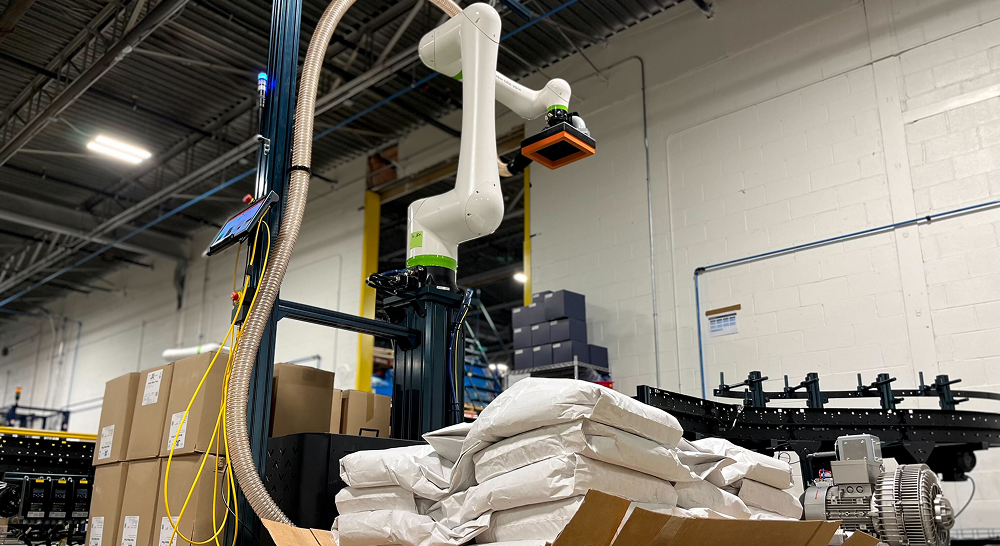
2. What are the most common types of robotic palletizing systems?
There are many variations for robotic palletizers, optimized for specific use cases. Here are some of the most common robotic palletizing systems and their common use cases that you can consider:
Single In-Line Robot Palletizer: This type of setup uses one robotic system to handle picking, placing, slip sheet dispensing, and pallet dispensing across multiple production lines and SKUs. Single-line robot palletizers such as Vention’s Rapid Series offer excellent flexibility and lower throughput compared to specialized configurations.
Layer-Forming Robot Palletizers: These systems employ multiple robots to significantly increase throughput. One palletizing robot assembles product layers while another stacks completed layers onto pallets. Hybrid configurations are also possible that can combine traditional layer-forming palletizers with collaborative robots for stacking operations.
Cartesian Palletizer: Operating on X, Y, and Z axes, this configuration handles uniform products and heavier payloads effectively. Cartesian palletizers provide a cost-effective solution for simpler, lower-throughput operations requiring precise positioning.
Gantry Palletizers: These systems move along one horizontal axis and can manage heavier loads than Cartesian models due to their robust mechanical design. They’re ideal for applications requiring large payload capacity and stability, though typically operate at slower speeds.
7th Axis Palletizers: By incorporating an additional axis of movement, these collaborative robot palletizers provide extended reach and greater flexibility. They are particularly effective in confined spaces, for slower throughput requirements, and for applications that require taller stacking configurations.
3. What throughput can robotic palletizers achieve?
Throughput varies significantly based on robot type and gripper configuration:
- Cobot Palletizers : Best suited for low-to-medium throughput applications, achieving up to 13 picks per minute or over 20 boxes per minute with multi-pick grippers.
- Industrial Robots: Can achieve higher throughput rates with appropriate gripper and conveyor integration.
- Large Industrial Palletizers: High-capacity systems capable of handling complete pallet loads within one minute, suitable for very high-volume operations.
***
Download All Ten FAQs for Robotic Palletizing
Want to get a shareable version of our robotic palletizing FAQs? Download the expert guide to get answers to the top ten questions.


