From Concept to Conveyors in 6 Months: Join us for an exclusive webinar to learn how manufacturers can go from concept to fully deployed conveyor systems in weeks instead of months. Register Now
An industrial conveyor system is the backbone of modern material handling, serving as a critical tool to transport goods safely and efficiently across a facility. Most market estimates expect the global automated material handling equipment market to grow by 10% by 2033, and conveyors play a crucial role in this. As manufacturers and logistics providers redesign their facilities for higher throughput and greater flexibility, selecting the right conveyors and conveying systems has become a critical factor in eliminating operational bottlenecks.
Today, industrial conveyors and conveying system solutions range from simple unpowered gravity rollers to complex automated frameworks that dictate the speed and efficiency of entire warehouses. When designing your facility layout, selecting the right conveyors and conveying systems is essential for maximizing throughput and minimizing operational bottlenecks.
Historically, deploying conveying systems took months of custom engineering, but modern facilities require far greater agility. Manufacturers now need plug-and-play conveyor systems that integrate seamlessly into existing operations, allowing entire production lines to be deployed in weeks rather than months.
In this guide, we explore the most common types of industrial conveyors, the applications they support, and the key considerations for selecting the right conveying system for your facility.
Primary Types of Conveyor Systems
1. Timing Belt Conveyors
Belt conveyors are the most common type of transport mechanism used in industrial automation. They are highly versatile and are the best option for moving irregular items or facilitating precise positioning and synchronized movement along an assembly line. Designing these systems has never been easier. On the other hand, in our video tutorial on designing a belt conveyor, users learn how to quickly add a conveyor module, design a custom base frame using T-Slot aluminum extrusions, and seamlessly add automation components.
What Modular Belt Conveyors Can Be Used For
- Single Pallet Conveyance: Belt conveyors are ideal for creating a small pallet system to transport parts with specific referenced points, making them highly effective for robotic applications and precision tasks.
- Assembly Line Integration: They are perfect for building full assembly lines that integrate conveyors with other applications, including the addition of 90-degree angled turns.
- Small Product Conveyance: A single timing belt conveyor can be utilized as a simple, effective solution to move smaller products.
- Large Material Handling: You can configure several timing belts together to create a larger, highly cost-effective solution for conveying large products.
Explore Vention’s Belt Conveyors to see how timing belts can elevate your operations.
2. Roller Conveyors
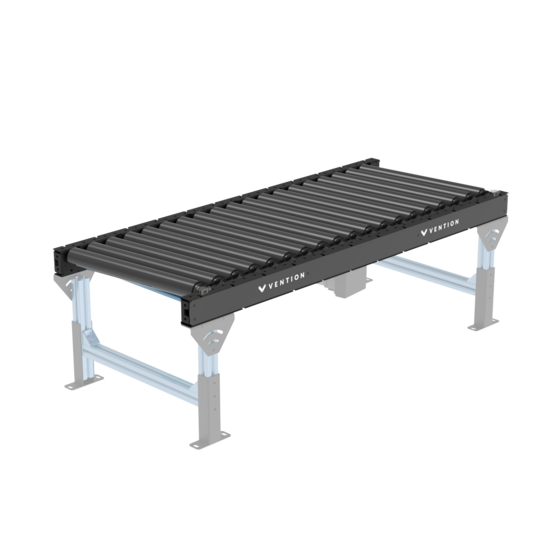
Roller conveyors are essential for moving boxes, totes, and pallets. It is important to differentiate between standard unpowered gravity rollers and advanced motorized versions. Both options are available on Vention’s marketplace. The Unpowered Straight O-Ring Conveyor, for instance, can be used as a gravity conveyor across applications. Powered roller conveyors, specifically Poly-V and O-Ring variations, arrive pre-assembled and are seamlessly controlled by our MachineMotion AI. These modular systems are available in precise industry-standard between-frame widths of 405 mm, 585 mm, and 945 mm. It’s also possible to customize width although the pricing and lead time may vary.
Explore Vention’s Roller Conveyors to find configurations that match your facility’s specific demands. Vention also offers specialized shapes like the 45-degree curved roller conveyor section and advanced skewed sections designed to shift boxes laterally for precise staging. Capable of speeds ranging from 150 mm/s to 773.5mm/s, these systems keep your production moving at the exact pace your automation requires.
Specialized & Custom Conveyor Solutions
1. Accumulating Conveyors
Accumulating conveyors are engineered to stage products safely without causing damage. Vention’s O-Ring conveyors utilize zero-pressure accumulation technology, ensuring items do not touch one another while being sequenced for the next stage of production. Each section is divided into distinct zones, with each zone powered by its own dedicated motor and capable of handling up to 40 kg.

This technology is transformative for high-volume environments. A perfect example is The Feed, a sports nutrition marketplace that needed to process thousands of daily orders. By utilizing Vention’s zero-pressure O-Ring accumulating conveyors, The Feed successfully deployed a custom warehouse logistics solution that allows them to process over 600 orders per hour, fulfilling more than 5,000 orders daily while reallocating 15 workers to higher-value tasks.
2. Heavy Duty Applications
When moving substantial loads, standard systems will not suffice. You need heavy duty roller conveyor systems designed specifically to handle heavy products and dense packaging. Vention’s Poly-V conveyors are built for this exact purpose. By utilizing grooved strips for higher resistance power, they safely support a maximum payload of up to 100 kg per section.
According to the Conveyor Equipment Manufacturers Association (CEMA), which tracks industry statistics across both unit handling and bulk conveying sectors, heavy-duty applications represent a critical segment with orders totaling billions annually. This makes them an ideal use case for heavy industrial manufacturing.
3. Custom Conveyors
Every manufacturing environment is unique, and standard off-the-shelf conveyor systems do not always meet the specific requirements of a production line. Platform-based custom conveyors provide the flexibility needed to design a conveying system that matches the exact workflow of a facility. By leveraging Vention’s unified structural extrusion ecosystem, manufacturers can configure conveyor systems with components such as:
- Adjustable conveyor legs with height and angle brackets
- Belt conveyors or roller conveyors for different product types and flow requirements
- 90-degree product transfer modules for directional changes
- Pneumatic pushers for automated product routing
- Flexible guardrails to guide products safely through the conveying system
Custom conveyors are particularly valuable for end-of-line integration where packaging, sorting, and palletizing operations must work seamlessly together. McAlpine & Co. Ltd leveraged Vention’s modular automation ecosystem to deploy a fully automated case packing cell built around a custom conveyors and conveying system. By combining configurable conveyors with a UR10e cobot and Vention’s MachineMotion controller, the company eliminated manual labor at the final stage of production. The system manages six different products across four box sizes while exceeding the target throughput of 7.2 picks per minute and operating reliably on a 24/5 production schedule.
Industrial Conveyor Selection Quick Guide
| Conveyor Type | Best Used For | Vention Payload Spec | Key Advantage |
|---|---|---|---|
| Timing Belt | Irregular items, precise positioning, cobot cells | Continuous flow | Synchronized movement; prevents tracking issues |
| Gravity Roller | Low-cost transport, manual push lines, declines | Dependent on incline/operator | No power required; easily modular |
| Powered Roller (O-Ring) | Standard boxes, totes, lightweight packaging | Up to 40 kg per section | Cost-effective motorized transport |
| Heavy-Duty Roller (Poly-V) | Heavy industrial goods, dense packaging, transformer assembly | Up to 100 kg per section | Grooved strips for high-torque, slip-free transmission |
| Accumulating (ZPA) | Buffering, sortation, staging for palletizers | 40 kg per zone | Smart zone logic; zero-pressure staging without complex PLCs |
| Custom / Transfers | 90-degree routing, lateral shifts, end-of-line packaging | Fully customizable | Integrates pneumatic pushers and curved/skewed sections natively |
End-to-End Automation & End-of-Line Systems
A conveyor system rarely exists in isolation. It is typically part of a broader automation strategy. Automating end-of-line systems often requires stitching together equipment from multiple vendors, which forces manufacturers to rely heavily on third-party integrators. This disjointed approach increases compatibility risks and drives up the total cost of ownership.
Vention solves this by offering a unified factory-wide automation platform. Unlike traditional project-based deployment, Vention’s conveyors connect flawlessly to our Rapid Series Palletizer and Adaptive Case Packer solutions. Using a single plug-and-play ecosystem, products can move from case erectors to Poly-V transport conveyors, into zero-pressure O-Ring staging zones, and finally to robotic palletizers without any complex third-party PLC programming. Everything can be synchronized through MachineMotion AI. This cohesive environment means that operations teams can plug in, program, and ship fully integrated lines in days, not weeks or months.
Download brochure to learn more about automating the entire end of line with Vention.
How to Choose the Right Conveyor System
Selecting the right conveyor system requires evaluating several key factors, including the type of products being transported, required throughput, facility layout, and integration with upstream and downstream equipment. Careful planning of conveyor paths, transfer points, and workstation interfaces is essential to ensure smooth material flow. Taking a structured approach to these decisions helps ensure the selected conveyor system supports operational efficiency, minimizes bottlenecks, and scales with future production needs.
Technical, Facility, and Operational Needs
- Load Capacity: You must correctly match the conveyor to the weight and rigidity of your products. For delicate tote management or standard cardboard boxes, Vention’s zero-pressure O-Ring zones safely handle up to 40 kg per zone. However, heavy industrial manufacturing requires heavy duty roller conveyor systems. High-payload Poly-V sections can safely support up to 100 kg per section.
- Incline Physics: You must also consider elevation changes, as a 10-degree incline on a powered roller conveyor reduces the maximum load capacity to 15 kg per zone. When calculating the drive force required for an incline, you must account for the load’s weight acting against gravity plus the rolling resistance of the specific rollers used—making motor torque specifications just as critical as your payload weight.
- Speed Requirements: Your production pace dictates your motor choices. Vention’s motorized roller systems offer controllable speeds ranging from a precise 150 mm/s up to a rapid 450 mm/s. This control ensures items reach the next robotic cell at the exact pace your automation logic requires.
- Facility Environment: The physical setting heavily influences hardware choices. Washdown environments need specialized materials like stainless steel mesh. Clean environments handling light goods are well-suited for standard PVC or PVU belt conveyors.
- System Dimensions: It is critical to account for your minimum and maximum product sizes; for instance, Vention’s motorized roller conveyors require a minimum box length of 160 mm to ensure stable transport across the system’s 78.75 mm roller pitch. To accommodate larger packages and totes, these modular roller systems are available in precise industry-standard between-frame widths of 405 mm, 585 mm, and 945 mm, with standard segment lengths of 630 mm or 1575 mm. If your operation requires a highly unique fit, Vention’s timing belt conveyors allow you to fully customize the exact length, width, and height of the system using a library of modular components
Need help to evaluate your automation needs? Consult Vention’s team to plan your conveyor system.
Designing the Conveyor System
Historically, designing a custom automated line required weeks of back-and-forth with third-party integrators. Today, designing your system is highly streamlined. Using cloud-based 3D design platforms like Vention’s MachineBuilder, you can build your entire material handling solution in your web browser, and re-use it as needed. For example, Sears Seating not only cut their OPEX by 20% but also built a library of re-usable conveyor system designs to scale up future deployments.
The actual process of designing in MachineBuilder is very intuitive. The built-in conveyor configurator tool allows instant design with auto-complete features for parts selection.
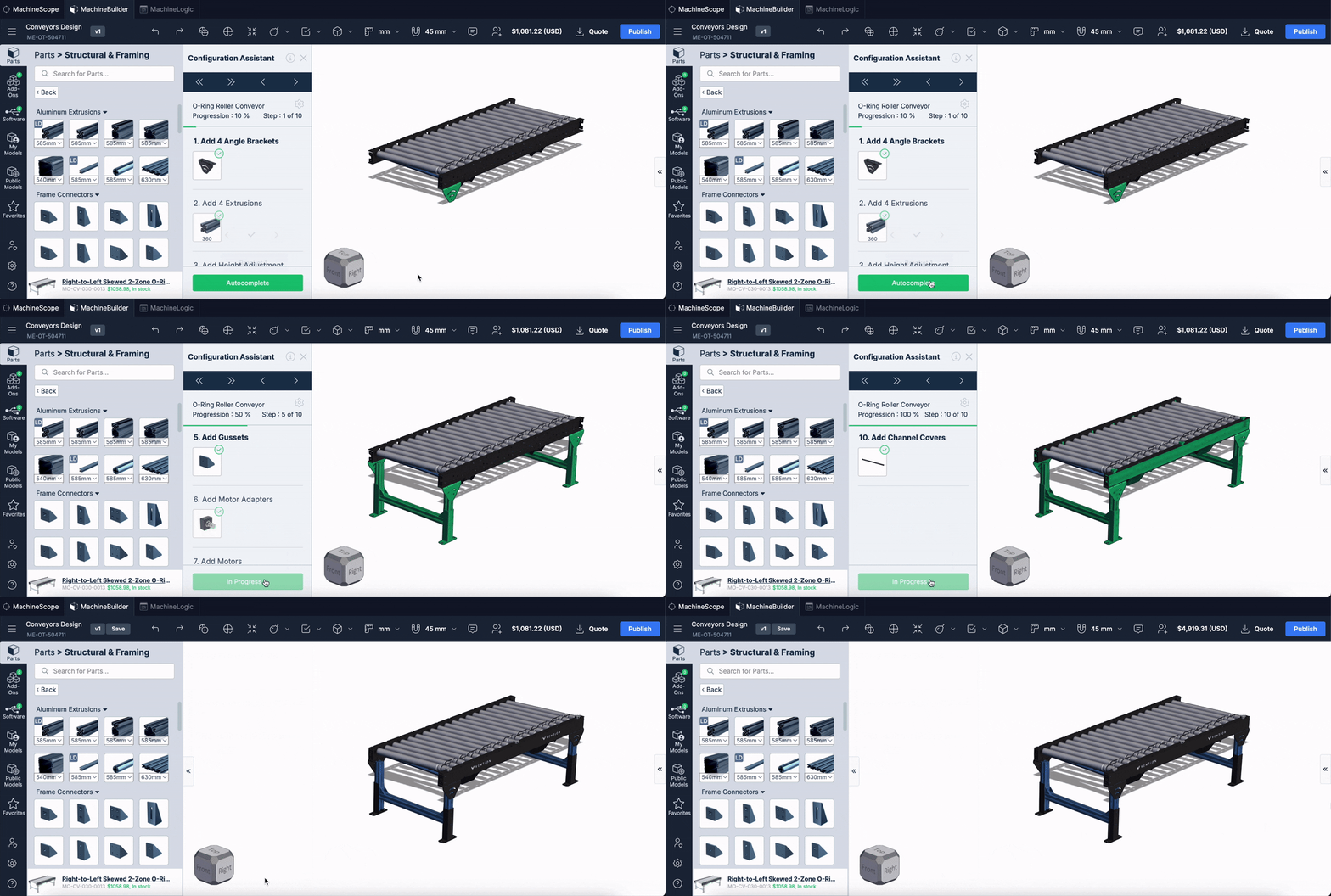
Manually designing in MachineBuilder is equally easy. You can quickly design a custom base frame using modular T-Slot aluminum extrusions, drop in pre-assembled conveyor modules, and seamlessly add automation components like sensors and pushers with the built-in AI validation from the design assistant. The platform also provides a clear visualization of the exact footprint and generates an instant bill of materials.
See the video below to start designing your conveyor ecosystem with Vention.
Simulating Conveyors to Validate Design
The absolute best way to choose the right system is to simulate it first. A digital twin allows you to thoroughly test and ensure the system is working before spending any money on physical hardware. By utilizing MachineLogic’s Physics Engine, you can create a highly realistic virtual environment to configure dynamic parameters like box insertion rates, dimensions, weight control, and part placement.
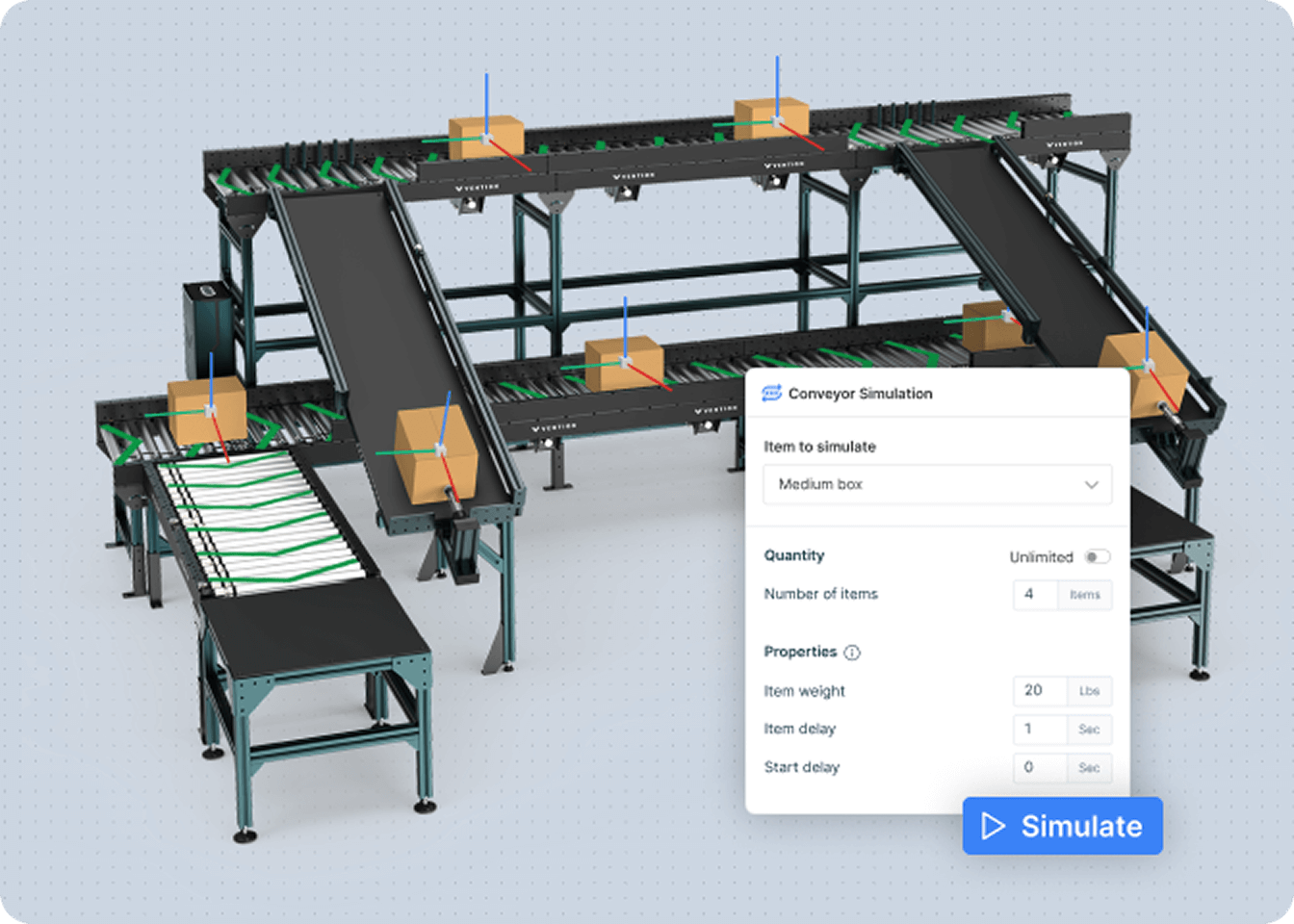
When The Feed needed a custom warehouse logistics solution, instead of relying on guesswork they created a 3D digital twin of their design and simulated their complex conveying logic in the cloud. This allowed them to test product specifications, debug program behavior, and verify throughput entirely virtually. Because they simulated first, they were able to deploy a fully operational custom conveyor system in just 6 weeks.
Conveyor Belt Automation and Code-free Operations
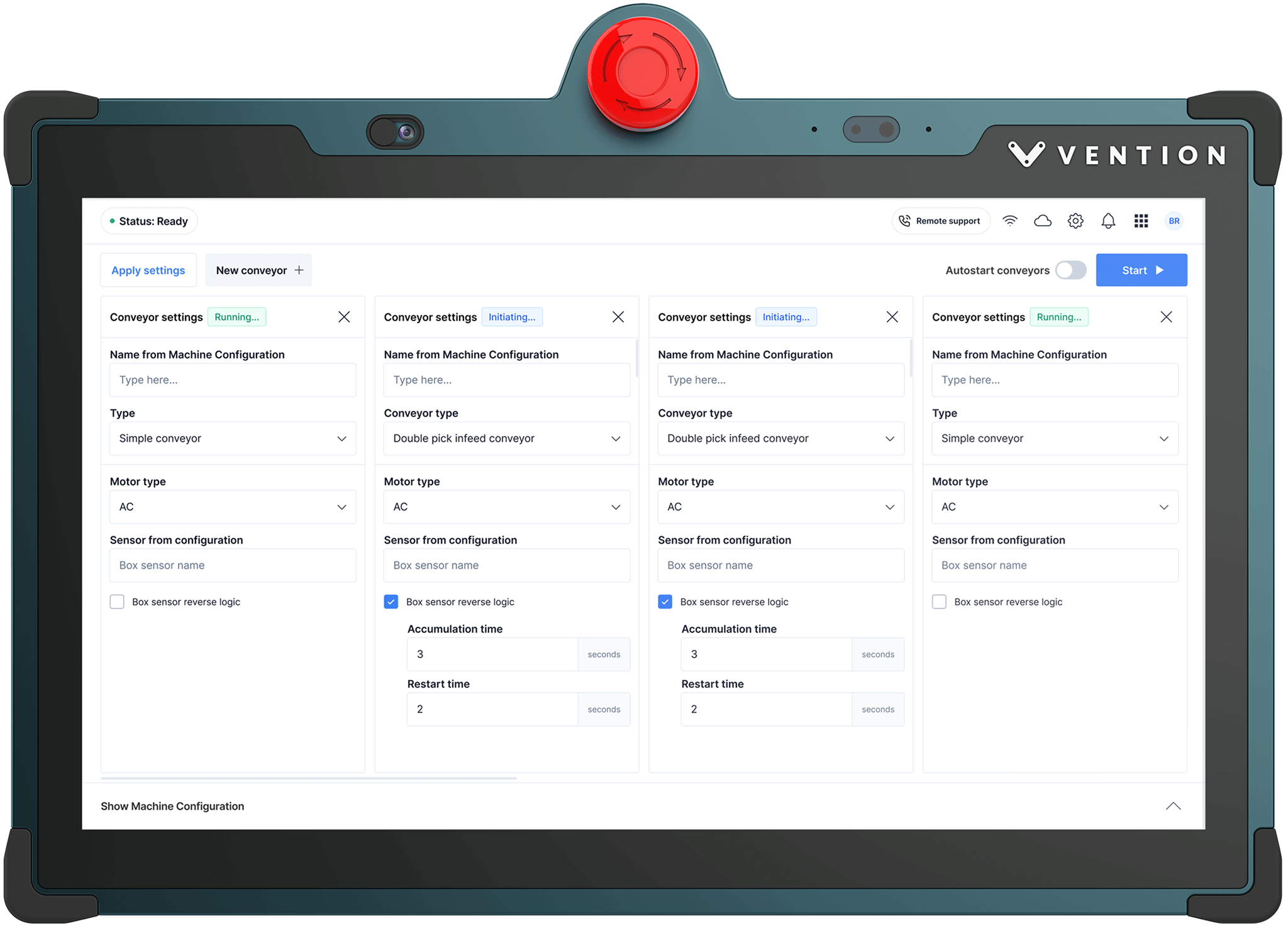
Traditional conveyor automation often requires specialized PLC programmers, complex ladder logic, and weeks of tedious integration. Vention eliminates this bottleneck by offering an entirely code-free programming environment. By utilizing MachineLogic and the dedicated Conveyor MachineApp, operators can deploy and manage their material handling systems through a highly intuitive user interface. It’s also easy to maintain, support and modify the system with no need for external integration experts.
Because the entire ecosystem is unified under the MachineMotion AI controller, configuring your automation is incredibly straightforward. Maintenance teams and floor operators can easily set up complex sensor logic, adjust variable motor speeds, and define zero-pressure accumulation zones without writing a single line of code.
For highly variable end-of-line systems, this intuitive software even allows users to configure an unlimited number of SKUs and create intricate pallet recipes in just minutes. This completely code-free approach empowers your in-house team to take full control of your conveyor belt automation, drastically reducing deployment times and eliminating the ongoing need for expensive third-party software integrators.
Frequently Asked Questions About Conveyor Systems (FAQs)
Can I build my own conveyor?
Yes you can always build your own conveyors, however industrial safety and reliable continuous throughput require professional manufacturing. Vention bridges this gap by providing easy, tool-light assembly that your in-house maintenance or engineering teams can handle safely. Since the components arrive pre-assembled and feature plug-and-play wiring, you get the reliability of industrial-grade hardware with the flexibility and cost savings of a self-deployed system.
What is an extruded aluminum conveyor?
An extruded aluminum conveyor uses a structural framework built from T-slot aluminum profiles, focusing on modularity and lightweight design. This allows the conveyor to be easily reconfigured, scaled, or upgraded over time. Vention’s entire conveyor ecosystem mounts seamlessly to these extrusions, ensuring perfect mechanical alignment across your assembly line.
How fast can a custom automated conveyor system be deployed?
Traditional integrators often quote lead times of over 3-4 months for customized conveying solutions. With Vention’s standardized, modular ecosystem alongside cloud-based design software, custom systems can be fully designed, programmed, and deployed in a week. Vention also offers greater flexibility to purchase conveyors turnkey (designed, programmed, deployed with experts), partial turnkey or self-deploy.
Vention provides flexible purchasing options for conveyors: choose a turnkey solution (designed, programmed, and deployed with expert assistance), a partial turnkey approach, or self-deploy the system.
Do I need to know how to code to program the automation?
No. Vention’s MachineLogic software and the dedicated Conveyor MachineApp offer an intuitive, code-free programming environment. Operators can easily configure sensor logic, establish pallet recipes, and set motor speeds directly from a digital interface without writing a single line of complex code.
Can an industrial conveyor system run 24/7 without maintenance?
As many experienced maintenance engineers will note, no machine runs 24/7 indefinitely without some form of planned upkeep. The secret to maximizing uptime for continuous operations is investing in modular conveyor platforms. Vention’s plug-and-play ecosystem allows for incredibly fast swap-outs of sections without the need for complex re-engineering.
How do you fix conveyor belt tracking issues and keep belts from tracking?
Belt tracking is a notorious headache in material handling, often caused by out-of-square rollers or uneven frames. Instead of constantly adjusting torque, you need a mechanically sound foundation. Vention systems are built on rigid T-slot extruded aluminum frames, guaranteeing perfect mechanical alignment. Utilizing our precision timing belt conveyors provides synchronized movement that naturally mitigates tracking nightmares.
How do I manage a complex conveyor layout without creating “sensor chaos”?
Routing products to multiple destinations can quickly lead to a tangled mess of wiring and complex PLC logic. The most effective solution is utilizing smart zone logic. Vention’s accumulating conveyors divide your line into distinct motorized zones. Our conveyor motors feature built-in sensors that run on EtherCAT to ensure zero latency, instant response and precision.
Why should I choose a modular conveyor platform over a traditional fixed system?
Traditional fixed systems become a massive liability if your throughput needs change, your facility layout shifts, or a section gets damaged. Modular conveyor platforms offer superior component quality and design standardization. With Vention, if you need to add a 90-degree product transfer module or replace a damaged roller conveyor section, you can simply unbolt the old module and plug in the new one.
***
Ready to build your custom conveying solution?
Talk to a Vention specialist today!


