As we close out the first quarter of 2026, the pace of innovation in Physical AI continues to accelerate. For manufacturers shaping their strategies for the year, Q1 reinforces two clear themes: scalable automation platforms are becoming a core competitive advantage, and Physical AI is transitioning into reliable, production-ready systems. Q1 also marked a significant milestone for Vention, with a $110M USD funding announcement and the commercial launch of Rapid Operator AI.
Below are the key highlights from the past quarter and what they signal for the near future of manufacturing automation.
Vention Raises $110M to Bridge the Automation Gap
60% of manufacturers delay automation initiatives as per The Automation Imperative report by Vention & Industry Week. The integration burden, need for the specialized expertise, and the risk of deployment failures creates an automation gap for the industry already under pressure due to labor shortages. In January, Vention announced a $110M USD ($150M CAD) funding round to address this gap and accelerate the development and global deployment of its AI-powered automation platform for manufacturing. The new capital will accelerate development of Physical AI, enabling robots and machines to perceive, adapt, and perform complex tasks with less custom programming and fewer fixtures.
This funding round includes leading institutional and strategic investors such as Investissement Québec, NVentures (NVIDIA’s venture arm), Desjardins Capital, and Fidelity Investments Canada, reinforcing confidence in Vention’s technology and global growth trajectory.
The investment validates a major shift in manufacturing automation, as companies move away from fragmented, one-off automation projects toward standardized, scalable platforms. Manufacturers are adopting Vention to deploy automation up to 6–8× faster than traditional approaches, enabling production systems to be designed and launched in days instead of months.
Production-Ready Physical AI: The Launch of Rapid Operator AI and GRIIP
Physical AI has reached an inflection point, shifting from isolated breakthroughs in labs to production-ready deployment. What is changing is not only model capability, but how these systems are built, packaged, and scaled across real manufacturing environments.
Against this backdrop, Vention introduced two foundational products that make Physical AI deployable at scale: the Generalized Robotic Intelligence Pipeline (GRIIP) and Rapid Operator AI.
Generalized Robotic Intelligence Pipeline
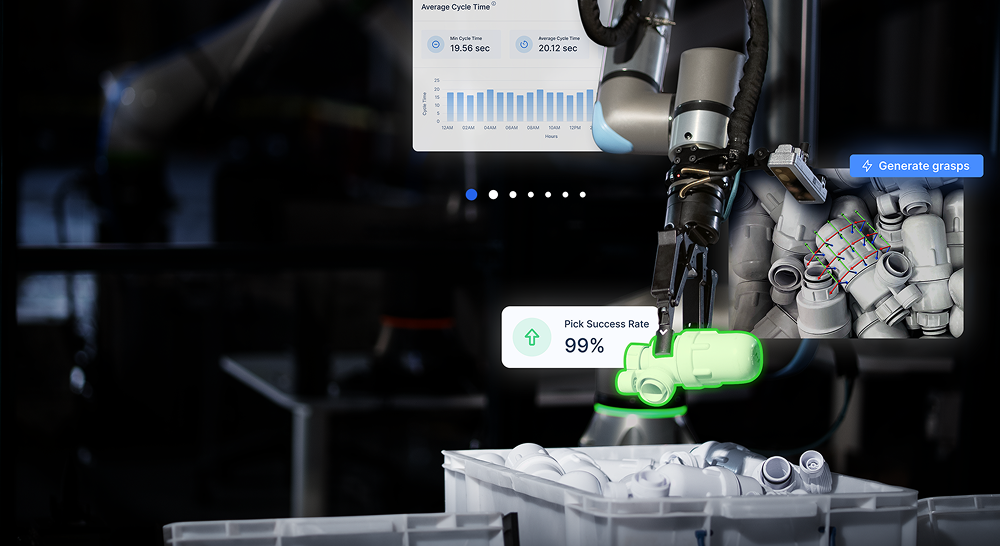
GRIIP™ introduces a new approach to building intelligent robotic systems, shifting from task-specific automation to generalized robotic intelligence.
By bringing together perception, grasp intelligence, pose estimation, and motion planning into a unified, production-ready pipeline, it enables robot cells to adapt to real-world conditions without manual configuration. This significantly reduces deployment effort while enabling faster time to production without the need for custom AI models or training data.
GRIIP establishes a structured approach to building intelligent robotic systems. By abstracting perception, grasp intelligence, pose estimation, and motion planning into a production-ready pipeline, it enables robot cells to adapt to real-world conditions without manual configuration. This significantly reduces deployment effort and minimizes the need for specialized expertise.
Running on Vention’s MachineMotion AI controller and leveraging the NVIDIA Jetson module-on-compute platform, GRIIP can also convert traditionally programmed robotic applications into autonomous operations. The result is a shift from fixed, task-specific automation to adaptable, reusable systems that can scale across SKUs, processes, and facilities.
Rapid Operator AI: Turnkey Physical AI System
Launched at NVIDIA GTC 2026, Rapid Operator AI packages Physical AI into a turnkey solution. Instead of navigating a fragmented ecosystem of models, sensors, and software layers, manufacturers can deploy a single system with built-in intelligence. Powered by Vention’s GRIIP, the system continuously scans its environment, identifies objects, selects optimal grasp strategies, and executes collision-free motion in real time. With a 99 percent first-pick success rate and the ability to operate in low-light or fully dark conditions, it eliminates the need for custom programming while supporting mixed-SKU operations.
Together, these Q1 launches reflect a broader manufacturing trend: Physical AI is becoming easier to adopt, faster to deploy, and more reliable in production.
The Power of Automation Platforms
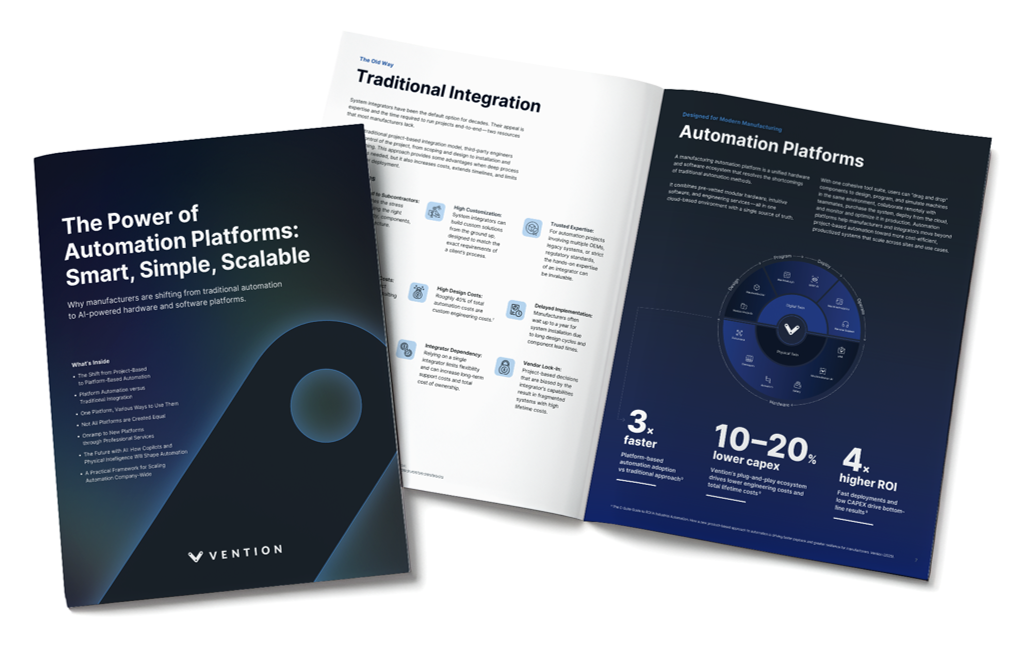
Physical AI has the potential to turn robots into autonomous operators. However, these next generation robotic cells will still need a replicable, scalable, and standardized approach to automation. This is where automation platforms have immense value.
Vention’s new whitepaper highlights how shifting from fragmented, project-based integration to a unified hardware and software platform eliminates the “integration tax.” By centralizing scoping, design, programming, simulation, ordering, and operations within a single cloud-based environment, manufacturers can reduce capital expenditures by up to 30 percent.
Download the whitepaper to learn more about how platform-based approaches can accelerate deployment timelines by up to five times.
Unified End-of-Line Packaging Automation
End-of-line packaging operations are often the most complex to automate. Multiple conveyors, varying product mixes, and the need for seamless coordination between staging, transport, and palletizing make it challenging to automate without losing efficiency. Q1 marked a continued consolidation of Vention’s end-of-line automation ecosystem, focused on delivering cohesive, pre-integrated solutions for palletizing, case packing, conveying, and everything in between.
Vention’s Next Generation Rapid Series Palletizer now handles higher payloads and throughput while supporting complex multi-conveyor configurations. Powered by AI-enabled controllers, these systems provide real-time monitoring and performance visibility without additional integration work. Whether you’re running collaborative or industrial applications, the interface remains consistent which minimizes downtime and improves the ease of troubleshooting.
Beyond palletizing, Vention expanded its Conveyor Ecosystem to support more flexible material flow and controlled accumulation, enabling tighter coordination between staging, transport, and downstream processes.
Together, these advancements move end-of-line automation away from fragmented equipment stacks toward a unified, operational layer that scales across lines and sites without re-engineering.
VentionBlue Stories: Scaling Customer Success
From OpenAI’s Super Bowl commercial to NVIDIA GTC 2026, VentionBlue has emerged as a visible marker of Vention’s growing influence. More importantly, customers and partners are demonstrating how the Vention delivers measurable results:
- Bright IA
Developed a multi-machine tending workcell for a Texas-based adhesives manufacturer using a FANUC CRX-10iA cobot. The system handles five cartridge formats with cycle times under 10 seconds, delivering up to 100 percent improvement in labor efficiency.
- The Horizon Group, Inc.
Automated repetitive sanding processes using a UR10 cobot with a linear rail and custom actuator pads. This enabled full reallocation of skilled labor to higher-value tasks, increasing project efficiency by 20 percent and reducing material waste by up to 15 percent.
- Meubles Foliot
Scaled a FANUC CRX-30 cobot deployment across facilities in Quebec and Nevada for panel feeding into edge benders and CNC machines. The result was a 15 percent increase in throughput, zero safety incidents, and full ROI achieved in approximately 16 months.
Community: Industry Conversations Shaping the Future
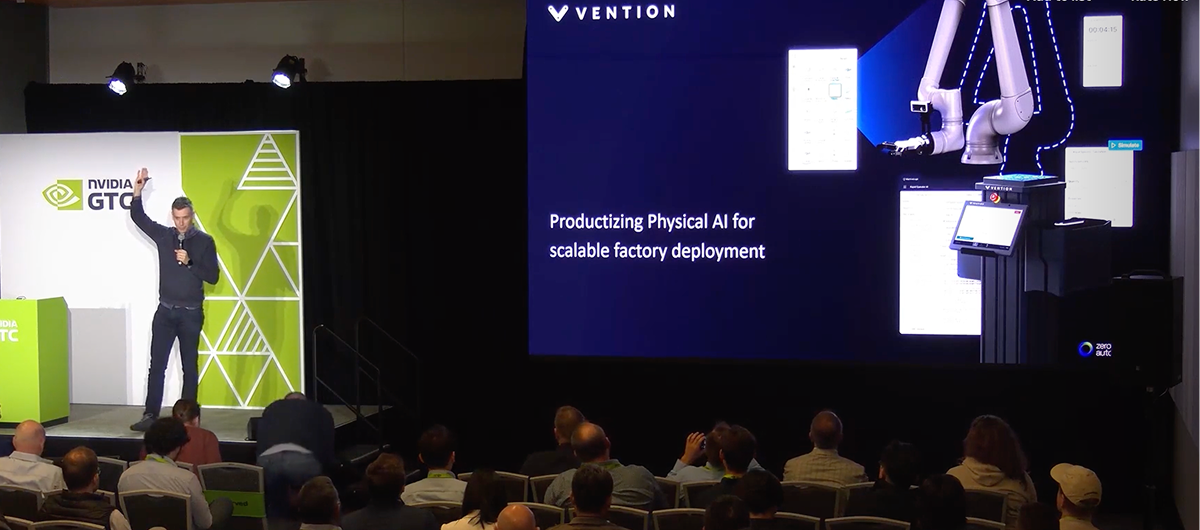
Vention’s community presence in Q1 extended beyond product launches, contributing to broader industry discussions on Physical AI, productized manufacturing automation, and how Vention’s platform integrates best-of-breed automation hardware.
At NVIDIA GTC 2026 in San Jose, CEO Etienne Lacroix joined leaders from NVIDIA, KUKA, and Universal Robots for a panel on scaling robotics workflows beyond the individual workcell. The discussion focused on what is practically achievable with Physical AI today, moving past conceptual demos to systems that can operate reliably in production environments. During the session, Etienne introduced both Rapid Operator AI and the Generalized Robotic Intelligence Pipeline (GRIIP) as key enablers of this transition.
Beyond GTC, Vention continued to engage directly with the manufacturing community.
Pack Expo East 2026
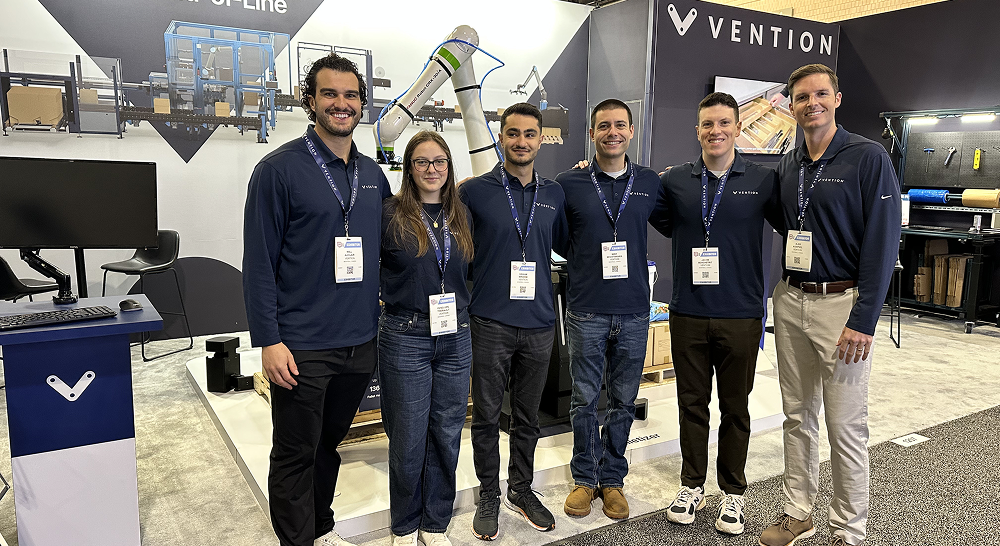
In Pack Expo East 2026, we connected with the packaging community through live, production-grade system demos of our end-of-line ecosystem, demonstrating how staging, transport, and palletizing connect effortlessly out of the box.
Midwest Manufacturers Tradeshow with Universal Robots
Feb 25, Branson Missouri
Alongside Universal Robots, Vention showcased a live UR10 application powered by MachineMotion AI. The demonstration highlighted how standardized hardware and software can accelerate deployment while maintaining flexibility across different use cases.
FANUC Collaborative Robot Workshop
March 10, Winnipeg, Manitoba
Vention partnered with FANUC America Corporation to host a collaborative robot workshop featuring live demonstrations and hands-on sessions. The event focused on how manufacturers can design, program, and rapidly deploy custom FANUC robot cells using a unified platform approach.
Universal Robots Webinar: From Design to Simulation in Minutes
Vention also co-hosted a live webinar with Universal Robots titled How to Design, Program, and Simulate a UR Robot Cell in Minutes. The session walked engineering teams through AI-assisted design, rapid programming using both no-code and Python environments, and physics-based cloud simulation, demonstrated through a live pick-and-place application.
From Momentum to Scale
Q1 2026 reflects a clear inflection point for manufacturing automation. Physical AI has matured from pilot programs to reliable production systems. Automation platforms have evolved from nice-to-have tools into essential competitive infrastructure.
The convergence of unified platforms and production-ready Physical AI fundamentally changes the economics of automation. It reduces engineering effort, shortens deployment cycles, and enables replicability across sites and applications. More importantly, it shifts automation from isolated projects to a scalable, software-defined capability embedded across the enterprise.
As manufacturers look ahead, the focus is no longer on whether to automate, but how quickly and effectively they can scale it.


