The industrial automation gap is widening, dividing the global community into adopters and laggards. The U.S., for example, currently in robot density, at 295 robots per 10,000 employees, while Germany and Japan sit well above 400.
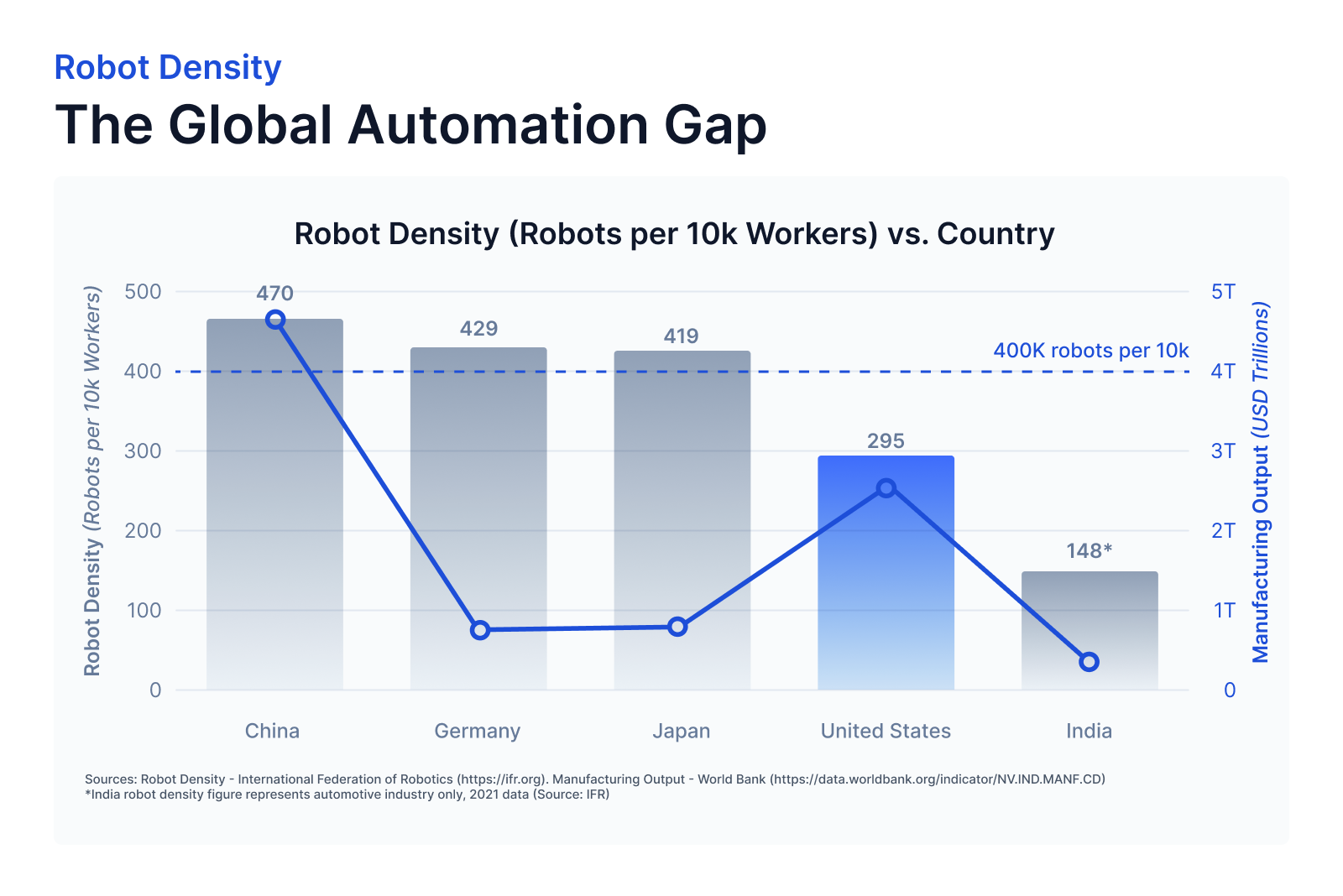
For laggards, the recent data from IndustryWeek’s State of Manufacturing survey adds a sense of urgency to course correct. Tariffs and shifting trade policy rank as the top external concern for 59% of manufacturers. Labor shortages are the top internal challenge for 49%. Manufacturers absorbing all of this through manual operations are essentially running a strategy with a ceiling. More importantly, they run the risk of falling behind their peers who are rapidly adopting next generation automation platforms.
How Manufacturers Risk Falling Behind Competition
The competitive clock is running, and those who automate now will stand to gain immediate advantages. Survey data shows manufacturers who have successfully automated report improved product quality (52%), higher throughput (50%), and reduced operating costs (48%). These are structural advantages that reshape the economics of a production operation over time. Early movers are already building the foundation for rapid, repeatable automation across their operations.
Polykar, a manufacturer of sustainable packaging products, is a clear example. After automating end-of-line palletizing at their Edmonton facility, the results extended well beyond throughput. Employee satisfaction improved, production became more predictable, and output increased by 30%. Early adopters will quickly outpace the laggards with real quantifiable gains as the cost gap erodes margin on every shipment. The labor dependency gap becomes critical every time a shift runs short, which for most manufacturers today is regularly.
End-of-Line Packaging: Entry Point for Immediate Automation Gains
End-of-line packaging, covering palletizing, case packing, conveying, and labeling, is where the cost of not automating becomes most visible and most immediate. When end-of-line cannot keep pace with upstream production, the entire line slows. And unlike upstream processes that are often at least partially automated, end-of-line packaging in many facilities remains largely manual, making it both the biggest bottleneck and the highest-leverage starting point.
The traditional approach to automation has historically been part of the problem. Coordinating separate vendors for each piece of equipment creates a multi-vendor environment where every integration point carries risk. Projects stretch to 6 to 12 months and integration overhead consumes 15 to 20% of total project cost.
The result? 32% of projects fail to perform as expected. Nearly a third go over budget, as per the data from the IndustryWeek report. The emergence of unified, platform-based automation changes this calculus entirely, and an equalizer for manufacturers trying to rapidly automate.
One platform across the entire line
When case erectors, conveyors, case packers, and palletizers share a common operating environment with one controller and one programming interface, integration complexity collapses. Troubleshooting becomes easier as there’s a single point of contact to coordinate instead of juggling between multiple vendors. After their first successful deployment Polykar replicated existing palletizer configurations with minimal engineering effort, rather than restarting the deployment process from scratch each time.
Deployment measured in weeks, with ROI validated before install
Digital design and simulation tools allow teams to confirm throughput assumptions and identify integration risks before a single machine is on the floor. Pre-engineered automation applications reduce commissioning cycles that traditionally inflate project cost. The Feed, the world’s largest sports nutrition marketplace for endurance athletes, deployed a fully customized conveyor system integrating two existing automation lines in six weeks, compared to the 40 weeks quoted by other providers.
Operators run the system, specialists are not required
Intuitive programming options with code-free or Python allow plant teams to manage SKU changeovers, configure pallet patterns, and adapt to production shifts without programming expertise. Knowledge stays in-house and reliance on external integrators drops significantly. When the people running the line can also adjust and troubleshoot it, adoption accelerates and operational continuity improves.
Real-time visibility across the line
Continuous performance monitoring, remote diagnostics, and on-demand expert support mean issues are resolved in minutes rather than after waiting for a specialist to travel on-site. Connected machine data makes it possible to identify root causes, track OEE, and improve performance continuously.
The Cost of Delaying End-of-Line Packaging Automation
Inaction has a cost when it comes to industrial automation. 73% of manufacturers plan to increase automation investment in the next one to three years. Nearly half are targeting end-of-line specifically within 24 months. Every quarter of delay is a quarter that competitors spend capturing throughput gains, reducing costs, and building the operational foundation that makes their next automation step faster and cheaper.
The cost of delay shows up in ways that rarely appear on a single line in a balance sheet: throughput capped by manual packing rates, quality variability that requires rework, labor costs that rise while headcount stays flat, and an inability to absorb new SKUs without proportional operational strain.
Decisive action has immediate benefits, especially when automating with a unified platform with shorter payback periods compared to traditional providers. Most palletizing deployments with Vention, for instance, recover their full investment within 1.3 years compared to over 2 years for traditional deployments. The financial case for waiting is difficult to sustain when the evidence consistently points the other way. The right time to automate is before your competitors make catching up the only option.
***
Understand what is limiting your end-of-line performance
Download the full State of the Market Report or speak with an automation expert to get a tailored end-of-line design recommendation at no charge.


