Executive Summary: Platform-based Approach to End-of-Line Packaging Automation
Modern end-of-line automation is moving away from siloed, bespoke automation toward unified platforms. This transition solves the ‘Negative Flywheel’ of labor churn, SKU proliferation, and the ‘Integration Tax’ that plagues fragmented systems. By adopting a platform-based approach, manufacturers can reduce deployment times by up to 5x and ensure long-term operational resilience.
Today’s plant managers and automation leaders are caught in a negative operational flywheel that limits their growth, starting with the labor churn. Manual packing roles in manufacturing see some of the highest exits, and resulting new vacancies. The US Bureau of Labor Statistics is projecting over a million new jobs per year for the next decade. For long-tail tasks, these exits are particularly challenging as the loss of ‘process memory’ negatively impacts throughputs until the new hires complete their learning curve.
Automating the end of line is the ideal solution to tackle this labor instability, and most market forecasts reflect this reality. By 2030, Packaging Automation is likely to be worth over $117 Billions as per a Research and Market report. However, in the era of Packaging 5.0, with focus on human-centric design, and connected automation systems, most factory automation remains siloed in isolated projects. Every new automation project comes with its own integration tax in the form of proprietary protocols, vendor-specific software, and custom interfaces that don’t communicate with existing systems or future additions.
Shifts in global trade and supply chain networks have further intensified this challenge. As per McKinsey’s consumer operation study, proliferation has increased packaging complexity, expanding the SKU counts by over 50% in the last decade. Now the disruptions of supply chains are pushing many manufacturers toward re-shoring and distributed “satellite” factories closer to demand. Traditional automation is too rigid to handle these realities. Long lead times for both brownfield retrofits and greenfield builds mean new facilities often default to manual operations, reintroducing the very inefficiencies automation was meant to eliminate.
In this article we explain why conventional automation is now a liability and how a unified, platform-based approach to end-of-line offers the best chance to create more resilient operations.
Why Fragmented End-of-Line Packaging Automation Affects ROI
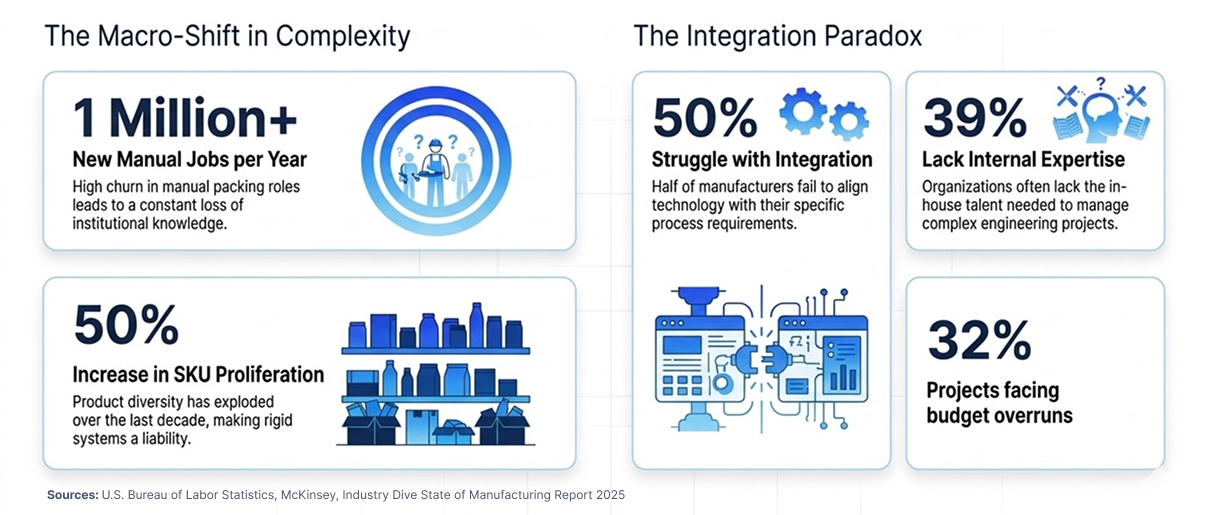
The traditional end of line automation strategy attempts to You can select best-of-breed case erectors, robot arms, and palletizers from three different vendors to build a robust system. In reality, 50% of manufacturers struggle to find the right technology, and 39% lack internal expertise to manage large integration projects. This creates an end-of-line Frankenstein that depends on different programming philosophies, control logic architectures, communication protocols, and operational state definitions.
Each of these machines requires distinct operational processes, training standards, and diagnostic methods. The resulting loss of ROI manifests itself in three distinct ways.
The High Cost of the ‘Integration Tax’
1. Additional Engineering Hours Due to the Need for ‘Automation Babysitters’
First, the handshakes required to make elements like a case packer and a palletizer talk to each other require full-time ‘automation babysitters’ adding thousands of lines of translation code. As a result, a deployment that should require weeks extends to months, adding to the engineering hours.
2. Additional OPEX and Inconsistent Quality
Overheads due to integration challenges are not limited to new deployments. When every changeover requires extensive re-programming and integration specialists, the associated OPEX can extend the payback periods. Take robotic palletizing, for example. If a palletizer is set up by a traditional integrator with individual taught positions for every single placement rather than utilizing dynamic user frames, commissioning a new product or box size can take weeks of fine-tuning.
This dependence also directly affects packaging quality. Disconnected, complex systems inherently create variability across different operators and shifts, which is a root cause of mispacked cases, uneven pallets, and transport damage.
If your in-house team cannot easily modify the code to correct these quality defects, or if they lack the connected machine data required for real-time root-cause diagnostics, a minor error quickly escalates. Ultimately, this reliance on reactive maintenance leads to prolonged, cascading downtime across your entire production line.
3. Downtime Caused by Lack of Visibility on Equipment Status
Orphaned machines running orphaned code also limit visibility into exact maintenance requirements. When things break, it can lead to costly downtime and a switch to manual processes.
The last and often overlooked aspect of this fragmentation is the impact on institutional knowledge. Ironically, automation that is supposed to standardize and prevent loss of key process knowledge leads to vulnerable dependencies on internal or external specialists.
How Does a Unified Platform Solve EOL Challenges?
Escaping the “Frankenstein” trap for end-of-line automation needs a fundamental shift to a new architecture. As the industry marches toward “Packaging 5.0,” the ultimate goals of human-centric packaging, high Overall Equipment Effectiveness (OEE), and AI-driven intelligent systems cannot be achieved if machines act as siloed, disconnected islands. Equipment must share standard connectivity and a uniform data structure.
This is where Vention’s unified approach to end-of-line automation can help manufacturers achieve ROI faster. Instead of juggling five different OEMs and hoping an integrator can make them speak the same language, plant managers and automation leaders can now utilize one partner to consolidate the following on a single platform:
- Case Erecting
- Case Packing
- Case Sealing
- Labeling
- Conveyors
- Palletizing
One-Stop Shop for End of Line
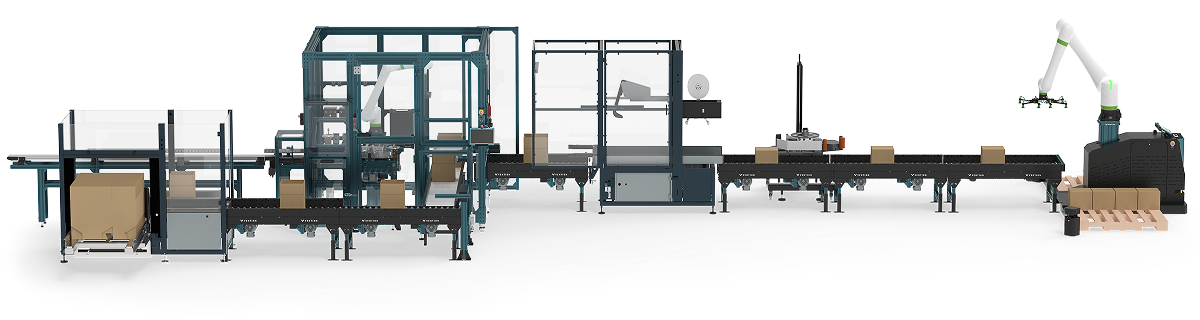
Here is how replacing the fragmented procurement model with a unified approach solves multiple challenges in end of line automation:
Accelerated Deployment
Vention’s modular platforms can be deployed in as little as 12 weeks for complete end-of-line systems, representing a 3-5× faster deployment timeline than traditional automation approaches. This acceleration is only possible with elimination of the translation layer. When every component shares a common language from the commissioning phase, “integration” effectively becomes deployment.
Operational Democratization
Platform standardization enables no-code or low-code interfaces that transform machine control from specialized expertise into accessible operational capability. Format changeovers that previously required vendor callouts become shift-supervisor tasks, retaining critical knowledge within internal teams rather than external consulting relationships.
Performance Standardization
Packaging automation and line integration lead to a 30% increase in throughput. Unified platforms generate consistent, comparable metrics natively, replacing vendor accountability disputes with data-driven root cause analysis. This standardization establishes high Overall Equipment Effectiveness (OEE) by design rather than through post-integration optimization.
Quality Consistency and Defect Elimination
Manual processes and disconnected systems introduce variability across shifts, operators, and runs. When case packers, labelers, and palletizers operate with different tolerances and error logic, issues compound at every handoff, while limited visibility delays detection.
By replacing disconnected, manual processes with a single, automated platform, manufacturers can ensure consistent, high-quality output across every shift. With common quality parameters and continuous performance visibility, deviations trigger system-wide responses, allowing teams to identify and resolve issues early before they lead to product loss.
Strategic Scalability: The Phased Implementation Model
Automating the entire end-of-line on a single platform has proven benefits. However, the reality is that end-of-line systems are commonly added in phases, allowing operations to adapt without major disruption. Most facilities cannot justify the capital expenditure or tolerate the production disruption required for wholesale end-of-line replacement. The phased approach is, in fact, easier to implement with a common platform.
The critical success factor is future compatibility.
Every modular piece in the end-of-line can be added incrementally with minimal disruption as it shares design standards, programming environment, and communication protocols. This transforms procurement criteria from “best performance today” to “best path forward.” Switching to a platform-based approach also offers immediate savings in engineering hours, especially for multi-site deployments. For example, Polykar, a manufacturer of sustainable packaging products, easily replicated their cobot palletizer cells with minimal engineering effort. The result is greater standardization and ease of replicating automation projects.
On a more tactical level, an automation platform with integrated programming and simulation can also improve design-to-deployment confidence. Since all equipment can be digitally validated, handshakes, layouts, and throughputs can be benchmarked, and design adjustments can be made faster.
Three Pillars of Smart End-of-Line Packaging Investment
A common platform for end of line automation challenges the usual economics of manufacturing automation. However, it needs a change in mindset in how end of line automation decisions are evaluated. Here are key factors automation leaders can consider to maximize value from end of line automation projects.
Standardize Before You Optimize
Today, there’s immense pressure from corporate IT and executives to digitize operations, extract complex data, and deploy advanced upgrades. However, layering complex enhancements onto a system with weak foundational logic runs the risk of automating the chaos. For example, manufacturers that integrate highly customized equipment into fragmented, multi-vendor lines often end up increasing troubleshooting complexity and cascading downtime rather than improving overall performance. Establishing a sound, standardized foundation for the end-of-line must be the priority. The most effective alternative is adopting a cohesive, unified platform where native interoperability and stable controls are built in from day one.
Prioritize Speed to Market Over Integration Theater
Traditional end-of-line projects often stretch into year-long engineering efforts because each piece of equipment must be specified, integrated, and commissioned independently. The result is lost production time and missed market opportunities. By the time you commission, integrate, and get the end-of-line operational, competition can gain first-mover advantage. Alternatively, if you can deploy in 5 months instead of 15, you capture 10 additional months of production in Year 1. At even modest throughput, that’s millions of dollars in margin you’d otherwise leave on the table.
Prioritize Vendor Support Infrastructure
When evaluating automation, most procurement teams obsess over the upfront CapEx of robotic arms, conveyor brands, and PLC models. This blinkered view can often distract from accurately estimating the cost of downtime and flying in experts for a fix that takes minutes. The same failure on Vention’s platform has a different outcome. To start with, the MachineAnalytics tool provides continuous performance visibility and root-cause diagnostics, empowering plant teams to identify performance drift using real-time machine data before it causes a stoppage. If a physical fault does occur, any operator on the floor can launch RemoteView, and Vention’s experts diagnose issues in real time and walk operators through procedures such as realignment. Over a total runtime of a decade, consider how much these avoided downtimes and remote support capabilities can translate into massive operational savings.
EOL Automation: Industry 5.0 and the Human Element
The companies achieving sustained competitive advantage in end-of-line operations are not necessarily those spending most aggressively or moving fastest toward full automation. They are the ones that recognize a simple reality. Perfect integration from day one is unrealistic, but thoughtful compatibility from day one is achievable.
This compatibility requires clarity around the target architecture, discipline in procurement criteria, and a willingness to prioritize systems that maintain integration pathways rather than creating future dead ends.
It also requires a renewed focus on the human role in automation. As manufacturing moves toward Industry 5.0, the goal is not to remove people from operations but to empower them with better tools. Intuitive user interfaces and simple programming environments allow operators and production engineers to interact directly with automation systems without relying on specialized PLC programmers for every change. When automation is accessible to the teams that run the line every day, troubleshooting accelerates, improvements happen faster, and operational ownership stays on the factory floor.
The ideal end state remains a unified end-of-line ecosystem with single-platform controls, common programming, pre-validated integration, and consistent data architecture. Most facilities cannot reach this end state through a single capital event. They can, however, structure each incremental decision to move steadily toward it while ensuring that the technology remains understandable, adaptable, and usable by the people operating it.
***
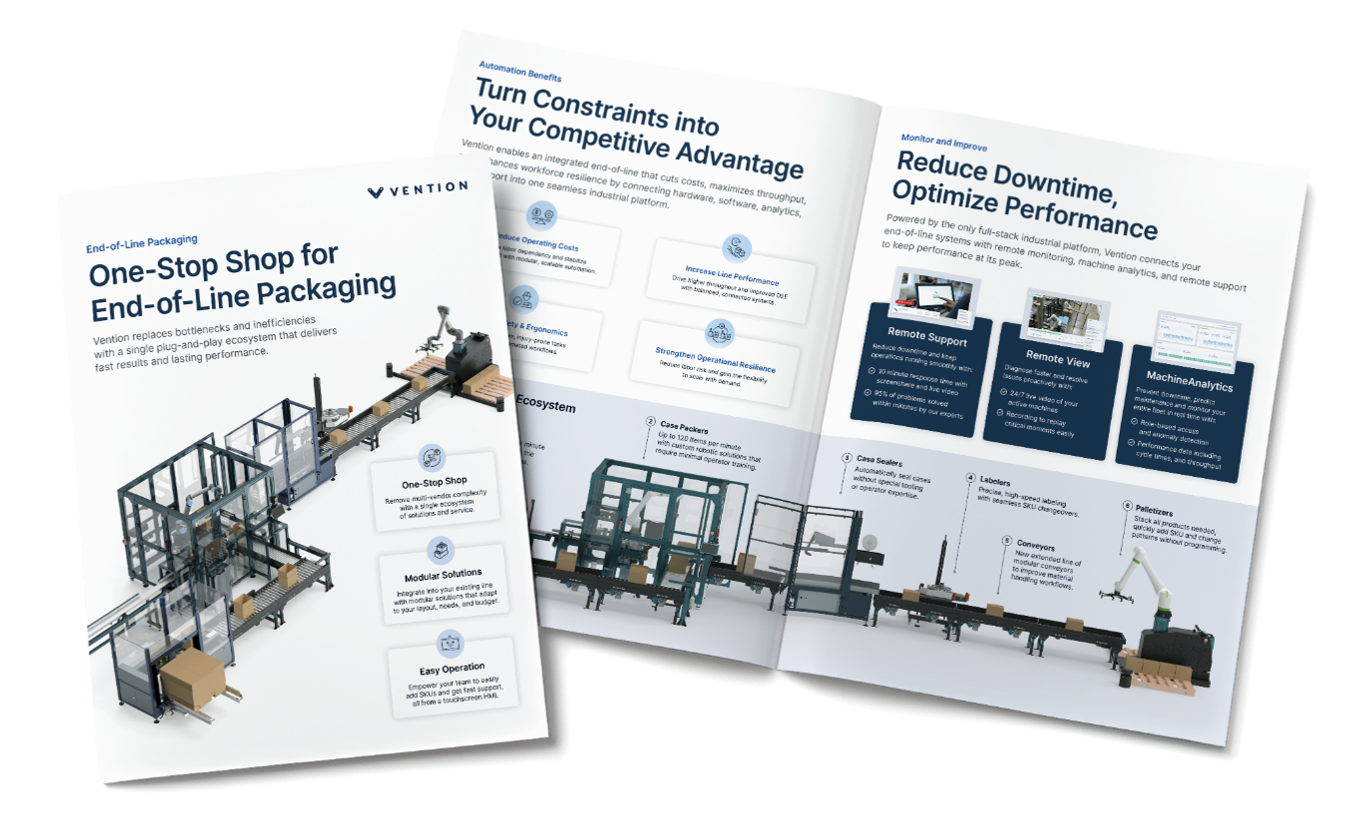
Learn how a one-stop shop for end of line systems can reduce downtime and optimize performance. Download brochure to get started.


