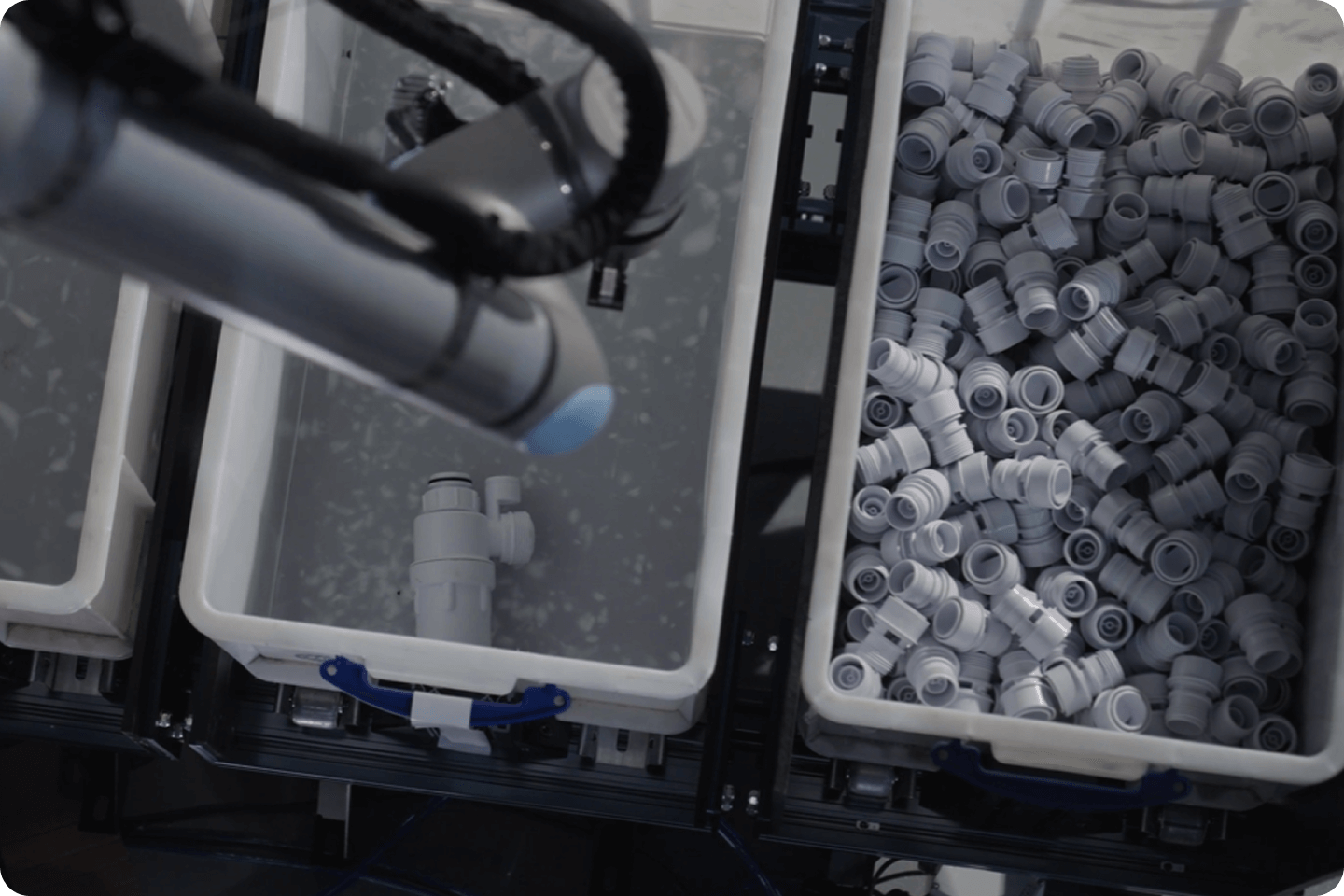
The “long-tail” tasks in manufacturing are generally where traditional automation loses its economic relevance. In bin picking for assembly, for example, a robot may need to retrieve randomly oriented parts from a bulk container and present them with sufficient precision for downstream operations. The challenge is not throughput, but variability. Each pick involves a different pose, occlusion, and grasp condition, making it difficult to rely on deterministic rules or fixed fixturing. Automation engineers must either constrain the environment through costly mechanical design or invest heavily in task-specific vision and programming. Even then, edge cases persist, and systems struggle to generalize across real-world variation. The result is automation that requires frequent exception handling and manual intervention, eroding productivity gains. This is why traditional automation has been most effective in stable, repeatable environments, rather than in high-variability tasks like these.
Physical AI is changing this equation by decoupling task variability from economic viability. Instead of requiring the factory to be perfectly structured before automation can work, modern AI-enabled systems can operate directly within imperfect, dynamic environments. They handle inconsistent lighting and messy pick-and-place tasks without SKU-by-SKU reprogramming, extensive data collection, or custom mechanical structuring.
However, this potential value by itself isn’t enough to prompt executives into action, especially when evaluating enterprise-wide automation plans. The real question is: can Physical AI deliver measurable impact on the factory floor today, and what does the business case for it actually look like?
The Economic Case for Physical AI
As we have discussed in previous posts, Physical AI isn’t a monolith. Today, AI Pipelines are the closest to rapid ROI.
Since they utilize proven industrial hardware, they can hit the strict sub-millimeter precision and cycle times required for immediate commercial viability. More importantly they allow access to economic efficiencies in fixed operator positions that could not be automated by traditional means. For example, tasks such as mixed-case palletizing, require greater dexterity, perception, and intelligence to handle the variation in box sizes and materials.
The repetitive nature of these tasks makes them the highest in terms of employee churn, adding to the replacement and training costs. This is where Physical AI pipelines can offer greater OPEX savings per dollar investment.
Budgeting and Payback for Physical AI Pipelines
The following calculation examines justifiable ROI periods and whether current Physical AI pipeline-based solutions can deliver them.
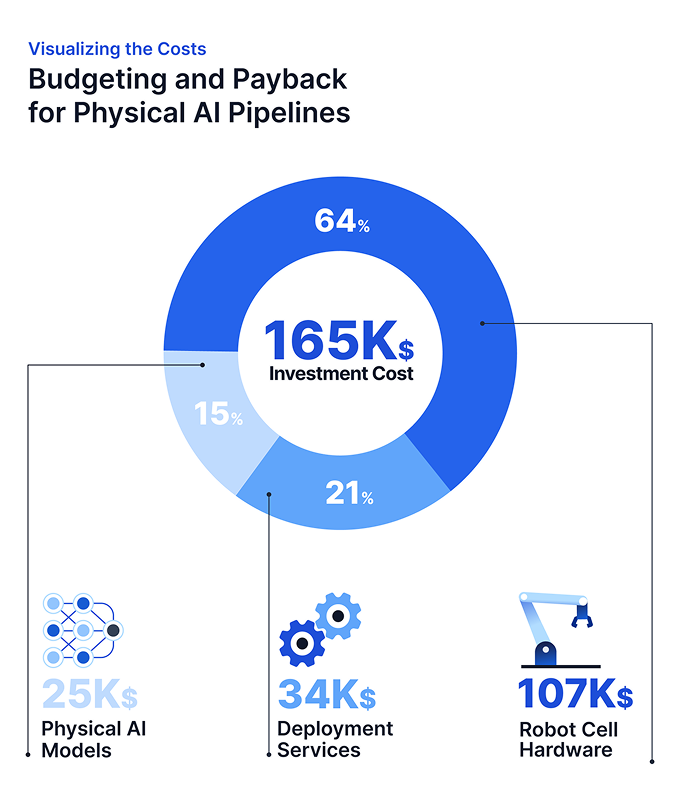
Total Investment Budget: ~$165k
For roles handling unstructured tasks such as pick-and-place operations, a mid-sized manufacturer typically sees a fully burdened cost around $55k/year. For a manufacturer running two shifts, this translates to $110k annually. Industry standard payback expectations range from 1 to 2 years, putting acceptable investment levels between $110k and $220k. A realistic midpoint falls around 1.5 years, establishing an investment budget of approximately $165k per cell.
Robot Cell Hardware: ~$107k
A typical AI-ready setup includes:
- A cobot with payload of 10-20Kg
- Compact workstation or pedestal
- 2-finger EOAT,
- RGB-D camera, safety,
- HMI, and GPU compute,
Based on Vention’s calculations, this lands at around $107K.
*Robot cells with more complex infeed/outfeed can push this north of $180K+, which may extend payback periods.
Safety Assessments & Deployment Services: ~34K
This is where Physical AI matters most. Highly generalized models can onboard new parts in minutes rather than weeks, materially reducing services. Assuming 4 weeks to assemble the cell, onboard SKUs, complete FAT/SAT, and train operators and maintenance teams, add an additional ~$34K.
Physical AI Models: ~25k
Pricing models vary (license, SaaS, RaaS), and higher-performing, more generalized models might cost more, yet reduce deployment and long-term support costs later. With a 1.5-year payback target, there’s ~$25K available for the Physical AI layer. This is well within current commercial pricing.
Based on this calculation, robot cells powered by a Physical AI pipeline can realistically meet payback targets under two years, making them viable for real-world deployments.
A New Competitive Advantage
For the last thirty years, simply being automated was a competitive advantage since it required absorbing upfront costs, and preparing for the long haul to recover it. This meant only large enterprises could automate at scale. Physical AI is leveling that playing field.
As more accessible automation becomes available, the competitive advantage is shifting to who can automate faster, deploy more versatile systems, and get payback faster. The manufacturers who learn to rapidly integrate Physical AI in their automation roadmap will be positioned to move faster than competitors still relying on traditional automation stacks.
***
Test Physical AI for Your Parts and Process
Can Physical AI add value to your process today? Find out by sending your parts for test to Vention. Our team will evaluate your specific application and show you exactly how Rapid Operator AI performs in your real-world conditions.


