Fixed operator positions in manufacturing are some of the most challenging to fill and retain and are likely to remain so for the foreseeable future. Over 25 percent of the manufacturing workforce is nearing retirement, according to the latest data from the U.S. Bureau of Labor. The result could be millions of unfilled roles in the next decade. What exacerbates the situation further is that the most repetitive and high-churn tasks are generally the hardest to automate. This is beginning to change with recent breakthroughs in Physical AI.
Last year at NVIDIA GTC Vention introduced the AI Operator as a technical showcase of physical AI for unstructured tasks in manufacturing environments. The demo showed that autonomous robot cells can be deployed reliably to address some of a facility’s hardest automation challenges, including picking randomly placed objects from deep bins. At NVIDIA GTC 2026, Vention launched Rapid Operator AI, the evolved and production-ready version of the system. We also introduced a powerful End-to-End Physical AI pipeline that unlocks the next frontier of manufacturing.
Beyond individual product announcements, GTC 2026 validated a core thesis Vention has been advancing. Physical AI cannot scale as a collection of disconnected models, sensors, and software layers. It requires unified, end-to-end systems that own the full execution stack. From new AI-powered solutions to Vention’s thought leadership on scaling Physical AI across operations, catch up on the key highlights from GTC 2026.
The “Always-On” Operator for the Factory Floor
The factory floor can be an unpredictable, highly variable environment where rigid automation solutions usually fall short of expected benchmarks. The Rapid Operator AI solves this by empowering robotic systems to seamlessly see, think, and act in real-time to perform unstructured manufacturing tasks. It delivers human-like adaptability right out of the box, entirely eliminating the need for custom programming, specialized robotics expertise, or training.
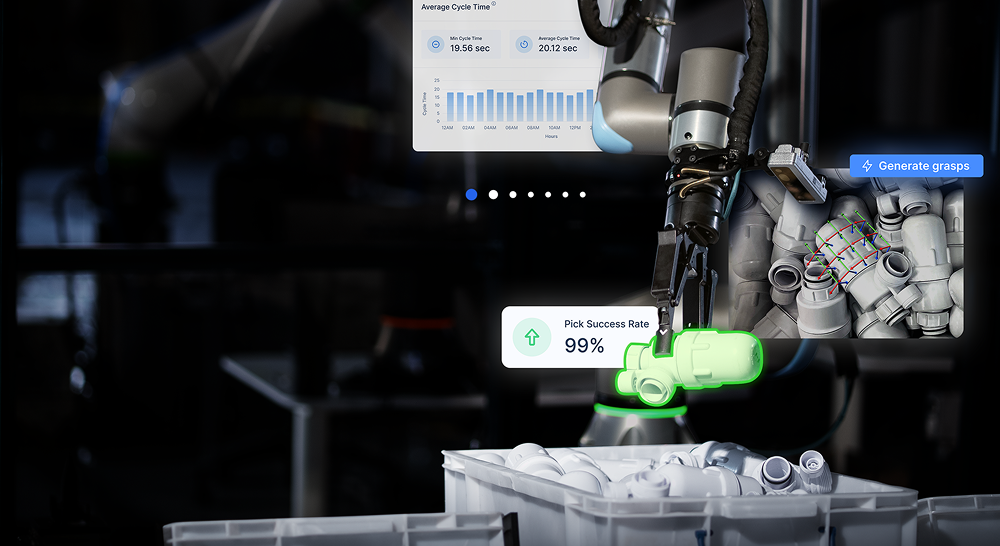
Powered by Vention’s GRIIP™, the intelligence layer for robotics, the system acts as an “always-on” autonomous operator. It seamlessly identifies randomly placed parts, picks a wide range of items with precision in real-time, and calculates collision-free paths. The generalized Physical AI intelligence layer also ensures high reliability with 99% first pick success rate under varying, low light or even complete darkness, enabling true 24/7 lights-out operations.
What truly sets Rapid Operator AI apart in the market is its end-to-end capability. Navigating the landscape of AI or 3D-vision based automation solutions today is a fragmented experience with standalone software, raw camera sensors, and hardware. Integrating it can be a challenging task that often requires additional engineering hours, with no centralized accountability. Rapid Operator AI completely eliminates this guesswork and gaps that derail advanced automation. It unites robotic arm, vision camera, AI pipeline, and motion controller into one complete solution.
Five Key Benefits for Manufacturing Teams
1. Parts Diversity
Rapid Operator AI adapts to parts with varying geometries, materials, and surface finishes, enabling mixed-SKU operation within a single cell.
2. Rapid Deployment
New SKUs can be introduced in minutes without retraining models or relying on robotics specialists. Adding a new part requires only uploading a CAD file.
3. Continuous Operation
The system supports 24/7 production with no manual intervention. It autonomously manages bin emptying and retries failed picks, even in highly cluttered environments.
4. Predictable ROI
Consistent cycle times and a 99 percent first-pick success rate support payback periods as short as one year in labor-constrained applications.
5. Intuitive Operation
Configuration and operation are handled through a single, operator-friendly interface with no coding required.
Vention’s GRIIP™ : End-to-End Physical AI pipeline for Industrial Robotics
At NVIDIA GTC 2026, Vention also demonstrated GRIIP™, an end-to-end Physical AI pipeline that powers Rapid Operator AI. Built on state of art foundational models, GRIIP enables the robotic cell to perceive, reason, and act in unpredictable environments.
How GRIIP Works
- Scans the Workspace in Real-time
The system instantly identifies every part with varying object shapes, materials, and arrangements.
- Automatically Estimates Object Coordinates
GRIIP tracks the exact position and angle of every part before it’s picked up by the robot arm. It continues to track the real-time position until the part is placed.
- Selects the Optimal Grip for a Successful Pick
Before picking a part, AI evaluates every possible way to ensure a secure grip, and picks the one with the highest probability for a successful, clean pick.
- Ensures Collision-Free Movement
GRIIP intelligently adapts to the chaotic manufacturing environment in real-time to ensure a collision-free, efficient, and safe path for the robot arm.
NVIDIA and Vention Collaboration
Rapid Operator AI emerged from deep integration between Vention’s AI stack and NVIDIA’s technology, an approach highlighted throughout discussions and demonstrations at NVIDIA GTC 2026. By aligning perception, reasoning, and motion execution within a single architecture, the system minimizes latency and reduces the variability that typically constrains AI-driven automation to lab settings. This integration enables Rapid Operator AI to move beyond prototype behavior and deliver predictable, production-ready cycle times on the factory floor.
NVIDIA Tech Stack Powering Rapid Operator AI:
###
- State-of-the-Art Foundation Models
The cognitive capabilities of Vention’s intelligence engine were built on NVIDIA Foundation Stereo and Foundation Pose models, enabling real-time responsiveness without extensive training. - AI at the Edge with NVIDIA Jetson Thor
Production-ready performance requires minimal latency. Rapid Operator AI is equipped with Vention’s MachineMotion AI controller, powered by NVIDIA Jetson Thor, delivering local GPU acceleration directly on the shop floor without reliance on cloud connectivity.
Vention’s AI Thought Leadership: Beyond the Workcell
As the premier event on Physical AI, NVIDIA GTC 2026 provided a platform not only for product launches, but for shaping the next phase of manufacturing automation. As part of Vention’s Lightning Talk series, Vention founder and CEO Etienne Lacroix joined leaders from NVIDIA, KUKA, and Universal Robots for the session “Beyond the Workcell: Scaling Robotics Workflows Across the Factory Floor.”
The discussion moved beyond individual applications to a broader architectural shift. Foundation AI models, simulation, and digital twins are enabling a transition from isolated robotic cells to connected, software-defined workflows that span the factory. This shift reinforces a central idea: the future of Physical AI is not a collection of point solutions, but coordinated systems that can be deployed, scaled, and continuously improved across operations.
For manufacturing leaders, the implication is clear. The challenge is no longer whether a single task can be automated, but how automation systems are designed to scale beyond the workcell from day one.
What’s Next for Physical AI in Manufacturing
NVIDIA GTC brought together leading minds in AI and industrial robotics with a focus on solving real-world automation challenges. This year marked a clear shift in the conversation, moving from what is possible with Physical AI to what is deployable today.
Rapid Operator AI reflected this transition, signalling a move away from fragmented and experimental solutions toward an end-to-end platform designed for factory-ready deployment. For manufacturing leaders worldwide, the takeaway from GTC was clear. 2026 marks the year Physical AI becomes scalable, deployable, and reliable.
***
Want to know how Rapid Operator AI could help in the real world conditions? Send us your parts to test it today!


