
At Toyota, Ford, and other industrial giants, the ‘gemba’ or the factory walk has been instrumental to strategic initiatives, helping executives collect unfiltered data before making big decisions. However, when setting an economically relevant automation target, the factory walk needs to be more targeted. Instead of an open-ended discovery, the purpose is to identify specific facilities, processes, and opportunities to automate brownfield equipment that ultimately help achieve the strategic OPEX reduction targets. This requires a different level of rigor and structural framework.
Selecting Economically Relevant Factories
A factory walk cannot realistically cover every site, making it crucial for automation leaders to prioritize sites that offer maximum savings potential. Ideally, the walk should cover at least 50% of the total labor pool to adequately address the largest cost item for the business. Determining headcount at each facility, average salaries, OPEX, number of shifts, and average wage rates helps create a priority list for automation transformation.

Sites with the highest headcount, number of shifts, average salaries are the easiest to prioritize, as they usually have the highest OPEX. The number of shifts, in particular, is a crucial metric since factories operating on two or three shifts multiply the impact of any automation project. Additionally, evaluating site-specific hiring or labor challenges can add a qualitative dimension to this analysis. Plants with severe labor shortages, for example, may benefit more from automation.
Assembling the Right Team and Estimating the Factory Walk Duration
A well-executed factory walk is both a technical and cultural exercise, bridging technology, people, and business priorities. To yield actionable insights, the team conducting the walk must ideally represent all three sides.
A technical expert provides the engineering foundation. They bring in vital process knowledge which can be supported by an external automation specialist if needed. This helps determine which processes can be automated, and to what extent.
A business stakeholder brings financial and strategic alignment. They connect observations from the floor to enterprise objectives, ensuring each identified opportunity translates into a commercially viable project that fits within capital allocation priorities.
A people representative ensures organizational acceptance. Whether drawn from HR, plant management, or labor relations, they help build trust with operators, gather accurate information about current practices, and preempts potential resistance to change. Additionally they also help identify operations with higher risk of injury.
Timing and duration are equally important. The walk should be conducted during a representative production shift, typically the day shift, when staffing levels and throughput reflect normal operations.
Accurately estimating the time required for each site ensures adequate coverage. Vention’s experience with large enterprises suggests allocating 60 to 70 minutes per 200,000 square feet of facility space.
This window provides adequate time for observation, dialogue, and documentation while maintaining focus and minimizing disruption.
Conducting the Walk: Data Points to Observe and Assess
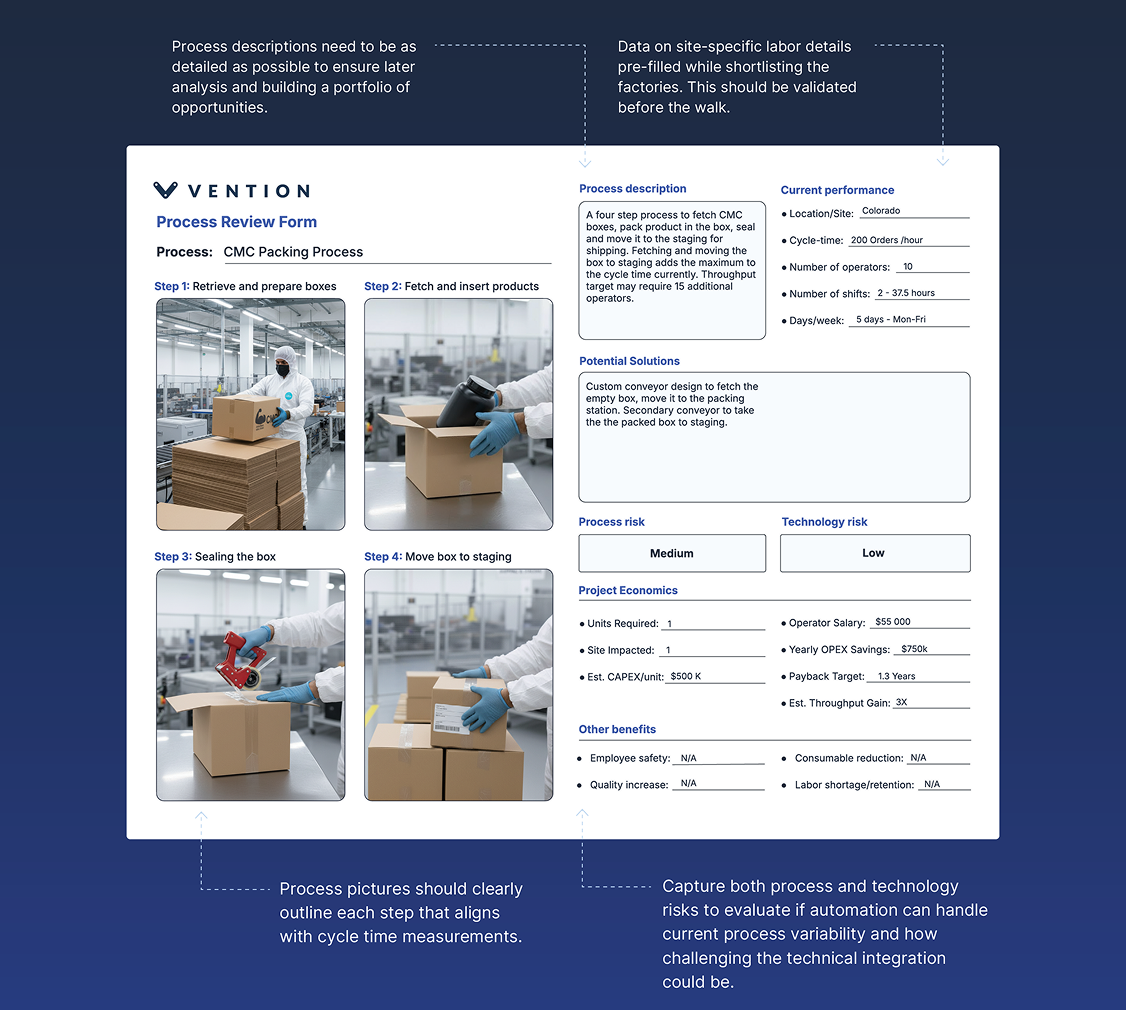
With preparation complete, the actual walk relies on methodically identifying, measuring and documenting the key motions each operator is performing. Generally operator tasks being considered for automation consist of five or six different motions, beyond which automation projects tend to become more complex. Clicking pictures of each of these steps helps create a visual record and measuring the human cycle time helps quantify them. This data then lets automation leaders determine if the task is automatable, and what exact technologies may be needed to automate it.
Tasks with cycle times of around 15 seconds are generally considered automatable with collaborative robot arms. Longer and shorter cycles both impact the choice of automation and CAPEX requirements.

The operational data and pictures collected during the factory walk for each automation opportunity can then be consolidated for further analysis using the template below. In this example, the four steps of the CMC Packing Process and specific bottlenecks are clearly defined. This framework also outlines other essential information such as process and technology risk, potential solutions along with key metrics needed for further analysis.
Codify and Prepare for Prioritization
The factory walk reaches its conclusion when the team has systematically documented work across multiple operators and facilities, creating a comprehensive inventory of potential automation projects. This inventory is not yet an action plan. It’s a database of possibilities for the next phase of the automation strategy process. In subsequent decision-making, these projects will be evaluated using a prioritization matrix that accounts for impact, risk, complexity, cost, and interdependencies.
It’s important to note that while the factory walk captures routine operations, automation success often hinges on handling edge cases well. Seasonal surges, unplanned downtime, night shift workarounds, and instinctive operator adjustments are easy to miss. Gathering this context directly from operators who navigate these realities daily ensures automation leaders extract maximum value from the factory walk and avoid blind spots in project planning.
***
Planning a factory walk at your site? Contact Vention experts for inputs and resources to plan your automation journey.


