Aerospace and defense demand is stretching production systems built for a slower era. Commercial backlogs remain high, defense spending is accelerating, and reshoring pressure is pushing manufacturers to increase output without diluting quality. The companies scaling most effectively are not simply adding more labor, more suppliers, or more machines. They are changing how production systems are designed, validated, deployed, and improved.
The new playbook is built around a simple shift: manufacturing systems must be able to evolve as fast as the programs they support.
Digital Engineering Moves Production Upstream
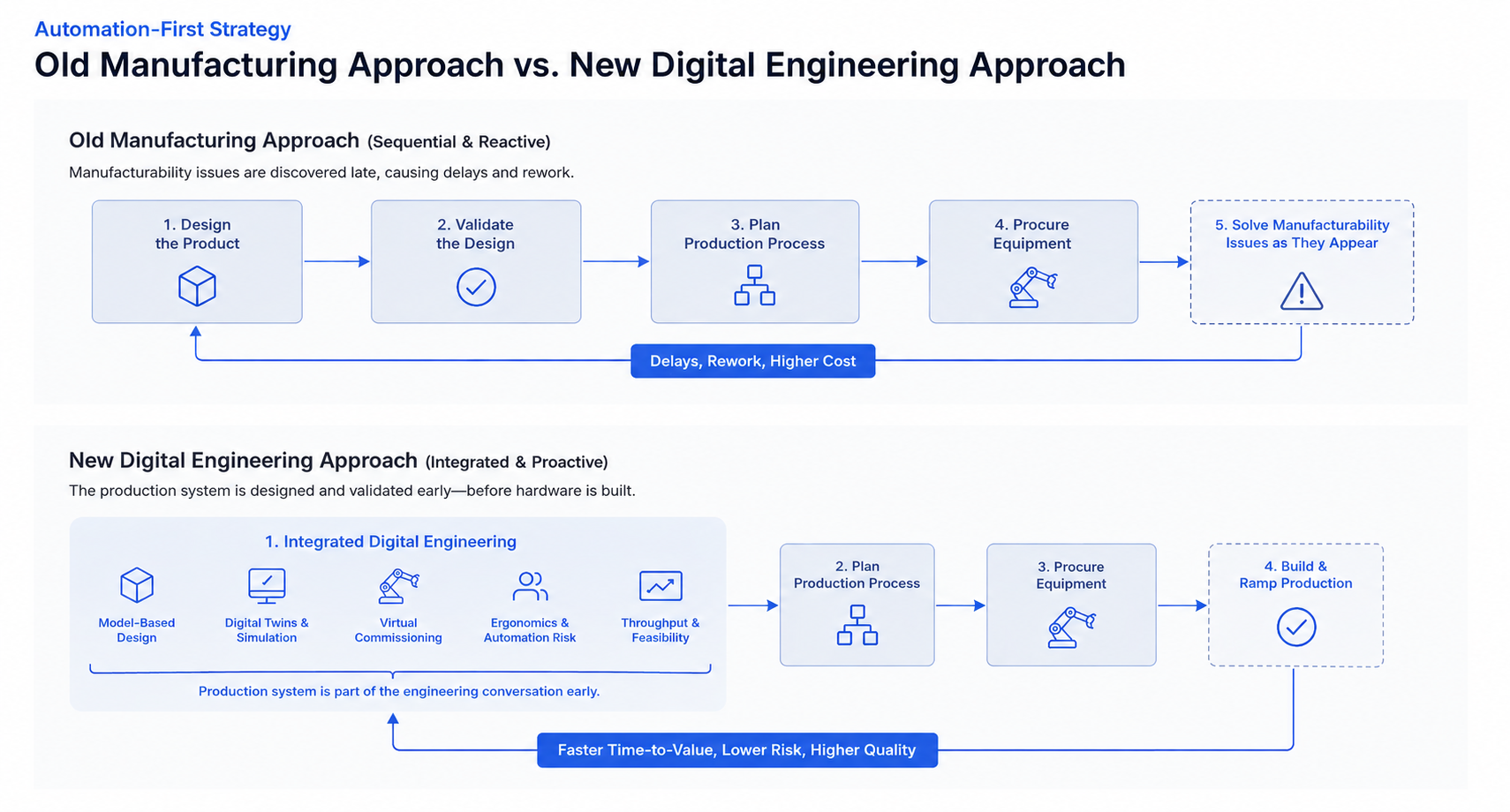
For decades, aerospace manufacturing followed a largely sequential model: design the product, validate the design, plan the production process, procure equipment, then solve manufacturability issues as they appeared. That model resulted in expensive programs and timelines that are too slow for today’s market environment.
Digital engineering is changing the sequence. With digital twins, model-based engineering, simulation, and virtual commissioning, manufacturers can evaluate factory workflows, tooling requirements, automation risks, ergonomics, and throughput before hardware is built. The production system becomes part of the engineering conversation earlier, rather than a downstream constraint discovered late.
Pratt & Whitney’s XA103 adaptive engine program is a clear example of this shift. The company recently completed a fully digital assembly readiness review, moving from virtual engineering toward physical production without relying on traditional sequential review cycles. By validating assembly readiness, supplier coordination, and technical performance in a digital environment, Pratt & Whitney reduced risk before hardware entered the production floor.
Lockheed Martin has reported similar benefits through digital twins and its ARISE software. Instead of waiting for mechanical design, procurement, electrical integration, and physical test cycles to finish before validating software, their teams can begin testing earlier in a virtual environment. The result is faster engineering and earlier visibility into production risk.
This approach is not restricted to the largest primes. Newer aerospace manufacturers are also moving in the same direction. Solestial, a space-grade solar manufacturer, is using digital simulation and rapid iteration workflows to accelerate the development of automated production equipment.
This matters for emerging aerospace companies because production readiness can no longer wait until the product is mature. The factory has to mature with it. Digital engineering enables manufacturers to iterate production systems earlier, reduce downstream commissioning risk, and move from prototype to scalable production with far fewer late-stage surprises.
Modular Manufacturing Replaces Fixed Infrastructure
Aerospace production has historically been optimized for long lifecycles, specialized tooling, and relatively stable programs. That model still has a place, but it struggles when manufacturers face higher mix, shifting demand, supplier disruption, and faster platform evolution.
McKinsey has highlighted the challenge in low-volume, high-complexity manufacturing: traditional mass-production logic often breaks down when products vary, batch sizes shrink, and requirements change. In aerospace and defense, the answer is not simply more capacity, but more adaptable capacity.
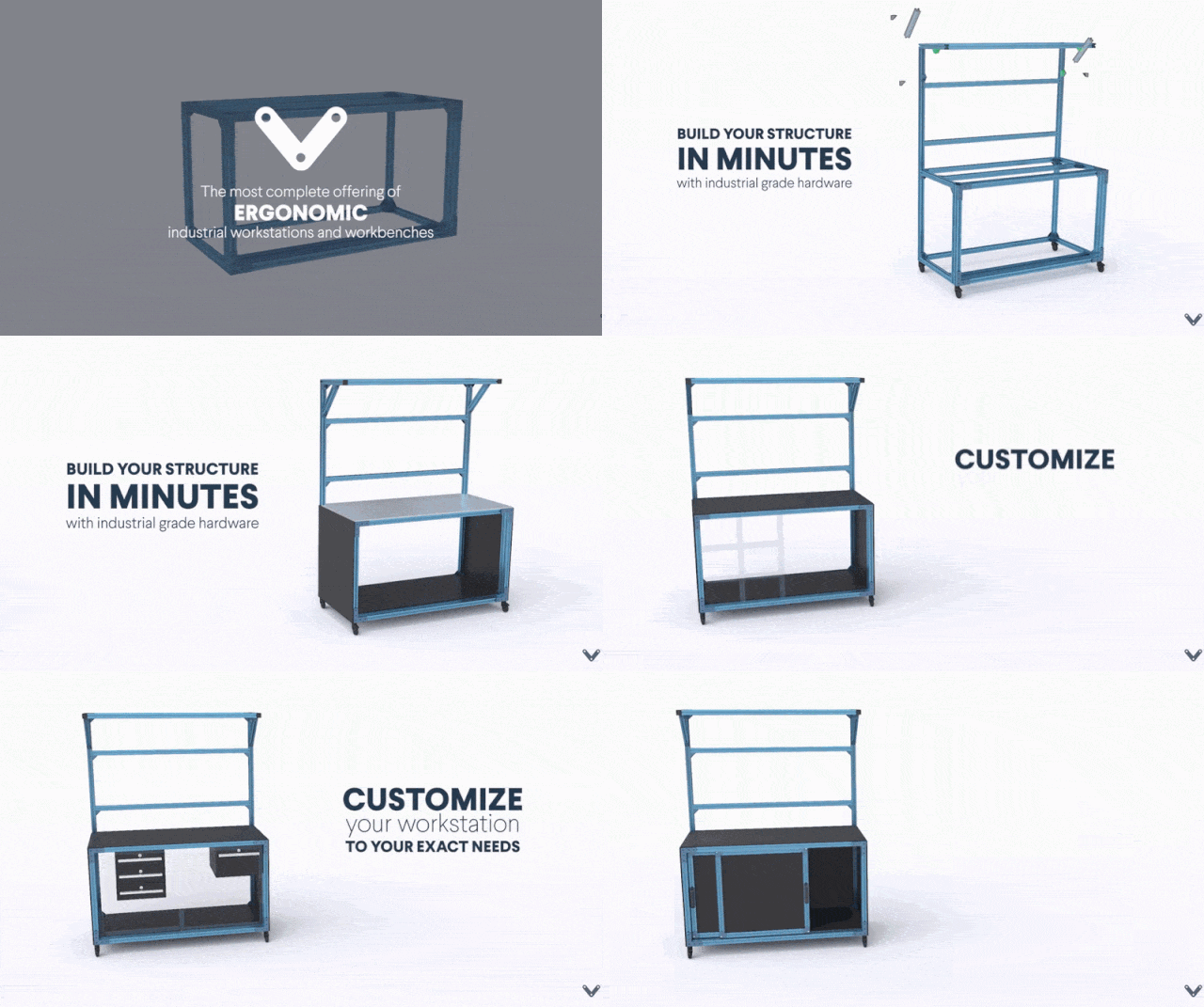
That starts with the physical layer. Traditional welded carts, fixtures, workstations, and ground-support equipment can become bottlenecks when floor layouts change or new programs ramp. Major aerospace engine manufacturers are increasingly using modular platforms to create production infrastructure that can be modified, replicated, or retrofitted as requirements evolve. The point is not that every fixture must be temporary. It is that production equipment should not become obsolete the moment the program changes.
The push for modularity and reusability is also reshaping entire factories. Anduril is building what it calls a software-defined manufacturing platform by designing products and factories together from the outset. Rather than treating manufacturing as a downstream function, the company designs autonomous systems for scalable production from day one. It simplifies product architectures, reduces reliance on custom parts, and uses commercially available components where possible, allowing systems to be assembled with more generalized production labor.
Anduril’s Arsenal software platform connects engineering, simulation, bill-of-material (BOM) management, production planning, and factory execution. That allows design updates to flow directly into manufacturing workflows and enables production resources to shift across programs more easily. The factory is not optimized around one fixed line. It is designed to absorb change.
Thales Alenia Space is applying a similar principle in satellite manufacturing. Its Space Smart Factory in Rome was designed to be reconfigured across different satellite programs and constellations. The facility combines modular production principles, digital connectivity with suppliers, robotics, and advanced manufacturing systems to support higher-volume satellite production than traditional aerospace factories.
The pattern is clear: manufacturers are moving from fixed infrastructure to production systems designed around variability.
Flexible Robotics, AI Widen the Scope for Automation
Robotics in aerospace is no longer limited to repetitive, high-volume tasks. It is expanding into drilling, testing, precision assembly, machine tending, material handling, inspection, and adaptable robot cells that support more variable production environments.
This matters because aerospace automation has historically carried a high integration burden. Programs were often too complex, volumes too low, or processes too variable to justify traditional fixed automation. Recent advances are changing that equation. Modern robotic systems are easier to deploy, faster to reconfigure, and flexible enough to adapt as production needs evolve. That reduces integration cost while extending the useful life of the equipment.
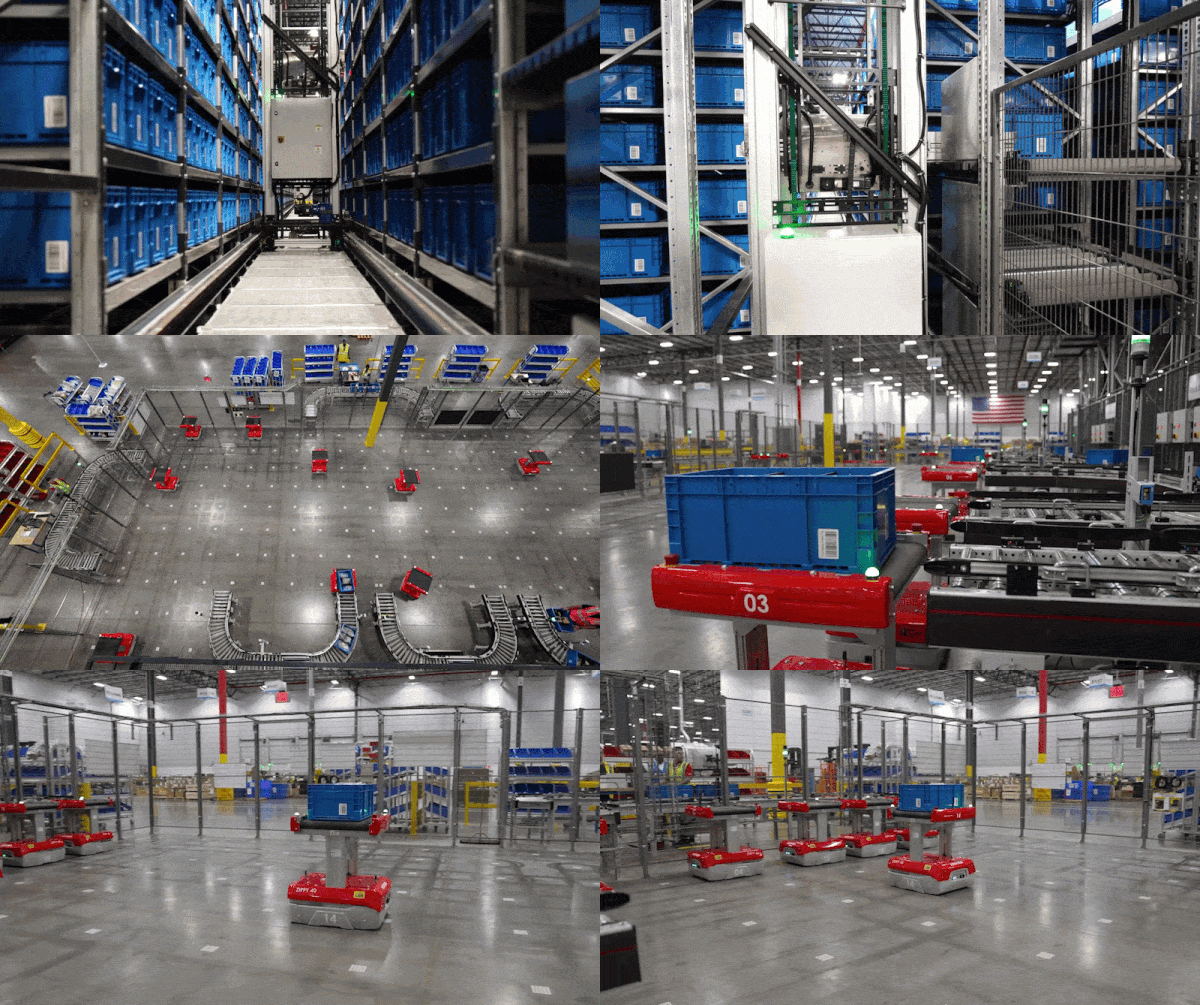
Large aerospace manufacturers are already applying these approaches operationally. Pratt & Whitney has highlighted the use of mobile robots for material handling to accelerate aircraft maintenance and production workflows. Instead of relying entirely on fixed automation cells or manual transport, mobile robotics allow production resources to move more dynamically across facilities as operational needs change.
Flexible machine tending is another example. Harris RCS deployed a mobile, reconfigurable robotic system to support high-mix machining environments, demonstrating how automation can adapt across machines and part families without permanently locking a robot to a single workflow.
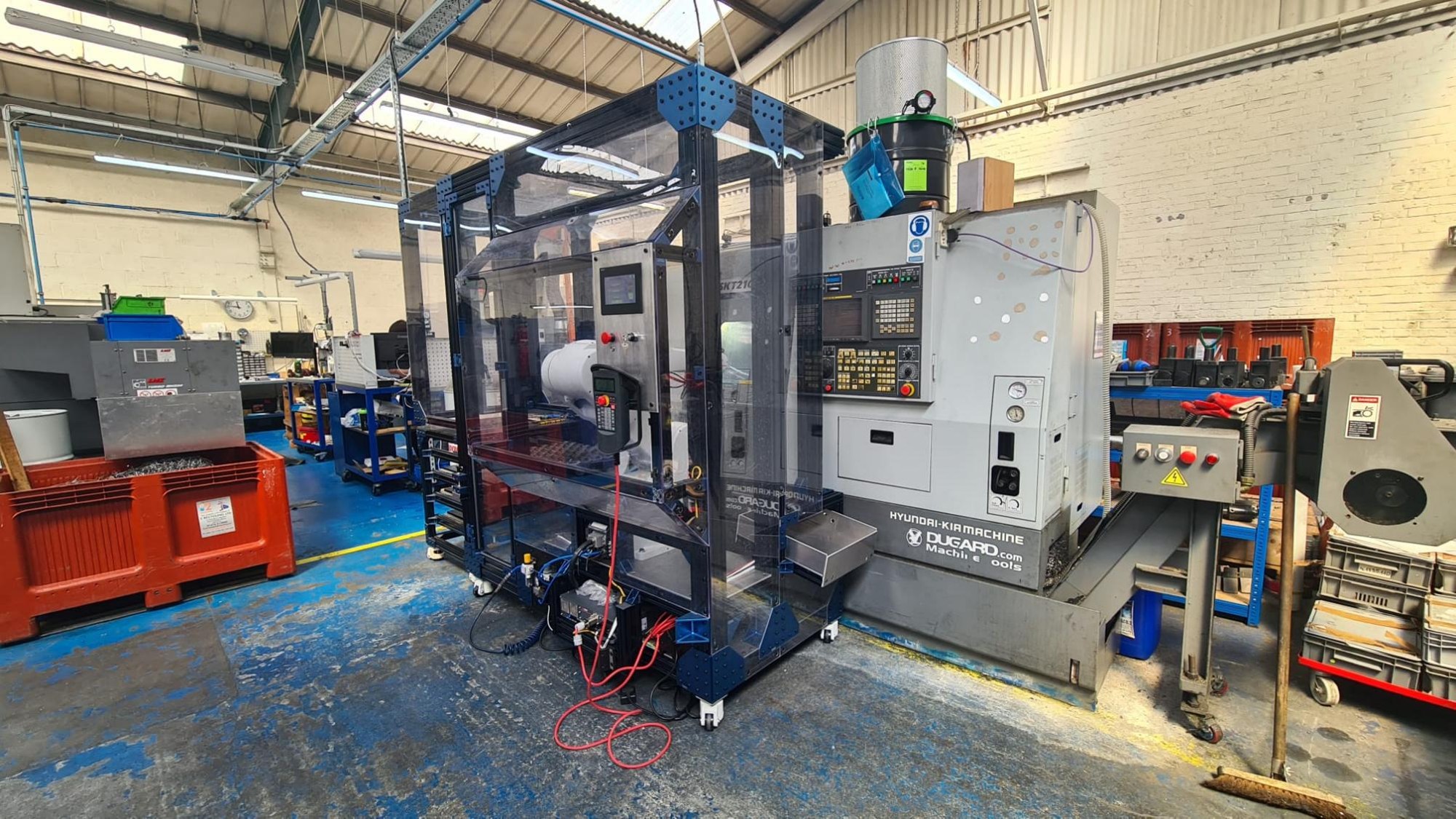
The broader shift is that robotic systems are becoming modular production assets rather than fixed-purpose equipment.
AI is also lowering the barrier to deploying and maintaining automation. AI-assisted programming can help engineers generate and modify robot code faster, reducing the engineering effort traditionally associated with robotics integration. Physical AI is beginning to make automation more viable for unstructured or variable parts that historically required manual handling or highly customized programming.
Inspection and maintenance workflows are evolving as well. Gecko Robotics deploys robotic systems that inspect and maintain submarines, missile silos, power systems, and industrial infrastructure. Their systems combine robotics, AI, and 3D vision to dramatically reduce inspection time while generating digital records that improve maintenance planning and operational readiness.
Together, robotics and AI are transforming automation from a fixed production tool into a flexible manufacturing capability that can evolve alongside aerospace programs themselves.
Manufacturing Agility Becomes the Advantage
Aerospace and defense manufacturers are switching to a new software-defined automation approach. Shorter timelines, flexible deployment, and easier, AI-driven configuration are the new standards. The result is an architecture built for reusability, and continuous adaptation rather than long-term rigidity.
The next decade in aerospace will be defined by adaptability. The competitive advantage won’t come from who has the most capacity but who can evolve production the fastest as technologies, missions, and demand continue to change.
Learn about flexible automation solutions for aerospace and defense.