Global defense spending has crossed $2 trillion, commercial aviation faces a backlog of more than 20,000 aircraft, and space is now a commercial frontier led by companies like SpaceX, Anduril, and Sierra Space. At the same time, VC-backed innovators like Shield AI, Saronic, and Helsing are redefining how systems are built for national security. The demand is clear. The only question is whether the industry can build fast enough to meet it.
Aerospace and defense (A&D) manufacturing has long been constrained by high-mix production and long development cycles, limiting its ability to adopt modern manufacturing models. That is now changing quickly.
Here are the five mega-trends reshaping the A&D industry.
1. The Defense Supercycle: The Race to Scale
Geopolitical instability has triggered a production surge unlike anything seen in decades. Governments aren’t just increasing defense budgets, they’re demanding that their industrial bases keep pace.
One of the clearest signals? Drones. Ukraine is producing millions of unmanned aerial systems annually, fundamentally redefining cost structures and production scale. Loitering munitions, once considered niche, are now manufactured in the tens of thousands.
The same pressure is extending to legacy systems too. Engine makers like Pratt & Whitney are under contract to ramp production of F-35 and F-22 engines to meet surging demand. Lockheed Martin was recently awarded $4.7B to upgrade the Patriot missile, with similar mega contracts emerging every week.
For manufacturers, this is both an opportunity and a test of whether legacy production systems can scale. Many are finding that they can’t. Scaling production without redesigning the system requires a fundamentally different operational model.
![Skydio, a leading U.S. supplier of drones, is investing $3.5B to expand manufacturing ([Manufacturing Dive]](https://ventionavatars.s3.amazonaws.com/cms_images/932df1af-c157-438c-81b6-8db458439587/A&Ddrone.png)
Skydio, a leading U.S. supplier of drones, is investing $3.5B to expand manufacturing (Manufacturing Dive, 24 April 2026)
2. Speed of Iteration: Compressing the Development Timeline
Traditional aerospace programs run on 5 to 10-year development cycles. That timeline is increasingly incompatible with modern defense needs, and new entrants know it.
Companies like Anduril and Boom Supersonic are compressing development timelines by years through rapid iteration and vertically integrated engineering. Instead of sequential, specification-locked programs, they’re running “build-test-learn” loops. Software is developed in parallel with hardware. Digital twins validate systems before a single physical part is machined. Modular platforms allow design changes without scrapping the line.
The result is a cultural and structural shift: aerospace and defense manufacturers are no longer measured only on precision and reliability, but also on how quickly they can deliver. Manufacturing systems must now support fast changeovers, rapid prototyping, and low-volume iteration, all without compromising quality. To stay competitive, manufacturers must now support fast changeovers, rapid prototyping, and low-volume iteration, all at the same time.
Anduril Industries has built their manufacturing operations for rapid prototyping and innovation
3. Reindustrialization and the Sovereign Supply Chain
COVID-era disruptions exposed a hard truth: years of globalized supply chains had left critical defense systems dangerously dependent on foreign components, including electronics, rare earth materials, and propulsion systems.
Governments responded with policy. Industry responded with investment. The result is a broad reindustrialization movement, with the U.S. and its allies prioritizing domestic production capacity for munitions, engines, and electronics. Primes like Lockheed Martin and RTX are actively pushing their supplier base to build local capacity and resilience. In Europe, companies like Northvolt are building large-scale gigafactories to reduce reliance on foreign battery supply chains. In parallel, the EU and U.S. have launched major semiconductor initiatives, including the European Chips Act and the CHIPS and Science Act, to bring critical chip production back onshore.
This is not just about reshoring. It is about rethinking the factory model. Centralized facilities are scaling production of critical components, while distributed manufacturing enables faster deployment and regional flexibility. Together, they create a more resilient system, but one that requires production platforms built for speed and adaptability.
4. Additive Manufacturing Moves to the Front Lines
3D printing has graduated from prototyping tool to production asset, and the missions it’s supporting are anything but experimental.
The U.S. Air Force is investing in additively manufactured jet engines, while companies like L3Harris and Red Cat Holdings are using large-scale 3D printing to accelerate production of satellites and unmanned systems. GE Aerospace is also applying additive manufacturing to produce complex engine components that would be difficult or impossible to make with traditional methods.
The common thread: additive manufacturing enables production of complex, mission-critical parts with lead times and cost structures that traditional subtractive methods can’t match. For a sector that increasingly demands performance and speed, that combination is hard to ignore.
5. Robotics, AI, and the Software-Defined Factory
The broader shift in A&D manufacturing is from fixed automation to software-defined production. AI is moving from analytics into execution: predictive maintenance, vision-based Physical AI, and AI-assisted robot programming. Robotics are expanding into high-mix environments that were previously considered too variable to automate. Modular workcells are replacing purpose-built lines, enabling faster program changes and easier reconfiguration that previously took years.
Defense manufacturing leaders are already moving to the new, software-defined approach. GE Aerospace is using AI to optimize engine production and maintenance workflows. Boeing is simulating factory systems digitally before any physical deployment takes place. Lockheed Martin has deployed robotics for precision drilling and composite manufacturing. Centers of Excellence for rapid prototyping are becoming standard, not exceptional.
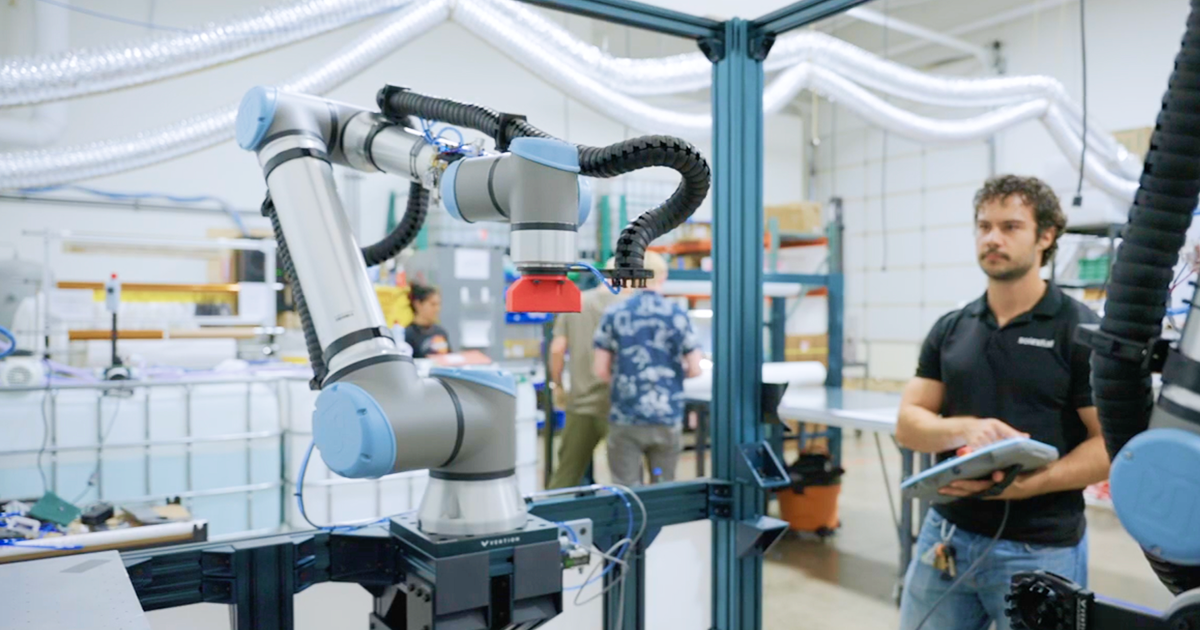
Innovative manufacturers, like Solestial shown above, are building centralized automation teams to scale software-defined production across the factory. Read more about the centralized approach here.
The New Mandate
Aerospace and defense manufacturing has always demanded precision, reliability, and security clearance-level rigor. What’s new is the urgency. Higher volumes, faster timelines, domestic sourcing requirements, and a new generation of vertically integrated innovators are converging, creating a mandate for manufacturing systems that must be both flexible and fast.
Meeting this new mandate requires a different approach to how manufacturing systems are designed, deployed, and scaled. That starts with understanding where automation is already driving meaningful success today.
***
Exploring Aerospace and Defense automation solutions? Talk to our experts to find out how Vention can help.