
The biggest risk in automation transformation isn’t the technology itself but prioritizing the wrong opportunities. In the 1980s, General Motors launched an ambitious plan to aggressively automate production. The result? Unclear outcomes at a staggering cost of $45 billion, creating a cautionary tale about automation without proper due diligence. Decades later, Tesla’s ‘Alien Dreadnought’ factory faced similar challenges before the company pulled back to reassess which plants and processes were actually suitable for automation.
Both examples reveal a common pitfall: roadmaps that fail to sequence projects by technical risk and economic impact. A more effective strategy takes the opposite approach, starting with early wins that build confidence and generate the cash flow to fund subsequent initiatives.
Building the Foundation: Creating the Prioritization Matrix
The prerequisite for building an automation roadmap is a portfolio of opportunities with Level 1 estimates. This provides the foundation for creating an objective matrix that ranks and sequences opportunities by deployment complexity, annual OPEX savings, and expected payback. Opportunities with low technical risk and strong financial returns belong in the first quadrant and serve as the best starting point. More complex, higher-value projects follow as the team’s capabilities and organizational confidence grow.
For example, cobot palletizing cells deployed across multiple sites may deliver $1.2 million in annual OPEX savings against a $1.6 million investment, yielding a 1.3-year payback with mature, proven technology. By contrast, case-packing systems with higher complexity and a longer payback would be sequenced later.

Prioritization Strategy: Start with Low Technical Risk to Build Confidence
For in-house automation teams still in the forming stage, the early priority isn’t maximizing ROI but achieving an initial win. This is where prioritizing projects with lower technical risk becomes most effective. Proven, productized solutions that don’t require custom software development or advanced machine vision integration are the ideal starting point.
An early win strengthens trust between the automation team and management, accelerating approvals for the next round of projects. It allows the organization to build new capabilities while complexity remains manageable.

Creating a Self-Funding Automation Sequence
Once pilot projects have delivered proven, quantifiable results, the roadmap shifts toward financial self-sufficiency. Projects with very short payback periods should be front-loaded so that their savings can fund deeper investments later. This reduces the total negative cash position of the entire program.
For example, an end-of-line packaging system that pays back within a year and generates $400,000 in annual savings effectively creates $400,000 of funding capacity for the following year’s projects. The roadmap becomes a compounding engine where early savings finance future growth.
This sequencing also acts as a risk buffer. If a later project takes longer than expected or underperforms, the savings from earlier quick wins absorb the impact. If early projects exceed expectations, additional capital becomes available sooner. None of this is possible if the roadmap begins with long-payback, capital-intensive initiatives.
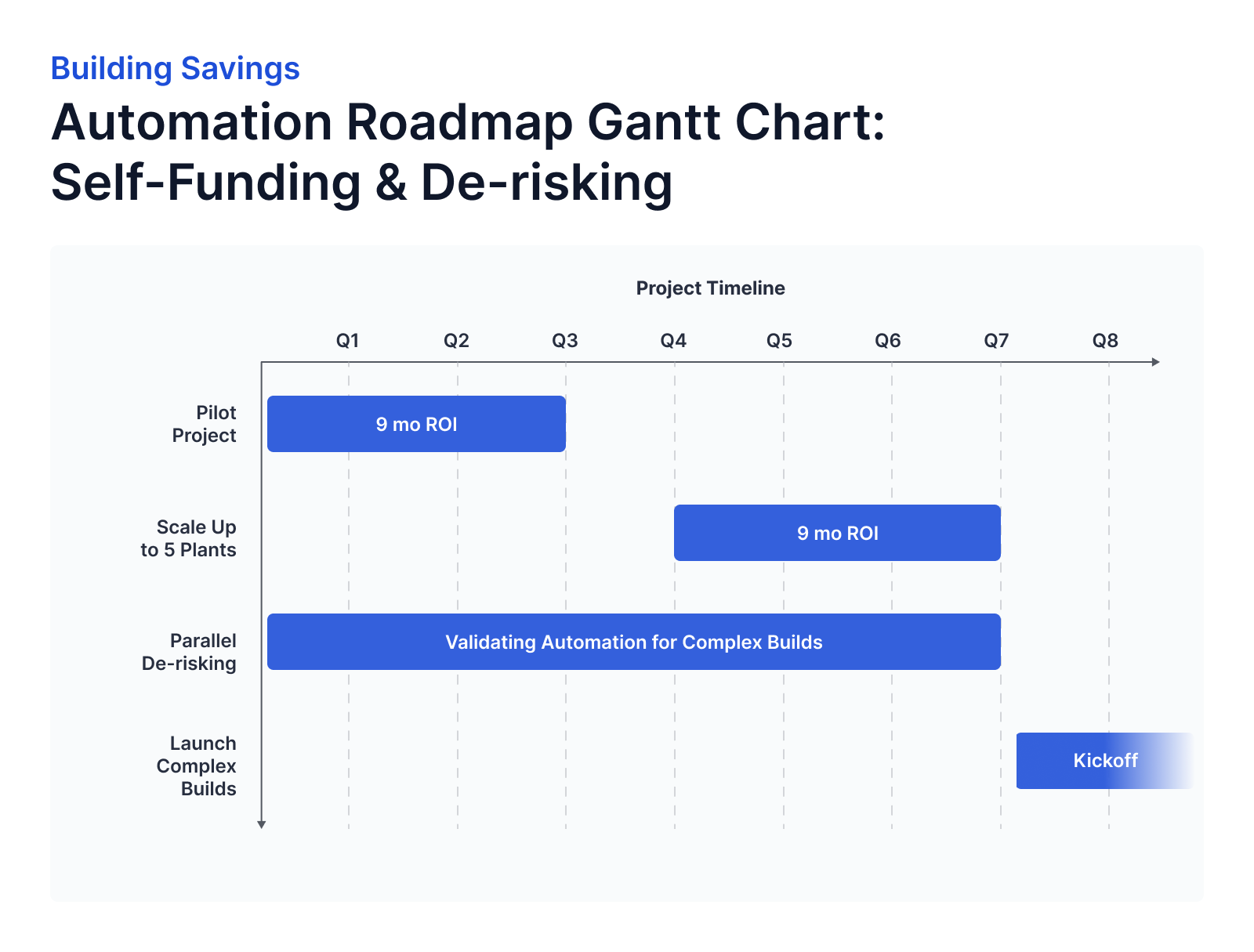
Parallel De-risking for Complex Opportunities
High-value but technically complex initiatives often require structured de-risking before full deployment. These efforts should run in parallel to the main execution track.
Centralized automation R&D labs play a key role here. Instead of committing immediately to full-scale build-out, teams can run feasibility studies, build pilot cells, and refine algorithms before ordering major equipment. A robotic depalletizing system handling dozens of SKUs, for example, may require months of controlled testing to validate gripping and vision performance. This way the project pipeline remains active, with a new release every few months. While months six through eighteen focus on executing quick wins, the next 12 months can line up advanced automation opportunities.
The Venture Capital Model: Gated Funding and Visible Returns
A long-term automation program cannot be executed under a blank-check model. The General Motors experience underscores this point: massive investment without structured checkpoints makes it difficult to course-correct when early assumptions prove wrong. A more effective model mirrors how venture capital manages risk and rewards.
Automation leaders should think of their transformation program as a startup progressing through funding rounds. Each wave of automation projects represents a stage of investment, and the responsibility of the automation team is to demonstrate how well the “startup” performed against its economic targets. If results meet or exceed expectations, the next tranche of funding is released. If projects fall behind or savings appear lower than modeled, the focus shifts to identifying the causes and implementing the right corrective actions before advancing.
This gated approach creates accountability, builds confidence with executives, and ensures capital is allocated only when the automation program is performing as expected.
From Roadmap to Execution
With a validated road map in hand, execution begins. Projects move through Level 2 estimates, Level 3 design, and Level 4 planning, with each stage adding detail and reducing uncertainty before capital is committed. Yet even the strongest road map cannot succeed without the structure to execute it effectively.
The next article examines the governance model that turns approved projects into deployed systems by aligning cross-functional stakeholders, and maintaining momentum from concept through commissioning.


