The conversation around revitalizing regional manufacturing has reached a fever pitch. From North America to Europe, the goal is uniformly clear: bring production closer to home, in order to build more resilient supply chains. Whether for small job shops or global enterprises, as industry leaders look to shore up domestic production, a stark reality remains: to compete on the global stage, the industry will need more than factories. It requires a significant leap in robot density.
The Global Automation Gap
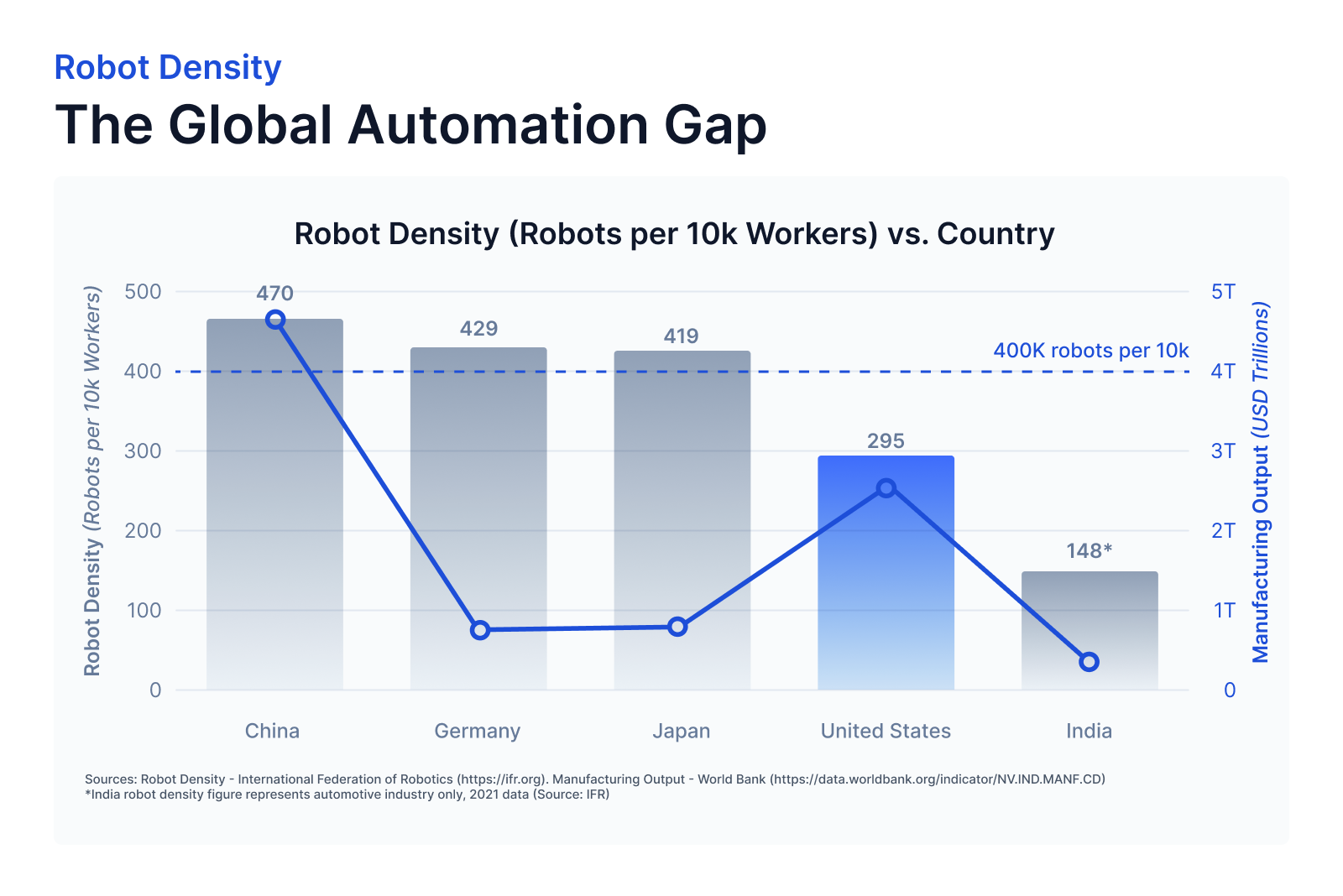
While countries like the United States remain manufacturing powerhouses, they are currently being outpaced in the race to automate. China, the world leader in manufacturing output, has grown its robot density by an average of 26% annually over the last five years.
A recent survey by IndustryWeek and Vention indicates that nearly 60% of U.S. manufacturers delayed automation investments in the past two years due to cost uncertainty and deployment risk.
The robot density data highlights a growing divide in investment:
- The Growth Lag: In the same five-year period, U.S. robot density grew by only 7% annually.
- Current Standing: The U.S. currently ranks 10th globally with 295 robots per 10,000 employees.
- The Benchmark: Global leaders like Germany and Japan maintain density levels well above 400, protecting their manufacturing infrastructure despite higher labor costs.
To bridge this gap and match the current trajectory of global leaders, the U.S. would need to grow its robot density by approximately 38% per year for the next five years, requiring nearly one million robots. This trend reflects a broader challenge across Western economies: how to scale automation fast enough to remain competitive.
The SME Challenge: A Universal Bottleneck
In practical terms, the real automation hurdle goes beyond buying robots. Automation has historically been too complex and too expensive for the average shop to actually use. While the world’s largest manufacturers have relied on robots for decades, 98% of all U.S. manufacturers are small and mid-sized enterprises (SMEs).
Regardless of geography, these SMEs face the same critical barriers:
- The Labor Crisis: Approximately 50% of manufacturers report that attracting and retaining a quality workforce is their primary business challenge. Recent data from the State of the Automation Report shows that over 90% of manufacturers expect labor shortages to persist or worsen over the next five years.
- The Integration Gap: There is a shortage of system integrators to design and install custom automation for every small shop.
- Complexity & Risk: Traditional custom automation often involves months of programming and high upfront costs that many SMEs cannot justify.
Moving Toward Platform-Based Automation
Vention believes that for automation to become the “great equalizer” for global manufacturing, the deployment model must change. The market is seeing a shift towards a more platform-based approach to automation, with modular hardware, combined with easy-to-deploy software. As automation platforms mature, manufacturers will be able to leverage ready-to-use design and programming libraries to make it faster to adopt and scale automation. The platform-based approach also makes it easy to productize repeatable tasks across factory floors such as case packing, palletizing and machine tending.
Being able to deploy and scale up automation through a common automation platform resolves multiple pain points for SMEs:
- Financial Viability: Achieving a payback period of under one year is the tipping point for mass adoption.
- Simplified Engineering: Reducing the need for on-staff automation experts through intuitive, modular tools.
- Global Resilience: Empowering manufacturers to thrive in volatile labor and supply markets.
A Resilient Future
The future of manufacturing will be powered by a synergy between a skilled workforce and collaborative robotics. To stay competitive, companies need a foundation that goes beyond simple cost-saving; they need a system where hardware, software, and physical AI work in unison to solve the labor and productivity challenges of the next generation. By lowering the barriers to entry, Vention is helping companies go beyond cost-saving, building the technological foundation required to keep regional manufacturing competitive and sustainable for the next generation.
***
Continue exploring automation trends shaping the manufacturing industry in 2026. Learn more about five surprising findings from the State of Manufacturing Report.


